All Types Of Numbers In Maths (With Definition And Examples)
What do 10, −7, 1/5, π, √2, and 5i have in common?
They are all numbers, yet each belongs to a distinct mathematical family with its own rules, strengths, and limitations.
The main types of numbers include natural numbers, whole numbers, integers, rational numbers, irrational numbers, real numbers, imaginary numbers, and complex numbers.
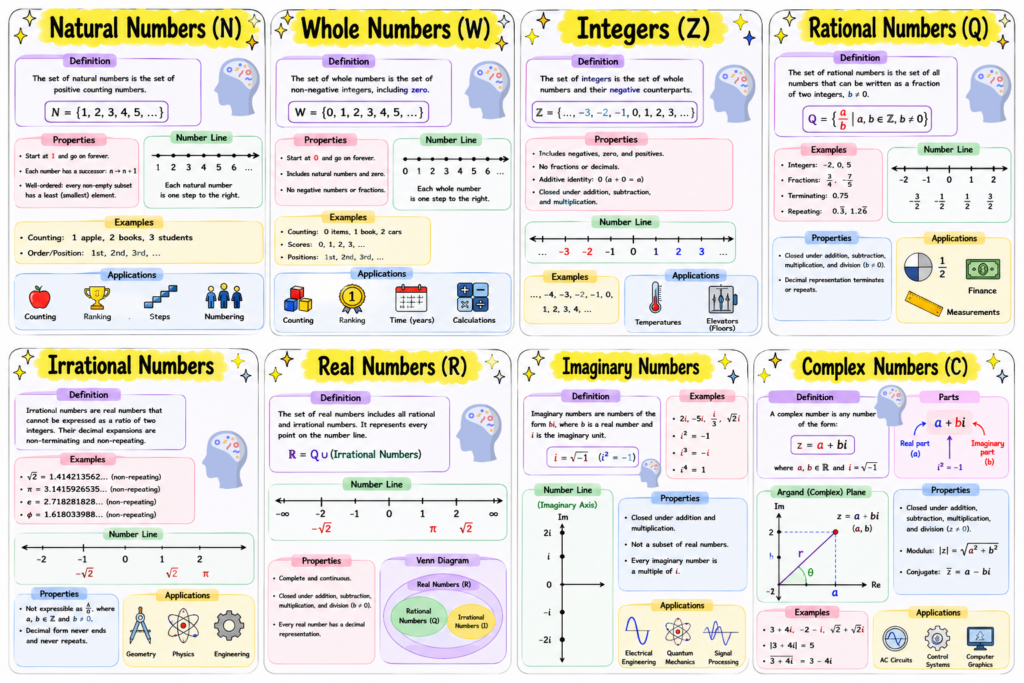
Whether you’re a student trying to master algebra, a teacher looking for a clear reference, a programmer working with numerical systems, or simply someone curious about how mathematics works, understanding the types of numbers is one of the most valuable foundations you can build.
In this comprehensive guide, you’ll explore every major type of number, discover how they fit together, learn their real-world applications, and develop a simple mental framework for identifying them with confidence.
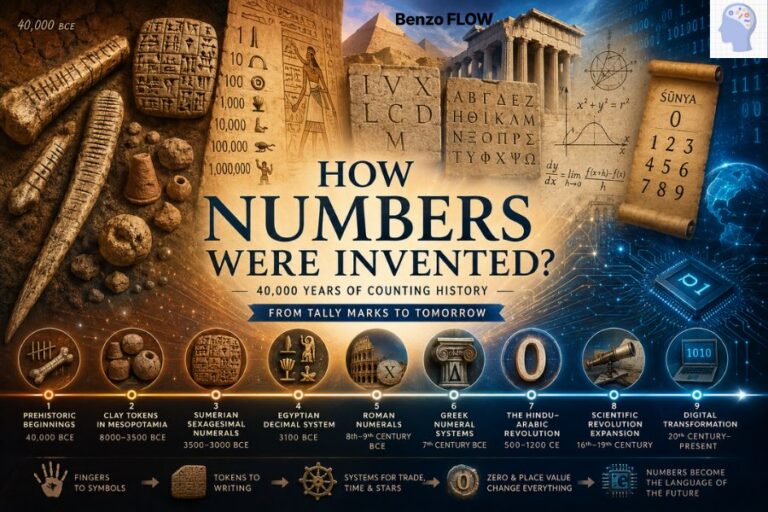
But before exploring the different types of numbers, you may enjoy reading our guide on the History of Counting and Numbers, which traces how humans went from tally marks and ancient numeral systems to the modern mathematical world.
If you’d like to understand how numbers are represented and converted in different bases, our Number System 101: Types, Examples & Conversion Methods guide provides a complete introduction to decimal, binary, octal, hexadecimal, and other number systems.
What Are Numbers?
A number is a mathematical object used to count, measure, compare, and represent quantities.
Numbers help us answer questions like:
- How many apples are there?
- What is the temperature?
- How far away is a star?
- What is the probability of an event?
As mathematics evolved, new situations required new kinds of numbers. This led to the development of multiple number systems.
Why Do We Need Different Types of Numbers?
For most of us, numbers begin as simple counting tools. But as civilizations tackled increasingly complex problems such as measuring land, tracking debt, calculating orbits, or modeling waves the existing number group proved insufficient.
Mathematicians responded by expanding the number universe itself, creating (or discovering) entirely new types to fill the gaps.
Negative numbers made it possible to represent loss and debt. Fractions enabled precise divisions. Irrational numbers capture quantities that defy simple ratios, like the endless non-repeating decimals of π or √2.
And perhaps most remarkably, the seemingly impossible square root of −1 gave rise to imaginary numbers, an invention that now underpins modern engineering, signal processing, quantum physics, and computer graphics.
This evolution wasn’t merely about creating new mathematical tools. Each new category of numbers emerged because existing ones could not fully describe reality.
Together, these number classifications form a structured framework that powers everything from basic arithmetic to advanced calculus, statistics, physics, engineering, data science, and computer science.
Structural Map of Numbers (Complete Hierarchy)
The hierarchy below provides a complete visual map of these relationships, making it easier to see how all major types of numbers connect within the broader number system.
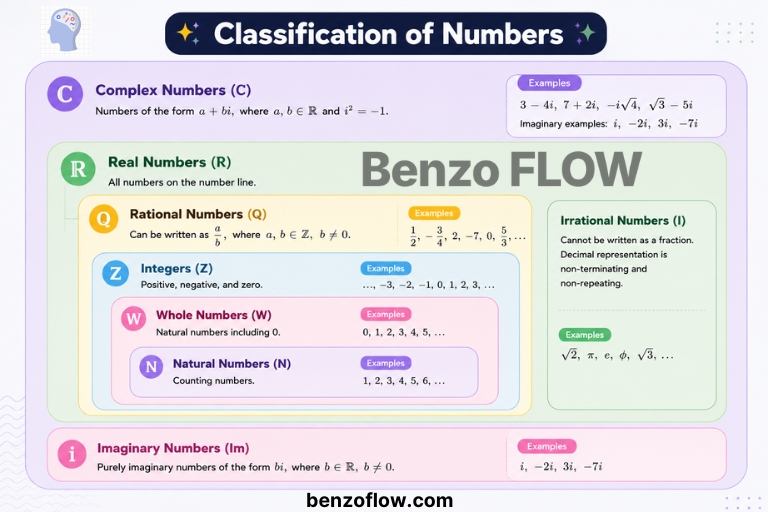
Before diving into the individual types of numbers, it helps to understand how the entire number system fits together. Mathematics organizes numbers into sets based on shared properties, and these sets are nested within one another.
| Set | Name | Examples |
|---|---|---|
| ℕ | Natural Numbers | 1, 2, 3, 4, … |
| 𝕎 | Whole Numbers | 0, 1, 2, 3, … |
| ℤ | Integers | …, -2, -1, 0, 1, 2, … |
| ℚ | Rational Numbers | 1/2, -3, 0.75, 0.333… |
| ℝ | Real Numbers | All rational and irrational numbers |
| ℂ | Complex Numbers | 2 + 3i, -i, 5, π + i |
Think of it like geography. A city belongs to a state, and that state belongs to the Country. In the same way, smaller number sets exist inside larger ones. Natural numbers are contained within whole numbers, whole numbers within integers, integers within rational numbers, and rational numbers within the broader set of real numbers.
In set notation:
ℕ ⊂ 𝕎 ⊂ ℤ ⊂ ℚ ⊂ ℝ ⊂ ℂ
Understanding this hierarchy is important because a single number can belong to multiple categories at the same time.
For example, the number 5 is a natural number, a whole number, an integer, a rational number, and a real number. Rather than fitting into just one box, numbers inherit the properties of every larger set that contains them.
Natural Numbers (ℕ)
Natural numbers are the most fundamental types of numbers we use. They are the very first numbers you learned as a child, instinctively utilized whenever you count physical objects on your fingers, before you ever sat in a classroom.
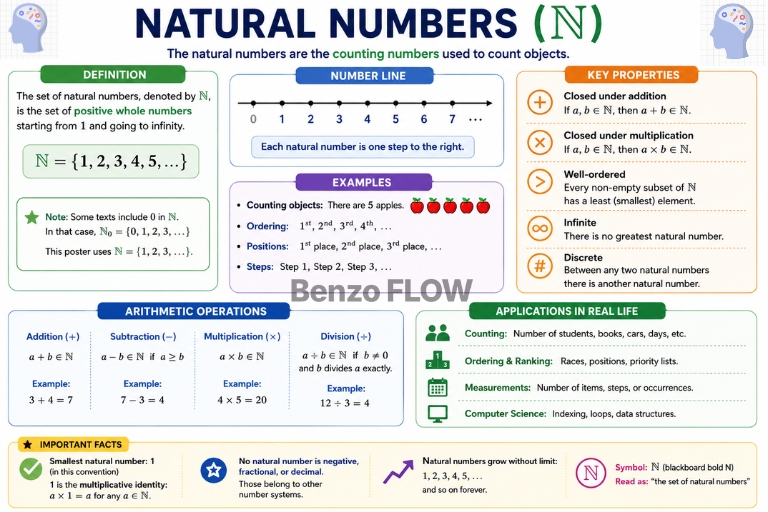
They’re the numbers you used to count your fingers, tally your toys, and keep score. . Often called counting numbers, they are the numbers we use to count and order objects: 1, 2, 3, 4, 5, …, continuing infinitely. Represented by the elegant double-struck mathematical symbol ℕ, the standard set of natural numbers is written as:
Set of Natural Numbers:
ℕ = {1, 2, 3, 4, 5, …}
The ellipsis isn’t decoration here, it signals that natural numbers never end. There is no largest natural number.
From a single apple in a basket to the page numbers in a massive textbook, or the 56,783 fans cheering in a football stadium, natural numbers scale sequentially from one to infinity. In formal mathematics, these foundational numbers serve as the building blocks for arithmetic and form the basis of the Peano axioms, which define the structure of arithmetic itself.
The Zero Controversy: Does the number 0 belong here? Traditionally, and in most modern school textbooks, natural numbers start at 1. However, many computer scientists and set theorists prefer to include 0. If a system includes zero, it is often explicitly referred to as the set of whole numbers or non-negative integers. Because conventions vary, it’s important to check the definition being used in your textbook or course.
Key Properties of Natural Numbers
- Always Positive and Whole: They are discrete, positive integers. They never include fractions (like 1/2), decimals (like 2.5), or negative values (like -1).
- Infinite Scope: While there is a definitive starting point, there is no largest natural number, the sequence continues infinitely.
- The Closure Property: Natural numbers are “closed” under addition and multiplication. This means if you add or multiply any two natural numbers, your answer will always be another natural number (e.g., 3 x 5 = 15).
- Lack of Subtraction Closure: They are not closed under subtraction. For example, 3 – 5 = -2. Because -2 is a negative integer, it falls completely outside the set of natural numbers.
Examples
Natural Numbers (✓)
1, 2, 10, 45, 100, 999, 1000
Not Natural Numbers (✗)
0* (depending on convention), −1, 1/2, 2.5
How to Identify a Natural Number
A number is a natural number if it meets all of the following conditions:
- It is greater than 0.
- It is a whole number.
- It has no decimal or fractional part.
If all three conditions are true, the number belongs to the set of natural numbers.
Real-World Applications
Natural numbers appear whenever we count measurable quantities in everyday life, such as:
- Students in a classroom
- Books on a shelf
- Pages in a book
- Apples in a basket
- Goals scored in a football match
- Positions in a race (1st, 2nd, 3rd, and so on)
For example, if there are 12 books on a shelf, the number 12 is a natural number because it represents a count of discrete objects.
Whole Numbers (𝕎)
Among the many types of numbers, whole numbers are one of the simplest and most useful. They include all natural numbers along with zero, making them the set of non-negative integers.
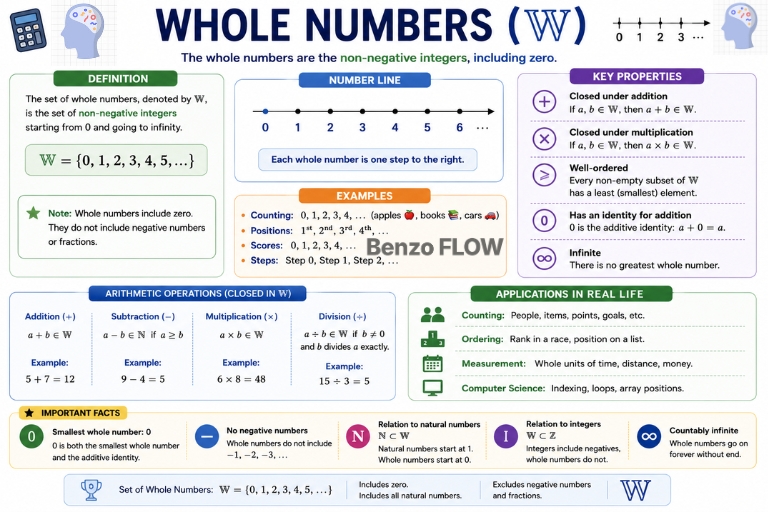
By definition, whole numbers are simply all natural numbers plus zero.
Represented by the mathematical symbol 𝕎 (or ℕ₀), whole numbers form an infinite set:
𝕎 = {0, 1, 2, 3, 4, …}
Examples of whole numbers:
✅ 0, 1, 25, 100, 5,000
❌ -3, -1, 1/2, 3.7
The Anatomy of Whole Numbers
To easily spot whole numbers when analyzing different types of numbers, look for these three defining characteristics:
- They Start at Zero: Unlike natural numbers, which begin at 1, whole numbers begin at 0.
- They are Strictly Non-Negative: Whole numbers include 0 and positive integers, completely excluding negative values (like -1 or -5).
- They are Seamless: There are absolutely no fractions (1/2) or decimals (3.7) and no percentage allowed. Every whole number represents a complete count or quantity.
| Number Type | Includes Zero? | Includes Negatives? | Includes Fractions/Decimals? | Examples |
| Natural Numbers (ℕ) | ✗ | ✗ | ✗ | 1, 2, 3, 99 |
| Whole Numbers (𝕎) | ✓ | ✗ | ✗ | 0, 1, 2, 3, 99 |
Why Is Zero So Important?
The only difference between natural numbers and whole numbers is zero, but that single addition changed mathematics forever.
Today, zero seems obvious, yet it was one of humanity’s most significant mathematical discoveries. Ancient Indian mathematicians, most notably Brahmagupta, helped formalize zero as a number in its own right rather than merely a symbol for “nothing.” This breakthrough made place-value notation possible and laid the foundation for modern arithmetic, algebra, calculus, and eventually computer science.
In modern mathematics, zero serves two critical roles:
The Additive Identity: In algebra, zero is the unique identity element where adding it to any number leaves that number unchanged (x + 0 = x).
The Ultimate Placeholder: Zero makes our positional place-value system possible. It is the reason we can effortlessly distinguish between 1, 10, and 100.
Without this foundational digit, modern calculus, algebra, and the binary code (0s and 1s) powering computer science would simply not exist.
Whole Numbers in the Real World
We rely on whole numbers daily to establish baselines, track inventory, and navigate structured systems. They are the go-to choice for:
- Starting Points: The score at the beginning of a sports match (0-0), ground-level floors in buildings (Floor 0), or a baby’s age before their first birthday.
- Depletion and Inventories: Tracking an empty shelf or inventory count (0 items left).
- Scientific Baselines: Measuring the freezing point of water (℃).
- Financial Reality Checks: Viewing your bank account balance when you are completely flat broke.
In short, whole numbers bridge the gap between counting and the concept of “none,” making them a fundamental building block of mathematics.
Integers (ℤ)
Integers are the set of numbers that include all positive whole numbers, all negative whole numbers, and zero. In simple terms, if you start with the whole numbers and add their negative counterparts, together with zero you get the set of integers.
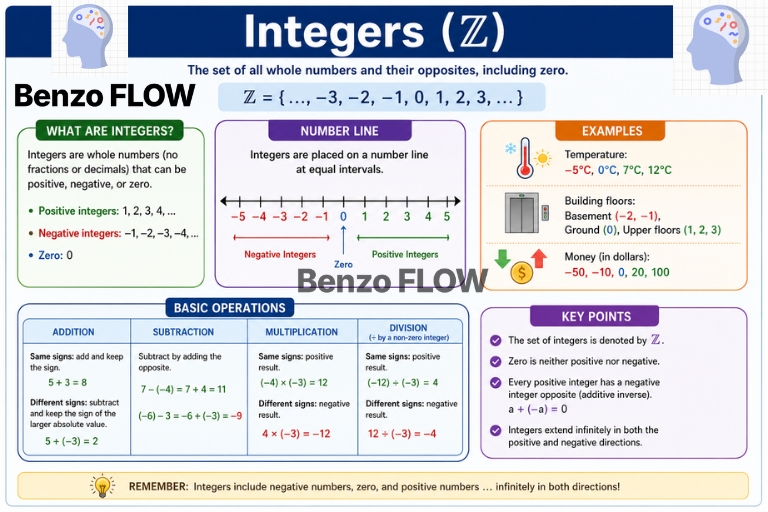
Symbol: ℤ (from the German word Zahlen, meaning “numbers”)
Set Notation:
ℤ = { …, −3, −2, −1, 0, 1, 2, 3, … }
The easiest way to identify an integer is to look for completeness: integers never contain fractional or decimal components. They extend infinitely in both directions along the number line, allowing us to represent quantities above and below a reference point.
Examples of Integers
✅ −100, −42, −1, 0, 5, 50, 2026
❌ 1/2, 3.5, √2, π
Types of Integers
| Type | Examples |
|---|---|
| Negative Integers | −1, −2, −50, −100 |
| Zero | 0 |
| Positive Integers | 1, 2, 50, 100 |
Zero is unique because it is neither positive nor negative.
Key Properties of Integers
- Include positive numbers, negative numbers, and zero
- Do not contain fractions or decimals
- Extend infinitely in both the positive and negative directions
- Are closed under addition, subtraction, and multiplication
- Are not closed under division (for example, 1 ÷ 2 = 0.5, which is not an integer)
- Every integer is a rational number, but not every rational number is an integer
Real-World Examples of Integers
Integers are used whenever values can move above or below a defined starting point:
- Temperature: −10°C represents a temperature below freezing.
- Bank Balances: A balance of −$500 indicates debt, while +$500 represents available funds.
- Elevation: Locations below sea level are represented using negative integers.
- Building Floors: Basement levels may be labeled −1 or −2, ground level as 0, and upper floors with positive integers.
For example, if you have $50 in your account and spend $75, your balance becomes −$25, which is an integer that represents debt.
Rational Numbers (ℚ)
When you hear the word rational, you might think of someone making logical, level-headed decisions. In mathematics, however, the term has a completely different origin. It comes from the word ratio, meaning these numbers can be expressed as a ratio (fraction) of two integers.
Definition
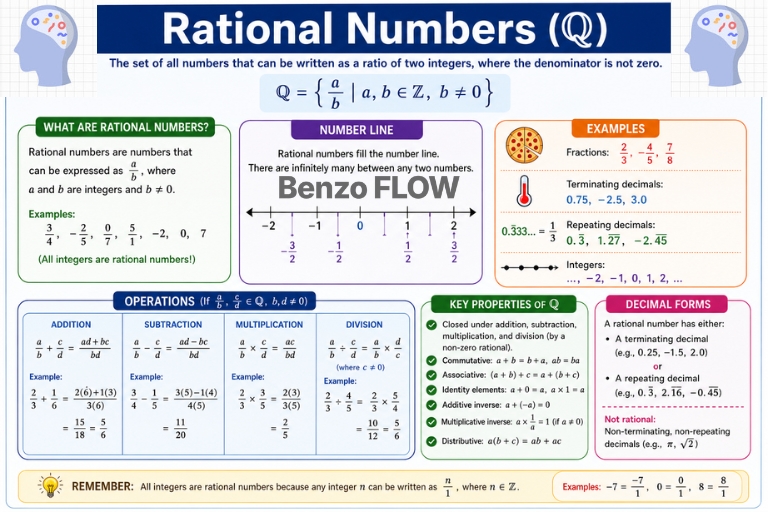
Mathematically, we represent the set of all rational numbers with the symbol ℚ, which stands for quotient. A rational number is any number that can be written in the form:
p/q
where:
- p and q are integers (whole numbers, positive or negative)
- q ≠ 0 (because dividing by zero is mathematically undefined)
The set of rational numbers is represented by the symbol ℚ, which comes from the word quotient.
Examples of Rational Numbers
Rational numbers include:
- Fractions: The most direct examples. ½, −¾, and 17⁄41 are all rational numbers.
- Integers: Every whole number is secretly a fraction. For instance, 5 can be written as 5⁄1, −3 as −3⁄1, and even 0 as 0⁄1.
- Terminating Decimals: These are decimals that come to a clean end. For example, 0.25 is just 1⁄4, and 0.125 is 1⁄8.
- Repeating Decimals: Decimals that go on forever but follow a strict, predictable pattern are also rational. For instance, 0.333… is exactly 1⁄3, while 0.142857142857… repeats a six-digit cycle and simplifies to 1⁄7.
The Decimal Test
A useful way to identify a rational number is by examining its decimal form.
Every rational number, when written as a decimal, will either:
- Terminate (end after a finite number of digits), or
- Repeat a pattern indefinitely.
| Decimal | Fraction | Type |
|---|---|---|
| 0.25 | 1/4 | Terminating |
| 0.125 | 1/8 | Terminating |
| 0.333… | 1/3 | Repeating |
| 0.1666… | 1/6 | Repeating |
For example:
- 0.75 = 3/4
- 2.75 = 11/4
- 0.333… = 1/3
- 0.142857142857… = 1/7
If a decimal continues forever without repeating a pattern, it is not rational. Numbers such as √2 and π are examples of irrational numbers.
Key Properties of Rational Numbers
- Every integer is a rational number because it can be written as a fraction with denominator 1.
- Rational numbers are closed under addition, subtraction, multiplication, and division (except division by zero).
- Rational numbers are dense on the number line, between any two rational numbers, there is always another rational number.
Converting a Decimal to a Fraction
To convert a terminating decimal into a fraction:
Example: Convert 0.75 to a fraction
- Write it as 0.75/1
- Multiply the numerator and denominator by 100 (because there are two decimal places): 75/100
- Simplify the fraction: 75/100 = 3/4
Therefore:
0.75 = 3/4
Real-World Uses of Rational Numbers
Rational numbers appear everywhere in daily life, including:
- Cooking: 1/2 cup of sugar
- Measurements: 3/4 inch, 2.5 meters
- Shopping: Prices such as $2.50
- Finance: Interest rates, discounts, and percentages
- Statistics: Ratios, averages, and probabilities
Because they accurately represent parts of a whole, rational numbers are essential for measurements, calculations, and practical problem-solving.
Irrational Numbers
Imagine a number that refuses to be tamed by a fraction. No matter how hard you try, you cannot express it as a clean ratio of two integers. These are irrational numbers, the beautiful, rebellious outcasts of the mathematical world.
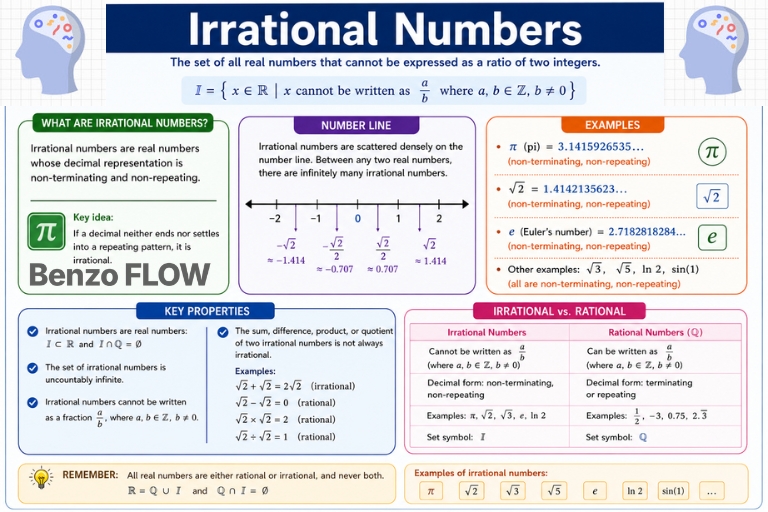
While rational numbers fit neatly into predictable patterns, irrational numbers are defined by infinite chaos. Their decimal expansions go on forever without ever stopping (non-terminating) and without ever falling into a repeating loop (non-repeating).
In many ways, irrational numbers reveal that the number system is far richer than simple fractions. They occupy the countless points on the number line that rational numbers alone cannot fill.
For centuries, these numbers disrupted our understanding of reality. Today, they form the literal bedrock of geometry, finance, and physics.
Dangerous History Of Irrational Number
The discovery of irrational numbers was so scandalous it allegedly led to murder.
The ancient Greeks, particularly the secret society of the Pythagoreans, believed that the universe was built entirely on whole numbers and their ratios. Their worldview was completely shattered by a simple geometric puzzle: What is the length of the diagonal of a 1 × 1 square?
Using the Pythagorean theorem (a² + b² = c²), the diagonal length (c) must satisfy:
1² + 1² = c² ⇒ c² = 2 ⇒ c = √2 ≈ 1.414213562…
When a mathematician named Hippasus of Metapontum proved that √2 could not possibly be written as a fraction, it sparked an existential crisis. Legend has it that the Pythagoreans were so deeply shaken by this disruption to their cosmic order that they threw Hippasus overboard from a ship to keep the discovery a secret.
Mathematicians later proved that √2 cannot be written as any fraction p/q. Its decimal digits continue forever without repeating, making it irrational.
Why √2 Defies Ratios: A Glimpse at the Proof
To understand why Hippasus allegedly lost his life, look at the logical contradiction that √2 creates.
Suppose √2 is rational. Then it can be written as a fraction in its simplest form, p/q, where p and q have no common factors:
√2 = p/q
Squaring both sides gives:
2 = p²/q²
Rearranging:
p² = 2q²
This means p² is an even number. If p² is even, then p must also be even. Let p = 2k.
Substituting 2k into the equation:
(2k)² = 2q²
4k² = 2q²
Dividing both sides by 2:
2k² = q²
Now q² is also even, which means q must be even as well.
But here is the contradiction: if both p and q are even, they share a factor of 2. That means p/q was not in its simplest form after all.
This logical dead end shows that our original assumption was false. Therefore, √2 cannot be expressed as a ratio of two integers. It is an irrational number.
Key Characteristics of Irrational Numbers
- Cannot be written as a fraction of two integers (p/q)
- Have decimal expansions that are non-terminating and non-repeating
- Can only be represented approximately in decimal form
- Exist between rational numbers throughout the number line
Famous Examples of Irrational Numbers
| Number | Approximate Value | Common Use |
|---|---|---|
| π (Pi) | 3.14159… | Circle measurements, engineering, physics |
| e (Euler’s Number) | 2.71828… | Exponential growth, finance, calculus |
| √2 | 1.41421… | Geometry and diagonal lengths |
| √3 | 1.73205… | Trigonometry and geometry |
| φ (Golden Ratio) | 1.61803… | Art, architecture, and natural patterns |
How to Identify an Irrational Number
Identifying an irrational number comes down to a quick, two-step diagnostic checklist. Ask yourself:
- Can this number be written as a fraction of two whole numbers?
- Does the decimal expansion either end or repeat a predictable pattern?
If the answer to both is no, the number is irrational.
- √3 ≈ 1.7320508… → Irrational ✓
- π ≈ 3.1415926… → Irrational ✓
- e ≈ 2.7182818… → Irrational ✓
- √4 = 2 = 2/1 → Rational ✓
The Perfect Square Trap: Do not assume every square root is irrational. While √3 (1.73205…) is irrational, the square root of a perfect square resolves exactly into a rational whole number. For example, √4 = 2 (or 2/1), making it entirely rational.
Real-World Applications of Irrational Numbers
Although irrational numbers cannot be written exactly as fractions, they are essential in science, engineering, and everyday calculations:
- π is used to calculate the circumference, area, and volume of circular objects.
- e models compound interest, population growth, radioactive decay, and many natural processes.
- √2 appears in architecture, construction, and design when calculating diagonal lengths.
- √3 is frequently used in geometry and trigonometry.
- φ (the Golden Ratio) appears in certain natural growth patterns and has influenced artistic and architectural design for centuries.
Far from being mathematical curiosities, irrational numbers are fundamental constants that help describe the physical world with remarkable precision.
Real Numbers (ℝ)
Imagine taking every number you have ever used to measure something. The length of a desk, height of a building, the temperature outside, the duration of a race, or the diameter of a circle, you’re working with real numbers, the weight of an atom, or the exact duration of a second and throwing them into a single bucket. That definitive collection is the set of real numbers, mathematically represented by the elegant script letter ℝ.
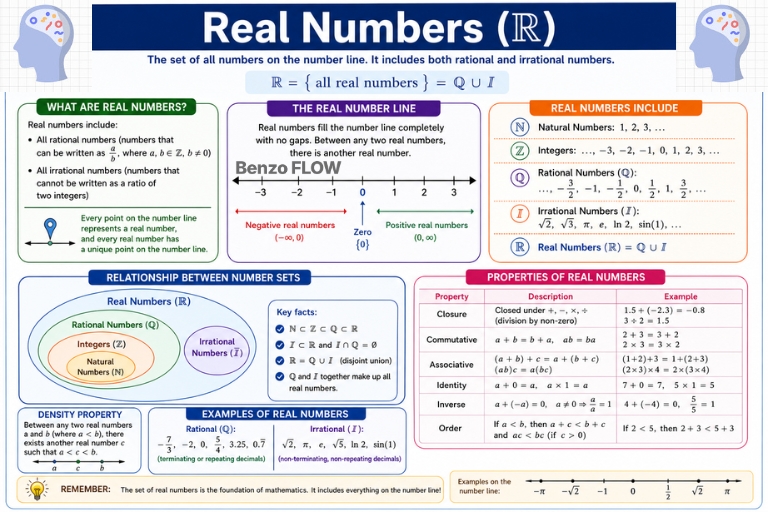
Real numbers (ℝ) are the complete collection of all rational and irrational numbers, representing every possible point on a continuous number line. If a number can be located on the standard number line, it is a real number.
In simple terms:
Real Numbers = Rational Numbers + Irrational Numbers
This means the real number system includes everything from counting numbers and fractions to non-repeating decimals such as π and √2.
What Real Numbers Include
Real numbers encompass all the foundational number systems we use daily. Because each system builds upon the last, they exist as subsets within the real number universe:
- Natural & Whole Numbers: 1, 2, 3… and the addition of 0.
- Integers: Positive and negative whole values (… −2, −1, 0, 1, 2 …).
- Rational Numbers: Fractions, terminating decimals, and repeating decimals (e.g., −11, 2/3, 4.56).
- Irrational Numbers: Non-repeating, infinite decimals that cannot be written as fractions (e.g., π, √2, e).
Examples of real numbers:
- -10
- 0
- 3/4
- 4.56
- √2
- π
What Real Numbers Do Not Include
Real numbers cover almost everything, but they do not include imaginary numbers (like i, which represents √−1) or complex numbers that contain imaginary parts (like 2 + 3i). If a number requires a component that cannot exist on a standard, one-dimensional number line, it belongs to a different mathematical universe entirely.
Examples that are not real numbers:
- i
- 2i
- 2 + 3i
Key Properties of Real Numbers
Real numbers have several important characteristics that make them the foundation of mathematics:
- Ordered: Any two real numbers can be compared to determine which is larger.
- Dense: Between any two real numbers, there is always another real number. For example, between 1 and 2 lies 1.5, and between 1 and 1.5 lies 1.25.
- Continuous: The real number line contains no gaps, allowing it to represent every measurable quantity.
- Arithmetic-Friendly: Real numbers support addition, subtraction, multiplication, and division (except division by zero).
Mathematically, the real numbers form what is known as a complete ordered field, a property that underpins calculus, algebra, geometry, and much of modern science.
Visualizing Real Numbers
Imagine an infinitely long number line stretching in both directions. Every point on that line corresponds to exactly one real number, and every real number corresponds to a point on the line. Together, these points create a seamless continuum that models the quantities we encounter in the real world.
Imaginary Numbers
For centuries, mathematicians encountered equations that seemed unsolvable. One famous example is:
x² + 1 = 0
Rearranging gives:
x² = −1
At first glance, this appears impossible. Any positive number squared is positive, and any negative number squared is also positive. No real number can produce −1 when squared.
Rather than accepting this as a dead end, mathematicians expanded the number system by defining a new number:
i = √−1
This breakthrough introduced imaginary numbers, numbers built from multiples of i. In simple terms, an imaginary number has the form bi, where b is a real number.
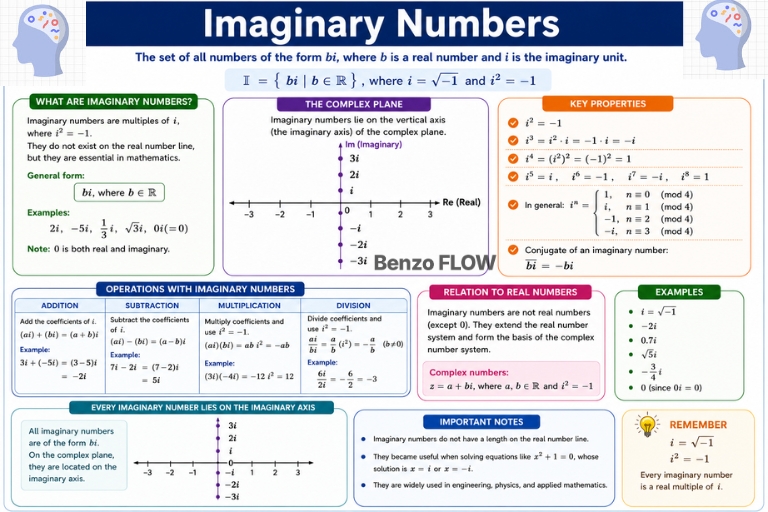
Examples include:
- i
- 2i
- −5i
- 7.3i
Imaginary numbers cannot be placed on the traditional real number line because they represent a fundamentally different dimension of mathematics. They are defined by the unique property:
i² = −1
From this definition, a repeating pattern emerges:
- i² = −1
- i³ = −i
- i⁴ = 1
- i⁵ = i
The term imaginary was coined by the French philosopher and mathematician René Descartes, who initially used it somewhat dismissively. Ironically, these numbers turned out to be indispensable.
Today, imaginary numbers help solve equations that real numbers cannot and form the foundation of complex numbers, which are widely used in engineering, physics, signal processing, quantum mechanics, and computer graphics.
What once seemed like a mathematical fiction became one of the most powerful tools in modern science.
Complex Numbers
Complex numbers extend the number system beyond the limits of the real number line. They are written in the form:
a + bi
where:
- a is the real part
- b is the imaginary part
- i = √(-1)
At first glance, complex numbers may seem like a mathematical invention with little practical value. However, they were created to solve a genuine problem: equations such as x² + 1 = 0 have no solution within the real numbers because no real number squared equals -1. By introducing i, mathematicians unlocked an entirely new mathematical framework.
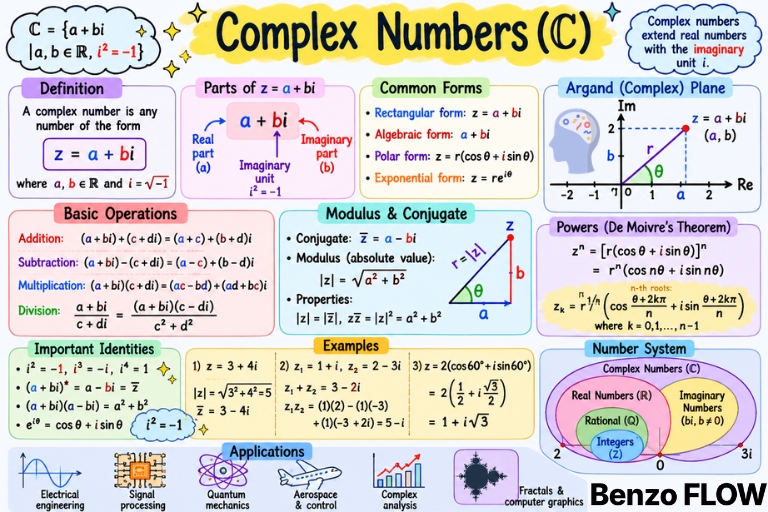
Complex numbers encompass both real and imaginary numbers. When b = 0, the number is purely real (such as 7). When a = 0, it is purely imaginary (such as 3i).
Examples of Complex Numbers
| Complex Number | Real Part | Imaginary Part |
|---|---|---|
| 3 + 4i | 3 | 4i |
| 5 − 2i | 5 | −2i |
| 7 | 7 | 0 |
| 3i | 0 | 3i |
Why Complex Numbers Matter
Complex numbers are far more than a mathematical curiosity, they are fundamental to modern science, engineering, and technology.
- Electrical Engineering: Engineers use complex numbers to analyze alternating-current (AC) circuits, model impedance, and represent voltages and currents as phasors.
- Quantum Mechanics: The mathematical foundations of quantum physics rely heavily on complex-valued wave functions.
- Signal Processing: Technologies such as digital audio, image compression, radio transmission, and Fourier transforms depend on complex numbers.
- Computer Graphics: Complex number operations provide elegant ways to perform rotations and transformations.
- Control Systems and Fluid Dynamics: They help model dynamic systems, airflow patterns, and other complex physical phenomena.
One reason complex numbers are so powerful is that they create a complete number system in which polynomial equations always have solutions. This property makes advanced mathematics significantly more elegant and enables many of the scientific and technological breakthroughs we rely on every day.
Without complex numbers, much of the modern world, from telecommunications and medical imaging to computer graphics and quantum computing would be impossible.
| Number | Natural | Whole | Integer | Rational | Irrational | Real | Complex |
|---|---|---|---|---|---|---|---|
| 5 | ✓ | ✓ | ✓ | ✓ | ✗ | ✓ | ✓ |
| 0 | ✗ | ✓ | ✓ | ✓ | ✗ | ✓ | ✓ |
| -3 | ✗ | ✗ | ✓ | ✓ | ✗ | ✓ | ✓ |
| 1/2 | ✗ | ✗ | ✗ | ✓ | ✗ | ✓ | ✓ |
| π | ✗ | ✗ | ✗ | ✗ | ✓ | ✓ | ✓ |
| √2 | ✗ | ✗ | ✗ | ✗ | ✓ | ✓ | ✓ |
| i | ✗ | ✗ | ✗ | ✗ | ✗ | ✗ | ✓ |
Special Classifications Within the Natural Numbers
Within the set of natural numbers, several important classifications help mathematicians identify patterns, solve problems, and understand how numbers relate to one another.
These categories range from the familiar concepts of even and odd numbers to more specialized groups that play key roles in mathematics, science, and technology.
Even and Odd Numbers
The most familiar way to divide natural numbers is by their divisibility by 2.
Even Numbers: Any integer that can be divided evenly by 2 without leaving a remainder. They follow the algebraic form 2n (where n ∈ ℕ) and always end in 0, 2, 4, 6, or 8. Examples include 2, 4, 6, 8, 10, …
Odd Numbers: Any integer that leaves a remainder of 1 when divided by 2. They follow the algebraic form 2n + 1 and always end in 1, 3, 5, 7, or 9. Examples include 1, 3, 5, 7, 9, …
These classifications exhibit highly predictable arithmetic behaviors, which serve as foundational patterns in mathematical proofs.
| Arithmetic Operation | Resulting Type | Example |
|---|---|---|
| Even ± Even | Even | 6 + 4 = 10 |
| Odd ± Odd | Even | 7 + 3 = 10 |
| Even ± Odd | Odd | 8 + 5 = 13 |
| Even × Any Number | Even | 4 × 3 = 12 |
| Odd × Odd | Odd | 5 × 7 = 35 |
Prime Numbers
A prime number is a natural number strictly greater than 1 that has exactly two distinct factors: 1 and itself. Examples include 2, 3, 5, 7, 11, 13, 17, 19, …
Why Prime Numbers Matter? Prime numbers are far more than a mathematical curiosity. Modern encryption systems, including RSA cryptography, rely on the difficulty of factoring extremely large numbers into their prime components. This principle helps protect online banking, digital communications, passwords, and secure transactions across the internet.
The Power of 2: The number 2 is uniquely significant. It is the smallest prime number and the only even prime number. Every subsequent even number is divisible by 2, automatically giving it more than two factors.
Infinite in Nature: Around 300 BCE, the ancient Greek mathematician Euclid proved that prime numbers are infinite. The search for them continues into the modern era; today, computer algorithms routinely discover massive Mersenne primes spanning tens of millions of digits.
Twin Primes: Primes often appear in pairs that differ by exactly 2, known as twin primes. Such as (3, 5), (5, 7), and (11, 13).
Co-Prime Numbers
Co-prime (or relatively prime) numbers are pairs of numbers that share no common factors other than 1. The numbers themselves do not have to be prime. For instance, 8 (factors: 1, 2, 4, 8) and 15 (factors: 1, 3, 5, 15) are both composite, but they are co-prime to one another because their greatest common divisor is 1.
Composite Numbers
A composite number is a natural number greater than 1 that has more than two factors, meaning it can be divided evenly by numbers other than 1 and itself. Examples include 4, 6, 8, 9, 10, 12, …
Every composite number can be broken down into a unique product of prime numbers. This is known as prime factorization.
12 = 2 × 2 × 3
60 = 2 × 2 × 3 × 5
100 = 2 × 2 × 5 × 5
⚠️ Crucial Warning: The number 1 is neither prime nor composite. By definition, a prime number must have exactly two distinct factors. Because 1 only has one factor (1 itself), it fails the definition of a prime. It also fails to be composite because it cannot be broken down into a product of primes.
Perfect Numbers
A perfect number is equal to the sum of its proper divisors (all positive divisors excluding the number itself).
Examples:
- 6 = 1 + 2 + 3
- 28 = 1 + 2 + 4 + 7 + 14
Perfect numbers are rare and have fascinated mathematicians for thousands of years because of their unique balance between a number and its divisors.
Fibonacci Numbers
The Fibonacci sequence is a famous pattern in which each number is the sum of the two preceding numbers:
1, 1, 2, 3, 5, 8, 13, 21, 34, …
Fibonacci numbers appear surprisingly often in nature, including the spiral arrangements of sunflower seeds, pinecones, and certain plant-growth patterns. They also have applications in computer science, economics, and design.
Geometric Numbers
Some numbers are defined by how they can be arranged into geometric shapes:
Square Numbers: The result of multiplying an integer by itself (1, 4, 9, 16, 25, …, or 1², 2², 3², 4², 5², …).
Cube Numbers: The result of multiplying an integer by itself three times (1, 8, 27, 64, 125, …, or 1³, 2³, 3³, 4³, 5³, …).
Triangular Numbers: Numbers that can form a perfect equilateral triangle (1, 3, 6, 10, 15, …). They are generated by finding the sum of the first n natural numbers.
Other Notable Number Classifications
Some classifications extend beyond the natural numbers but are important to understand in the broader landscape of mathematics:
- Algebraic numbers are numbers that satisfy a polynomial equation with integer coefficients, such as √2, √5, and 3.
- Transcendental numbers cannot be expressed as solutions to any such polynomial equation. The most famous examples are π and e.
All transcendental numbers are irrational, but not all irrational numbers are transcendental. For example, √2 is irrational yet algebraic because it is a solution to the equation x² − 2 = 0.
Understanding these special classifications reveals that numbers are much more than simple counting tools. Each category highlights unique properties and relationships, helping mathematicians uncover deeper structures within the number system.
How to Identify Any Type of Number
Follow this simple process:
Step 1
Can it be written as a fraction?
- Yes → Rational
- No → Irrational
Step 2
Is it negative?
- Yes → Integer (if no decimal/fraction)
Step 3
Does it contain i?
- Yes → Complex
Step 4
Is it a positive counting number?
- Yes → Natural
Key relationships to remember:
- Every natural number is a whole number, but not every whole number is natural (0 is the exception)
- Every integer is rational (e.g., –3 = –3/1)
- Every rational and irrational number is real
- Every real number is complex (with imaginary part = 0)
- Rational and irrational numbers together make up all real numbers, with no overlap
Common Mistakes to Avoid
1. Confusing natural and whole numbers Many students think these are identical. The key difference: whole numbers include 0, while natural numbers (in most conventions) start at 1.
2. Thinking all square roots are irrational √4 = 2 (rational), √9 = 3 (rational), √16 = 4 (rational). Only square roots of non-perfect-square integers are irrational.
3. Assuming all decimals are irrational A repeating decimal like 0.666… = 2/3 is perfectly rational. Only non-terminating, non-repeating decimals are irrational.
4. Forgetting that 1 is neither prime nor composite The number 1 has only one factor. Prime numbers must have exactly two distinct factors. This is a classic exam pitfall.
5. Thinking imaginary numbers aren’t “real” in any meaningful sense The name is misleading. Imaginary and complex numbers have profound, practical applications in physics, engineering, and computing.
6. Misclassifying negative fractions –3/4 is a rational number. Rational numbers can be negative. Students sometimes assume rational means positive.
7. Assuming π ≈ 22/7 is exact 22/7 is a commonly used approximation of π, but it’s not equal to π. Since π is irrational, it cannot be expressed exactly as any fraction.
Best Practices for Learning Number Types
1. Learn the hierarchy, not just individual definitions. Understanding that every integer is rational (but not vice versa) is more powerful than memorizing isolated facts. Draw the nested set diagram and refer to it.
2. Use the number line as a visual tool. Plot different types of numbers on a number line. Integers at whole number positions, rational numbers as fractions between them, and irrational numbers filling the remaining gaps.
3. Practice classification exercises. Given a list of numbers like {–5, 0, 3/4, √7, π, 2.5, –1/3, 6}, classify each into every applicable category. A number can belong to multiple sets simultaneously.
4. Connect number types to real-world contexts. This cements understanding far better than abstract drills:
- Counting items → natural numbers
- Temperature → integers
- Recipe measurements → rational numbers
- Circle geometry → irrational numbers (π)
- Electronics → complex numbers
5. Revisit definitions often. Mathematical definitions are precise. “An integer that has exactly two factors” means prime, not “a number that can only be divided by 1 and itself” (which is imprecise enough to include 1 by mistake).
Conclusion
From the humble natural numbers we use to count to the elegant complexities powering modern technology, the types of numbers form a rich, interconnected system that describes our world with astonishing precision. By mastering these classifications, you gain not just mathematical fluency but a sharper lens for problem-solving in everyday and professional life.