
Periodic Table: Interactive 3D Guide to All 118 Elements
The periodic table is one of the most important tools in chemistry. It organizes the chemical elements according to their atomic numbers and reveals patterns in their atomic structure, chemical properties, and behavior.
In this blog post, you can Explore all 118 elements with a free interactive 3D periodic table. Learn element properties, groups, trends, electron configurations, and tips for memorization.
But the periodic table is much more than a chart to memorize. It can help you predict how elements react, understand why certain atoms form similar compounds, compare the properties of metals and nonmetals, and explore the structure of matter itself.
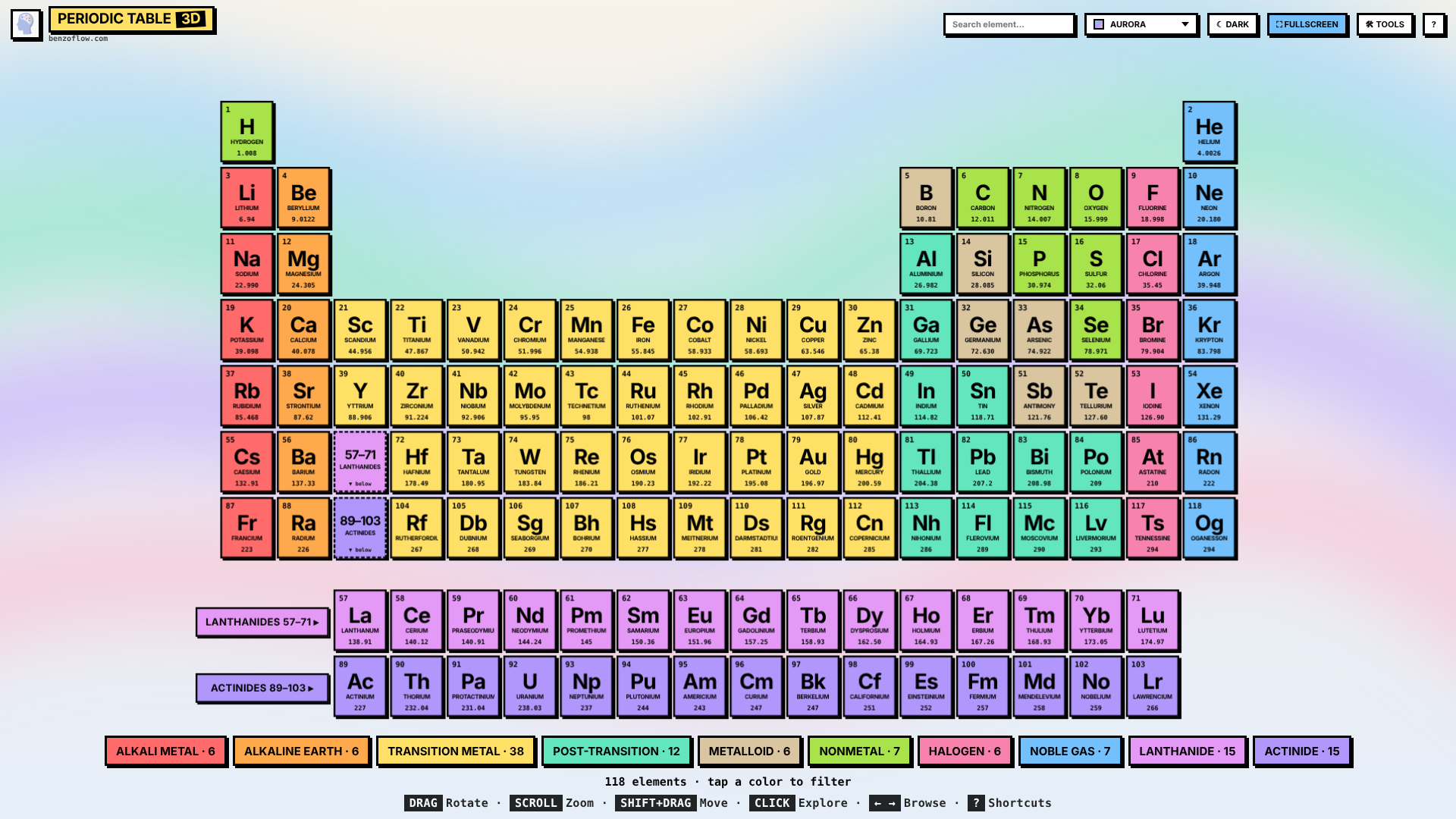
To make it easier, I built a free 3D interactive periodic table. You can rotate it, wrap it into a sphere, color it five different ways, compare two elements side by side, and quiz yourself.
Here is a full user manual for it, for both desktop and phone.
Interactive 3D Periodic Table
The 3D periodic table is embedded in this post, so you don’t need to open or download anything. It works in any modern browser (Chrome, Safari, Firefox, Edge) on desktop, tablet, and phone, with no sign-up.
Fullscreen Mode
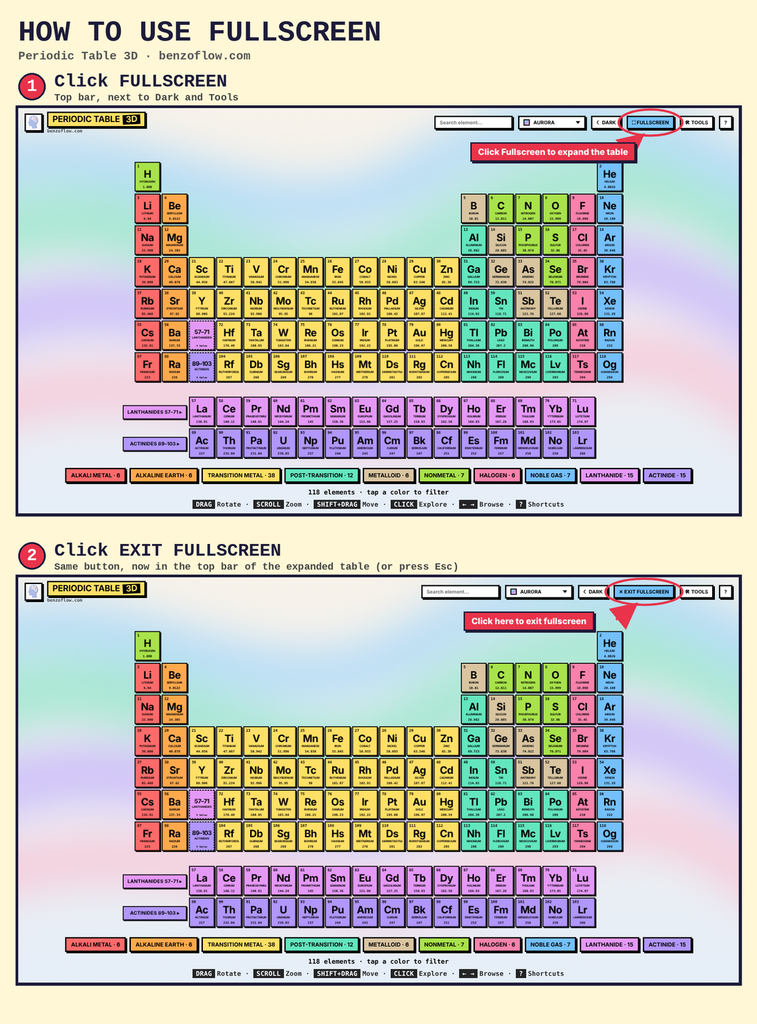
Click Fullscreen in the top bar to expand the periodic table and make the most of your screen. This is the recommended viewing mode, offering larger element tiles, more room for the footer and detail panels, and a cleaner experience for classroom demonstrations and screen recordings.
To return to the article, click Exit Fullscreen or press Esc.
On iPhone: Safari may not support fullscreen mode for embedded content. If the Fullscreen button doesn’t work, rotate your phone to landscape orientation and pinch to zoom for a better view.
What You See When It Loads
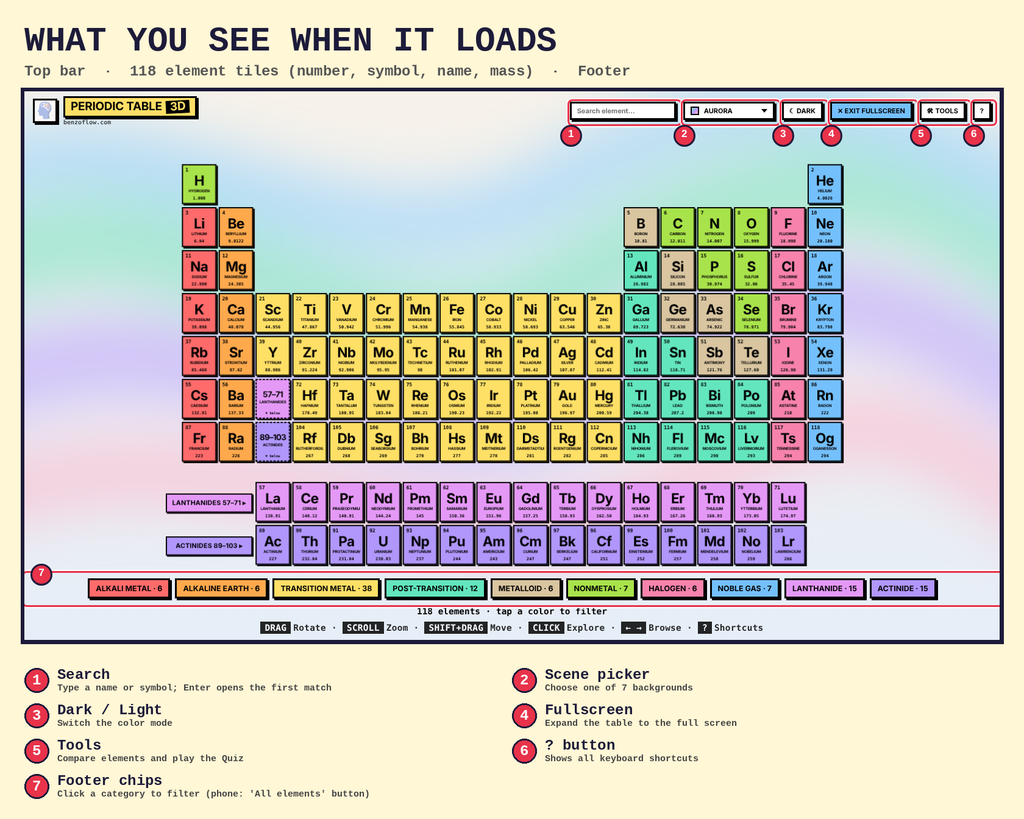
- Top bar: Logo and title on the left. On the right: Search, the Background Scene Picker, Dark/Light, Fullscreen, Tools, and the “?” shortcuts button.
- The table: All 118 elements as tiles. Each tile shows atomic number, symbol, name, and atomic mass.
- Footer: Colored category chips (desktop) or one “All elements” filter button (phone), plus a one-line hint for the mouse or touch controls.
Controls & Shortcuts
| Action | Desktop | Phone |
|---|---|---|
| Rotate the table | Click and drag | One-finger drag |
| Zoom | Scroll wheel, or + / − keys | Pinch |
| Move (pan) the table | Shift + drag, or Shift + arrow keys | Switch the Controls window to Move mode, then drag |
| Open an element | Click a tile | Tap a tile |
| Next / previous element | → / ← keys | Next / Prev buttons in the element panel |
| Spin automatically | Space | |
| Reset everything | R |
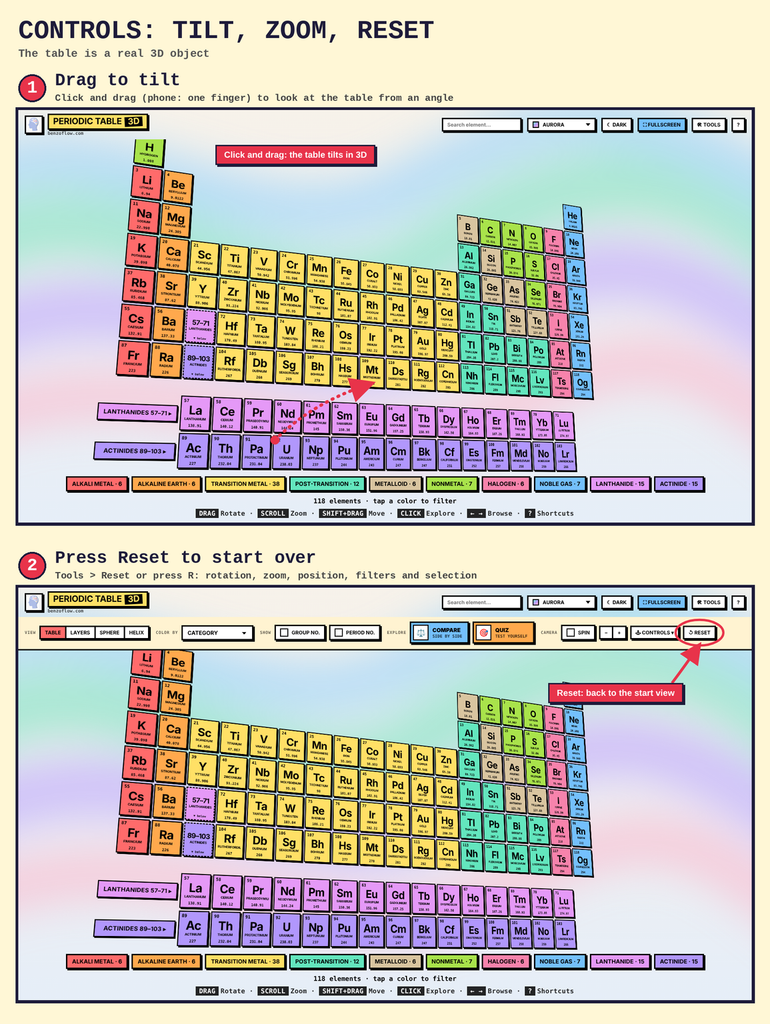
The table is a real 3D object, so dragging tilts it and you can look at it from the side. Press Reset (the ↺ button) any time you get lost; it returns rotation, zoom, position, filters, and selection to the start.
Phone Tips
- Use Fullscreen first. It gives you the largest possible view of the periodic table.
- Swipe in the right place. On the article page, swipe outside the table to scroll the page. Swipe directly on the table to rotate it.
- Switch to landscape mode. Turn your phone sideways to give the table more room on screen.
- Adjust the view with Fit. If the table looks too small or too large after rotating your phone, go to Tools → Controls → Fit.
- Zoom in and reset. Pinch to zoom into a specific area, such as the lanthanides, then use Reset to return to the default view.
- Close overlapping panels. If a panel covers part of the table, tap its × button to dismiss it.
The Tools menu
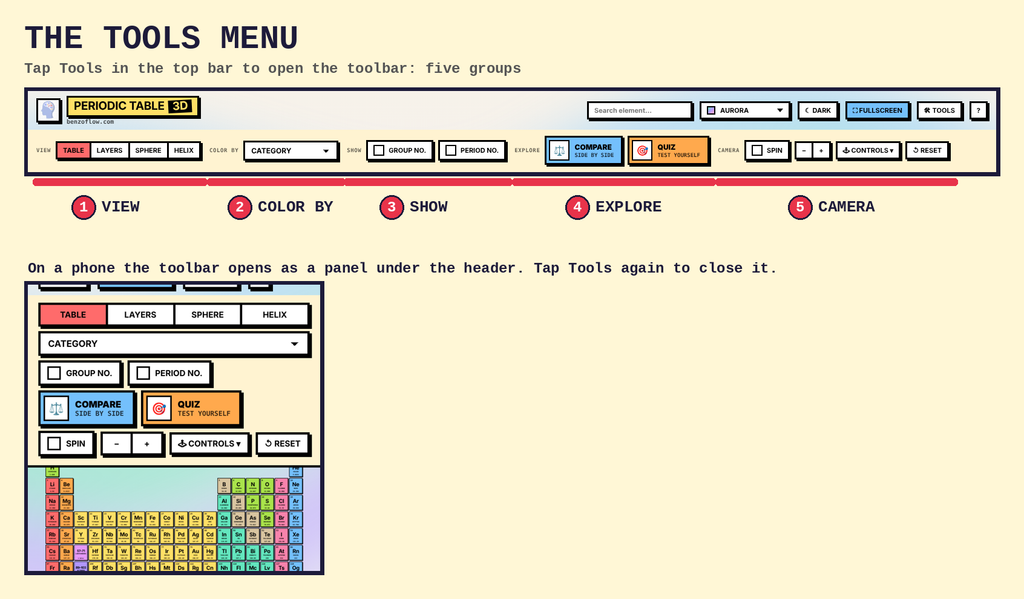
Tap Tools in the top bar to open the toolbar. It has five groups: View, Color by, Show, Explore and Camera. On a phone, it opens as a panel under the header.
Tap Tools again to close it.
View: Four Ways To See The Table
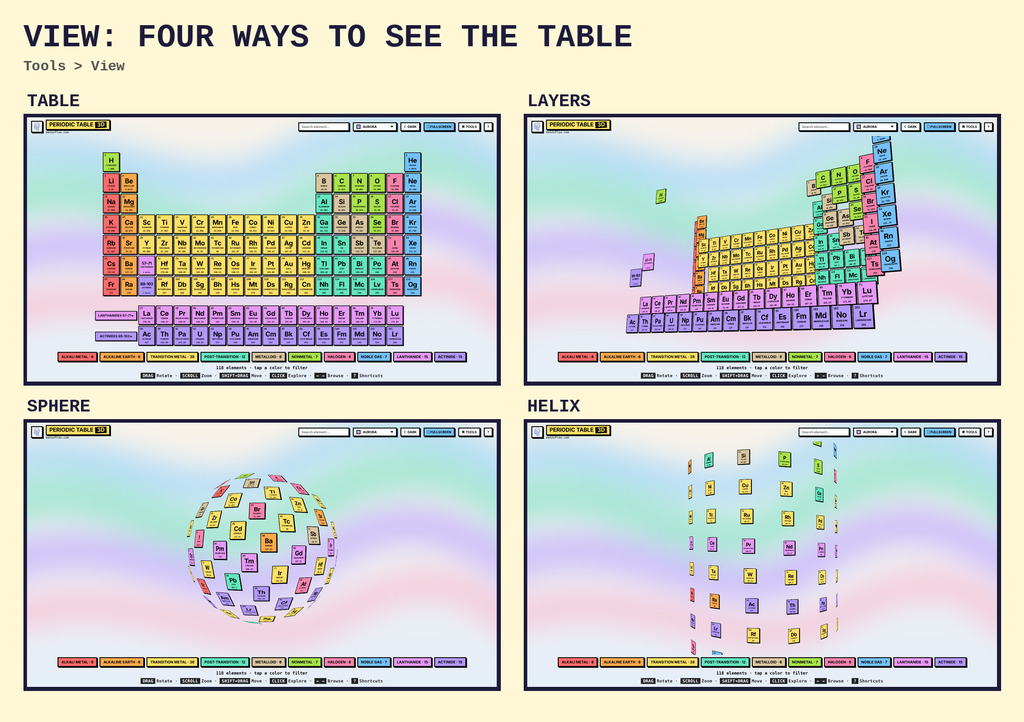
- Table: The classic flat layout with the lanthanide and actinide rows below.
- Layers: Stacks the element categories in depth, so families sit at different distances from you.
- Sphere: Wraps all elements into a ball. Drag to spin it and see every element from every angle.
- Helix: A spiral layout that follows atomic number from 1 upward, which shows the table’s periodic repeat as a coil.
Color by: Five Ways To Color The Tiles
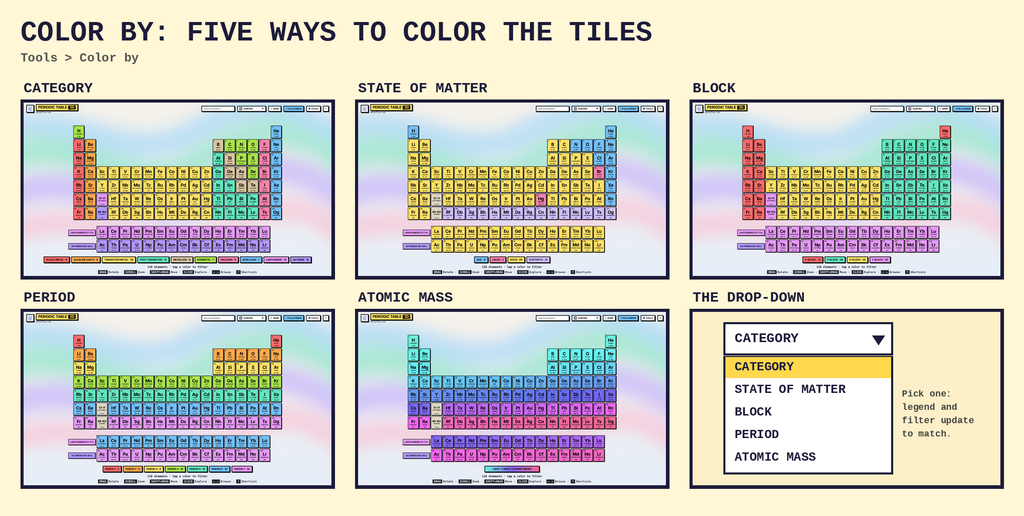
Pick one from the drop-down. The legend and filter always match the mode you picked.
| Mode | What it shows | Best for |
|---|---|---|
| Category | The 10 element families | Learning families and neighboring elements |
| State of matter | Solid, liquid, gas, or unknown at room temperature | Understanding why only a few elements are gases |
| Block | s p d f blocks | Understanding the table’s structure |
| Period | Rows 1–7 | Seeing electron shells grow |
| Atomic mass | Light-to-heavy color gradient | Visualizing how atomic mass increases across the table |
Show: Group And Period Numbers
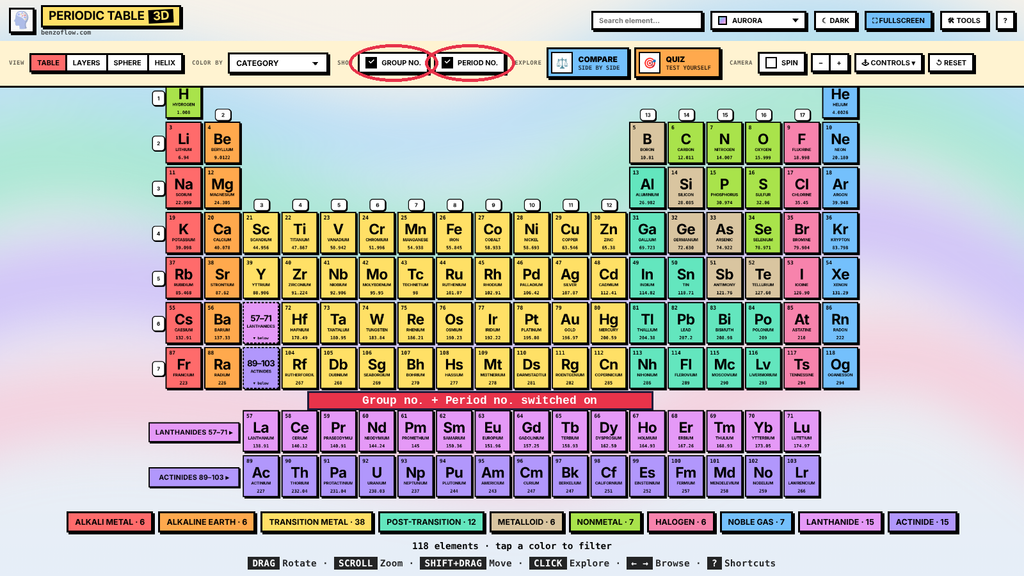
Turn on Group no. to show the column numbers 1 to 18 along the top. Turn on Period no. to show row numbers 1 to 7 down the side. Click a number label to highlight that whole group or period.
Camera: Spin, Zoom and Controls
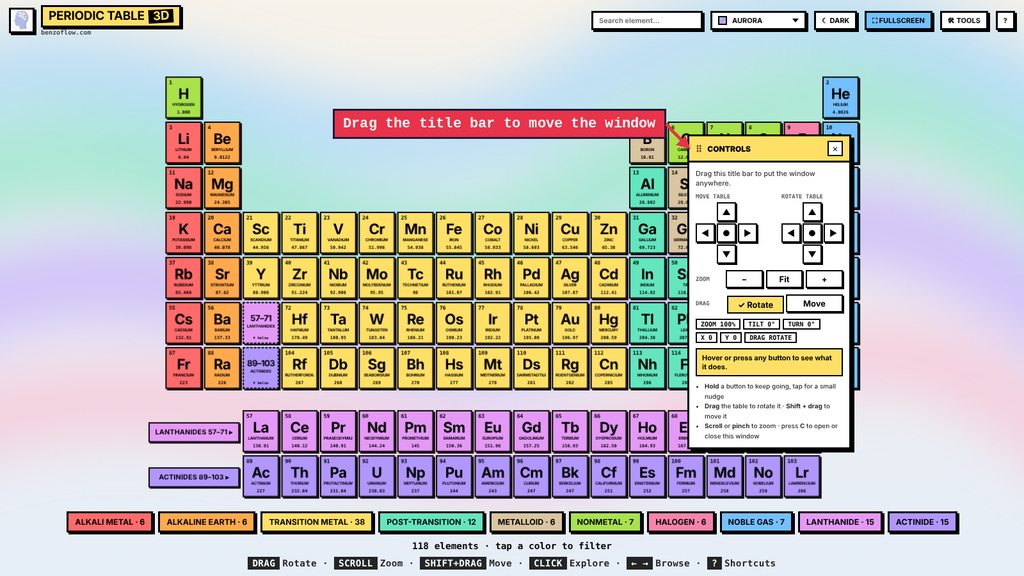
- Spin turns the table slowly on its own. Press it again to stop.
- − / + zoom out and in.
- Controls opens a floating window with arrow pads to move the table, tilt and turn it, zoom, and a Fit button that resizes the whole table to your screen. It also has a Rotate / Move switch so one-finger or mouse dragging either rotates or pans. Drag its title bar to put it anywhere on screen. Hold a button to keep moving. Press
Cto open or close it. - Reset returns everything to the default view.
Filter By Category
Filter the periodic table to focus on specific element families or properties. The available filters adapt automatically to your selected color mode.
Desktop
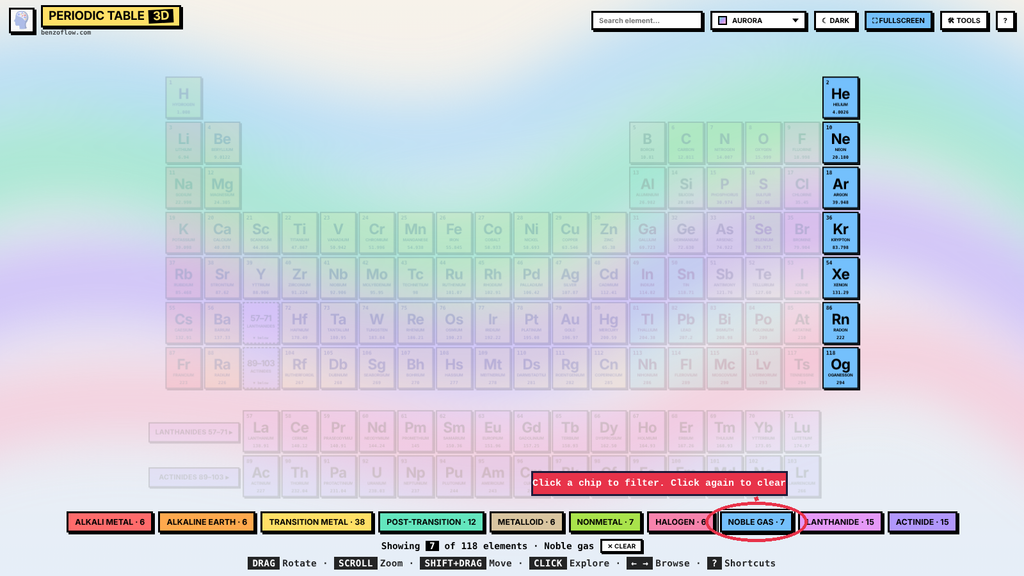
The footer displays color-coded category chips with element counts, such as ALKALI METAL · 6 and NOBLE GAS · 7. Click any chip to highlight the matching elements while dimming all others.
To remove the filter, click the active chip again or select ✕ Clear to restore the full table.
Phone
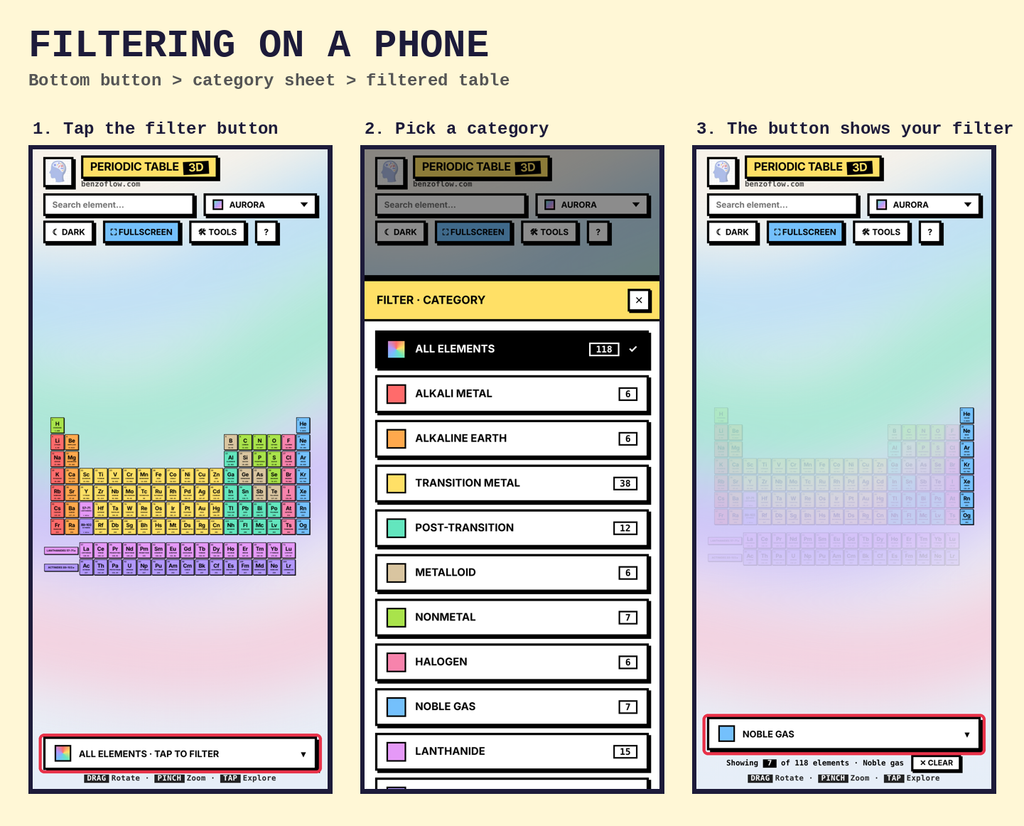
Tap the All elements · tap to filter button at the bottom of the screen. A category selection sheet slides up, displaying the available categories and their element counts.
Select a category to close the sheet and apply the filter. The bottom button then updates to show the active filter and its corresponding color swatch. Tap it again to change or clear your selection.
Filters That Adapt to Your View
Filtering follows the currently selected color mode. For example:
- Category mode: Filter by element family.
- State of matter mode: Filter by solid, liquid, or gas.
- Period mode: Filter by period.
This keeps the filtering experience consistent across different visualization modes and makes it easier to explore specific groups of elements.
Search
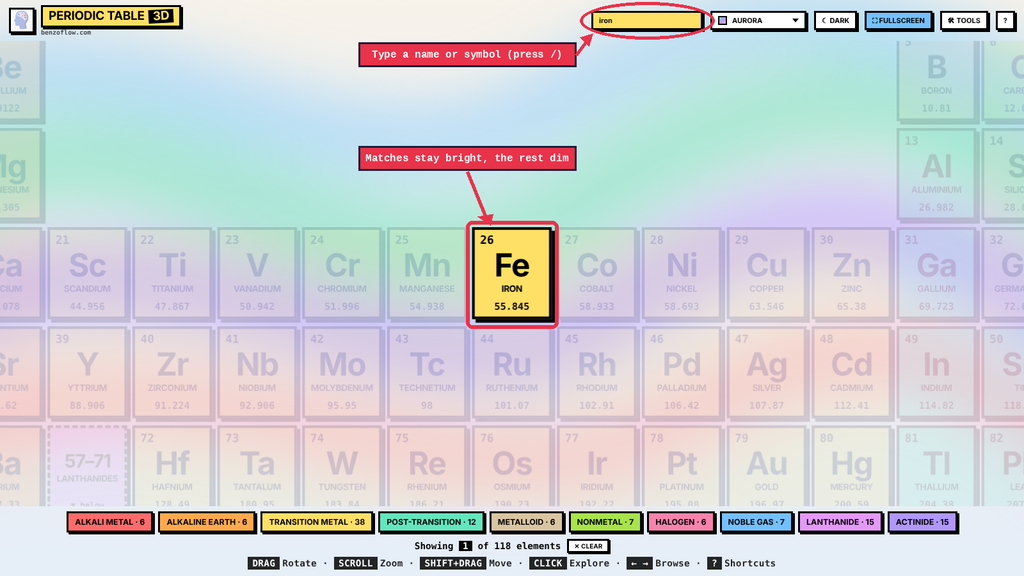
Quickly find any element by its name or chemical symbol.
Press / on your keyboard or tap the search box, then start typing. Matching elements remain highlighted while non-matching tiles dim automatically, making your results easy to spot.
Press Enter to open the first matching element. For example, type “iron” and press Enter to open Iron (Fe).
Explore Individual Elements
Click or tap any element tile to open its detail panel, featuring the element’s key properties and electronic structure.
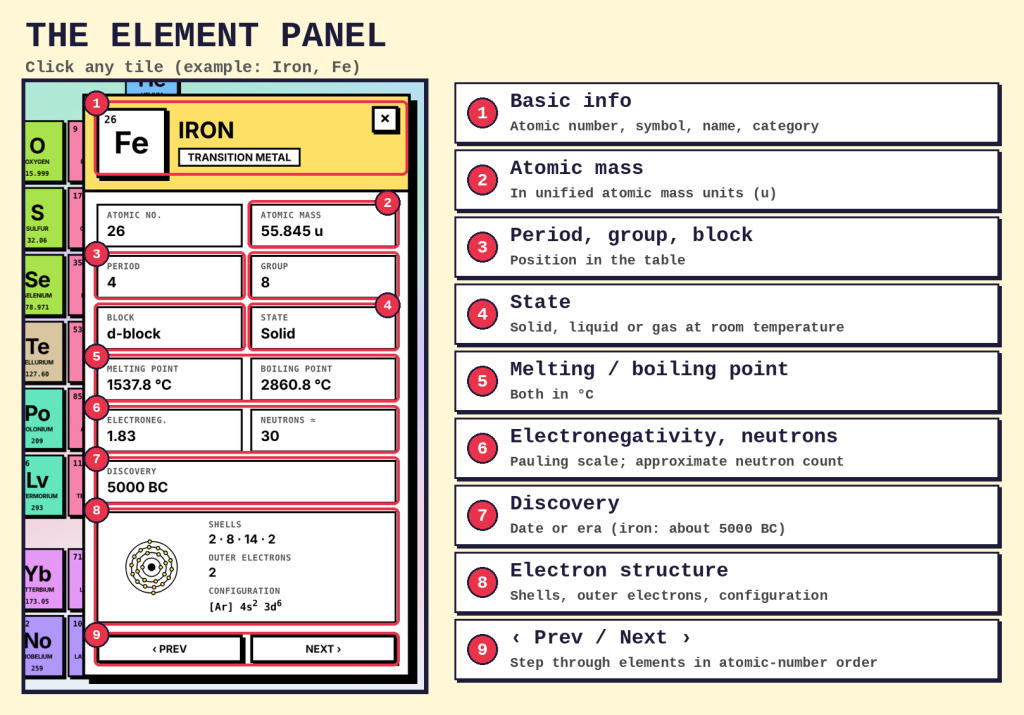
Each panel includes:
- Basic information: Atomic number, chemical symbol, element name, and category.
- Atomic mass: Relative atomic mass expressed in unified atomic mass units (u).
- Periodic position: Period, group, and block.
- State of matter: Physical state at room temperature.
- Melting and boiling points: Both expressed in °C.
- Electronegativity: Value on the Pauling scale.
- Neutron count: Approximate number of neutrons in the most common isotope or a representative isotope.
- Discovery: Discovery date or historical era. For example, iron has been known since antiquity, dating to around 5000 BC.
- Electron structure: Electron shells, outer-shell electron count, and electron configuration. For iron (Fe), the shell distribution is 2 · 8 · 14 · 2, and its electron configuration is [Ar] 3d⁶ 4s².
Use ‹ Prev and Next › to navigate between elements in atomic-number order. You can also use the left and right arrow keys to move through the table without repeatedly closing the panel.
Tip: Navigate through the elements one by one to explore how their properties and electron configurations change across the periodic table.
How to Read an Element Tile
Every element tile in the periodic table presents essential information about a chemical element in a compact format. At a glance, you can usually find its atomic number, chemical symbol, name, and atomic mass. Selecting a tile in the interactive 3D periodic table reveals additional details, such as electron configuration, electron shells, and physical properties.
Learning to read these details helps you understand an element’s identity, atomic structure, and chemical behavior without memorizing every element individually.
The Parts of an Element Tile
Consider iron (Fe), which has an atomic number of 26.
| Field | Example: Iron | What it means |
|---|---|---|
| Atomic number | 26 | Number of protons in the nucleus |
| Chemical symbol | Fe | Short abbreviation used to represent the element |
| Element name | Iron | The element’s name |
| Atomic mass | 55.845 u | Standard atomic weight based on naturally occurring isotopes |
| Period / Group | 4 / 8 | Its horizontal row and vertical column |
| Block | d-block | The block associated with its electron configuration |
| Electron shells | 2 · 8 · 14 · 2 | Distribution of electrons across the principal shells |
| Electron configuration | [Ar] 3d⁶ 4s² | Detailed arrangement of electrons in subshells |
The exact information displayed and its formatting may vary between periodic tables.
Atomic Number
The atomic number is the number of protons in an atom’s nucleus. It is the most important identifier of a chemical element.
Iron has 26 protons, so its atomic number is 26. Every iron atom has 26 protons, whether it is found in a mineral, a steel structure, or a biological system.
In a neutral iron atom, there are also 26 electrons. However, an iron ion may have fewer electrons because it has lost one or more electrons during a chemical process.
Chemical Symbol and Element Name
A chemical symbol is the abbreviated form of an element’s name. It usually consists of one or two letters, with the first letter capitalized and the second, if present, lowercase.
For example:
- H — Hydrogen
- O — Oxygen
- Fe — Iron
- Na — Sodium
- Au — Gold
Some symbols come from Latin names rather than modern English names. Iron uses Fe from ferrum, sodium uses Na from natrium, and gold uses Au from aurum.
Chemical symbols are used internationally in chemical equations, formulas, scientific diagrams, and laboratory work.
Atomic Mass: Why Is It Usually a Decimal?
The atomic mass shown on a periodic table is usually a decimal because most elements occur naturally as mixtures of isotopes.
Isotopes are atoms of the same element that have the same number of protons but different numbers of neutrons. Their chemical properties are generally similar, but their masses differ.
The standard atomic weight displayed for an element reflects the relative abundances of its naturally occurring isotopes. For example, chlorine has a standard atomic weight of approximately 35.45 u because natural chlorine contains a mixture dominated by chlorine-35 and chlorine-37.
For elements without a characteristic standard atomic weight, particularly radioactive elements with no stable isotopes, periodic tables often display the mass number of a selected isotope in square brackets. The exact isotope chosen depends on the convention used by the source.
Remember the distinction:
- Atomic number: Number of protons.
- Mass number: Total number of protons and neutrons in a particular isotope.
- Atomic mass or standard atomic weight: A mass value that may account for isotopic masses and natural abundances.
These quantities are related, but they are not interchangeable.
Period and Group
An element’s period and group indicate its position in the periodic table.
Iron belongs to Period 4 and Group 8. Its position reflects its electron configuration and its relationship with neighboring elements.
The period number generally indicates the highest principal electron shell occupied in a ground-state atom. The group helps identify chemical families and recurring patterns in electron configurations.
Elements in the same group often share chemical characteristics, although transition metals and some other elements show more complicated relationships.
Block
The periodic table is divided into four blocks: s, p, d, and f. These blocks are named after the types of electron subshells associated with the recurring electron-filling patterns.
Iron belongs to the d-block. Its electron configuration is commonly written as [Ar] 3d⁶ 4s², showing that its electrons extend into the 3d subshell.
The block helps explain an element’s position and provides useful clues about its electronic structure and chemical behavior.
Electron Shells: How Are Electrons Distributed?
Electrons occupy principal energy levels, commonly called electron shells, around an atom’s nucleus. Each shell is identified by a principal quantum number, n.
The theoretical maximum number of electrons in a shell is given by:
Maximum shell capacity = 2n²
For example:
| Shell | Principal quantum number (n) | Maximum capacity |
|---|---|---|
| K | 1 | 2 electrons |
| L | 2 | 8 electrons |
| M | 3 | 18 electrons |
| N | 4 | 32 electrons |
These values describe the maximum capacity of each principal shell, not the exact order in which electrons fill the shells. Electron subshells from different principal shells can overlap in energy, so the actual distribution depends on the atom’s electron configuration.
Iron has 26 electrons in its neutral ground state, distributed as 2 · 8 · 14 · 2 across its four occupied principal shells.
Sodium has the shell distribution 2 · 8 · 1. Its single outermost electron helps explain why sodium shares chemical characteristics with lithium and potassium.
The electrons in the outermost occupied shell are often called outer-shell electrons. For main-group elements, these usually correspond to the valence electrons. Transition metals require more care because electrons in d subshells can also participate in bonding and chemical reactions.
How to Read an Electron Configuration
An electron configuration describes how electrons are distributed among an atom’s subshells. Each subshell is represented by a number, a letter, and a superscript.
For example, iron’s electron configuration can be written as:
Fe (26): [Ar] 3d⁶ 4s²
Each part communicates specific information:
- [Ar] represents the electron configuration of argon. This shorthand replaces the configuration of the inner electrons.
- 3d⁶ means that the 3d subshell contains six electrons.
- 4s² means that the 4s subshell contains two electrons.
The order in which subshells are written can vary. Iron is also commonly written as [Ar] 4s² 3d⁶.
For many elements, electrons fill subshells approximately in the following order:
1s → 2s → 2p → 3s → 3p → 4s → 3d → 4p → 5s → 4d → 5p → 6s → 4f → 5d → 6p → 7s → 5f → 6d → 7p
This pattern helps explain the structure of the periodic table. As atomic number increases, electrons occupy subshells in a recurring sequence, producing the s-, p-, d-, and f-blocks.
However, the filling order is not an absolute rule for every element. Some atoms, including chromium and copper, have ground-state electron configurations that differ from simple predictions because the relative energies of subshells and the stability of particular arrangements matter.
Other Properties in the Element Panel
Depending on the interactive periodic table, selecting an element may reveal additional physical and chemical properties.
State at room temperature: Indicates whether an element is solid, liquid, or gas under the specified conditions. Most elements are solids, while mercury and bromine are liquids at ordinary room temperature. Some superheavy elements have unknown or incompletely measured physical properties.
Melting point: The temperature at which a substance changes from solid to liquid at a specified pressure.
Boiling point: The temperature at which a liquid’s vapor pressure equals the surrounding pressure. Values depend on pressure, and some superheavy elements have properties that have not been measured directly.
Electronegativity: A measure of an atom’s tendency to attract shared electrons in a chemical bond. On the Pauling scale, fluorine has the highest commonly assigned value, approximately 3.98.
Discovery: Indicates when an element was discovered, isolated, or first identified, depending on the historical record. Some elements were known in ancient times, while others were synthesized and confirmed in modern laboratories.
These details make it possible to compare elements and explore how atomic structure relates to physical properties and chemical behavior.
Compare Two Elements
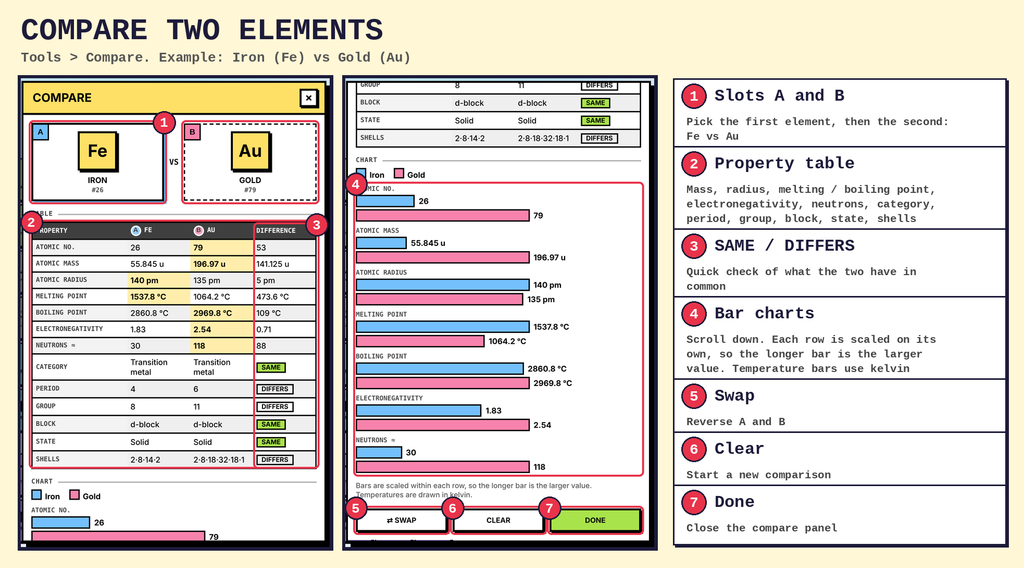
Compare any two elements side by side to explore their properties, identify similarities, and understand their differences.
How to Compare
- Open Tools and select Compare (side by side).
- Choose the first element for slot A, then select the second element for slot B. The active selection slot is highlighted.
- A comparison table displays both elements’ properties alongside a summary of their differences or similarities.
- Scroll down to explore visual bar charts comparing numerical properties. Each pair of bars is scaled within its own row, making it easy to identify the larger value. Temperature comparisons are displayed in kelvin (K).
- Use Swap to reverse the elements, Clear to start a new comparison, or Done to close the comparison panel.
What You Can Compare
The comparison table includes:
- Atomic number and atomic mass
- Atomic radius
- Melting and boiling points
- Electronegativity (Pauling scale)
- Approximate neutron count
- Element category
- Period, group, and block
- State of matter at room temperature
- Electron shells
The visual comparison section makes numerical differences easier to understand at a glance.
Example: Iron (Fe) vs. Gold (Au)
Iron and gold are both solid transition metals, but their properties differ in several interesting ways. Iron belongs to period 4 and group 8, while gold belongs to period 6 and group 11. The most common isotope of iron, iron-56, contains 30 neutrons; gold-197 contains 118.
Try comparing these two elements to explore how their atomic structure, physical properties, and position in the periodic table differ.
Screenshot references:
- Comparison table: Show the comparison panel with iron (Fe) in slot A and gold (Au) in slot B. Display the property table, including the values and difference/status column.
- Visual comparison: Show the same panel scrolled down to the numerical bar charts, with both elements’ values and relative bar lengths visible.
Optional: Highlight the Swap, Clear, and Done buttons to help readers identify the available controls.
Screenshot reference: Show the detail panel for iron (Fe), with all properties visible, including electron shells, electron configuration, and the Prev/Next buttons. Add callout arrows highlighting Shells, Configuration, and Next.
Quiz Mode
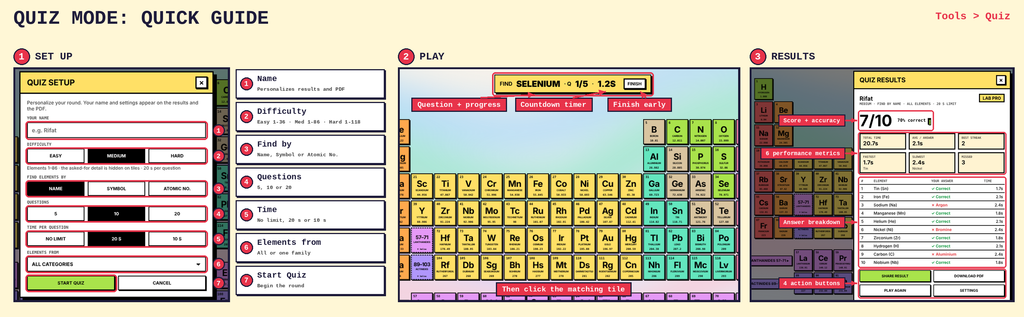
Turn the periodic table into an interactive learning game. Test your knowledge of element names, symbols, and atomic numbers through customizable quizzes, timed challenges, and detailed results.
1. Set Up Your Quiz
Open Tools → Quiz (test yourself) to access the Quiz Setup window.
| Setting | Options |
|---|---|
| Your name | Personalize your results and exported PDF. |
| Difficulty | Easy: Elements 1–36, with tile labels visible. Medium: Elements 1–86, requested details hidden, 20 seconds per question. Hard: All 118 elements, no hints, 10 seconds per question. |
| Find elements by | Name, Symbol, or Atomic No. |
| Questions | 5, 10, or 20. |
| Time per question | No Limit, 20 s, or 10 s, subject to difficulty settings. |
| Elements from | All Categories or a specific element family. |
How to illustrate: Capture the Quiz Setup window with all six settings visible. Ensure the name field, difficulty options, question type, question count, time limit, category dropdown, and Start Quiz button are clearly readable.
2. Play the Quiz
Click Start Quiz. A prompt appears at the top, such as “Find Barium.” Click the matching element tile before time runs out, if the round is timed. Continue until all questions are completed.
How to illustrate: Capture an active quiz showing the question prompt, countdown timer, and periodic table. Make sure the target element is identifiable and the quiz interface is unobstructed.
3. Review Your Results
The Quiz Results screen summarizes your performance.
| Metric | What it shows |
|---|---|
| Score & Accuracy | Correct answers and percentage accuracy. |
| Total Time | Time taken to complete the round. |
| Avg / Answer | Average response time. |
| Best Streak | Longest consecutive run of correct answers. |
| Fastest / Slowest | Quickest and longest response times, with element names. |
| Missed | Number of incorrect or missed questions. |
Below the summary, the answer breakdown lists each question, the element, your answer, and response time. Correct answers appear in green; incorrect answers appear in red.
How to illustrate: Capture the results window with the score, accuracy, six performance metrics, and answer breakdown visible. If the full report does not fit on screen, use two screenshots: one for the summary and another for the question-by-question results.
4. Share, Save, or Replay
Choose an action from the results screen:
- Share Result: Share your performance.
- Download PDF: Export your results for future reference.
- Play Again: Start another round.
- Settings: Adjust your quiz preferences.
Your best scores are saved locally in your browser.
How to illustrate: Capture the bottom of the results window with all four buttons clearly visible. Optionally, download the PDF and include a screenshot showing the exported report.
Tips for Better Results
- Start with Easy to learn the first 36 elements.
- Progress to Medium and Hard as your confidence grows.
- Switch between Name, Symbol, and Atomic No. questions to strengthen recall.
- Review incorrect answers and practice element families separately.
- Aim to improve your accuracy, response time, and best streak.
The goal: Build your knowledge one question at a time, then challenge yourself to master all 118 elements.
What Is the Periodic Table?
The periodic table is an organized arrangement of all known chemical elements in order of increasing atomic number. It groups elements with similar chemical properties into columns and reveals recurring patterns in their physical and chemical behavior.
A chemical element is a pure substance made up of atoms that have the same number of protons in their nuclei. Hydrogen, carbon, oxygen, iron, gold, and uranium are common examples of chemical elements.
The modern periodic table contains 118 officially recognized chemical elements, beginning with hydrogen (H), which has an atomic number of 1, and ending with oganesson (Og), which has an atomic number of 118.
Each element occupies a specific position in the table based on its atomic number. Its position also reflects its electron configuration, which helps explain how it interacts with other elements and forms chemical bonds.
The periodic table is arranged into horizontal rows called periods and vertical columns called groups (or families). Elements in the same group often have similar chemical properties because they have similar arrangements of electrons in their outermost shells. These electrons, known as valence electrons, play an important role in chemical bonding and reactions.
For example:
- Lithium (Li), sodium (Na), and potassium (K) belong to Group 1. These elements are alkali metals and share similar chemical properties.
- Fluorine (F), chlorine (Cl), and bromine (Br) belong to Group 17. These elements are called halogens and are generally highly reactive nonmetals.
- Helium (He), neon (Ne), and argon (Ar) belong to Group 18. These elements are known as noble gases and are generally much less reactive than most other elements.
These similarities are not accidental. They arise largely from recurring patterns in electron configurations, which explain why elements in the same group often behave in similar ways.
Why Is It Called the Periodic Table?
The word periodic refers to the recurring patterns in the properties of elements when they are arranged in order of increasing atomic number.
As you move across a period or down a group, properties such as atomic radius, ionization energy, and electronegativity follow recognizable trends. These patterns occur because the electronic structures of atoms change in systematic ways as the atomic number increases.
For example, atomic radius generally decreases from left to right across a period, while ionization energy generally increases. Down a group, atomic radius generally increases as additional electron shells are occupied.
These trends are not without exceptions, but they help scientists predict and understand the behavior of elements without having to study each one independently.
At its core, the periodic table is much more than a chart of chemical symbols. It is a practical tool for understanding the relationships between elements, predicting their properties, and explaining how they interact. By learning how to read the periodic table, you can begin to see the underlying patterns that connect the entire field of chemistry.
The History Of The Periodic Table
The periodic table took about 150 years to assemble, and Dmitri Mendeleev’s 1869 version is the one that stuck because it made predictions that came true. Before him, chemists had been spotting patterns in element properties for decades.
Before the Table: Finding Elements
Humans used several chemical elements long before they understood what elements were. Ancient civilizations worked with naturally occurring materials such as gold, silver, copper, iron, tin, lead, sulfur, carbon, and mercury.
These substances were used to make tools, jewelry, weapons, pigments, and medicines, even though their fundamental nature was not yet understood.
The first element widely recognized as having been deliberately isolated through an experiment was phosphorus, discovered by German alchemist Hennig Brand around 1669 while experimenting with urine in search of a way to produce gold.
A major step toward modern chemistry came in 1789, when French chemist Antoine Lavoisier published a list of 33 substances he considered to be elements or simple substances.
His list included several substances that were later shown not to be elements, such as light and heat, which were then understood differently from how science explains them today. Nevertheless, Lavoisier’s work helped establish a more systematic approach to identifying and classifying chemical substances.
Timeline of the big steps
| Year | Who | What changed |
|---|---|---|
| 1789 | Antoine Lavoisier | First modern list of elements, defined by what could not be broken down further |
| 1803 | John Dalton | Proposed that each element has its own atomic weight |
| 1817 to 1829 | Johann Döbereiner | Noticed “triads”: groups of three similar elements, such as chlorine, bromine and iodine, where the middle one’s weight is about the average |
| 1862 | Alexandre-Émile Béguyer de Chancourtois | Arranged elements by weight on a spiral wrapped around a cylinder, the first to show that properties repeat |
| 1865 | John Newlands | “Law of octaves”: every eighth element resembles the first, like notes in music |
| 1869 | Dmitri Mendeleev | Published a table ordered by atomic weight with gaps left for undiscovered elements |
| 1870 | Lothar Meyer | Published a similar table with an atomic-volume curve showing the repeating pattern |
| 1894 to 1898 | William Ramsay and colleagues | Found argon, neon, krypton and xenon and showed helium exists on Earth, creating a whole new column (the noble gases) |
| 1913 | Henry Moseley | Used X-ray spectra to prove that atomic number, not weight, is the true ordering |
| 1937 | Perrier and Segrè | Made technetium, the first artificially produced element |
| 1940s | Glenn Seaborg | Proposed the actinide series and moved it below the main table |
| 2016 | IUPAC | Named nihonium, moscovium, tennessine and oganesson, completing row 7 |
Why Mendeleev Won
Dmitri Mendeleev transformed the classification of chemical elements in 1869 by developing a periodic table that revealed patterns in their properties and even predicted the existence of elements that had not yet been discovered.
Mendeleev’s approach stood out for three important reasons. First, he arranged elements mainly by increasing atomic weight but prioritized similarities in chemical properties when the two did not align. For example, he placed tellurium before iodine despite tellurium’s slightly greater atomic weight, allowing the elements to fit their expected chemical groups.
Second, he deliberately left gaps in his table for elements he believed were yet to be discovered. Rather than treating these gaps as flaws, he used them to show where the periodic pattern suggested missing elements should belong.
Third, Mendeleev predicted the properties of three undiscovered elements, which he provisionally named eka-aluminium, eka-boron, and eka-silicon. He estimated properties such as their atomic weights, densities, and chemical behavior based on the elements surrounding the gaps in his table.
His predictions were remarkably successful. Gallium was discovered in 1875, scandium in 1879, and germanium in 1886. Their observed properties closely matched Mendeleev’s predictions for eka-aluminium, eka-boron, and eka-silicon, respectively.
These discoveries established the periodic table as more than a way to organize known elements. It had become a powerful scientific tool capable of predicting the properties of elements before they were discovered.
Moseley Fixes the Order
Although Mendeleev’s periodic table was a major breakthrough, arranging elements by atomic weight created a few inconsistencies. Some elements had to be placed out of strict weight order to keep elements with similar chemical properties in the same groups.
In 1913, English physicist Henry Moseley discovered that atomic number, rather than atomic weight, provides the correct basis for organizing the periodic table. Atomic number is the number of protons in an atom’s nucleus, and it uniquely identifies each chemical element.
When the elements were arranged by increasing atomic number, many of the inconsistencies in Mendeleev’s table were resolved. For example, tellurium correctly appears before iodine, even though tellurium has a slightly greater atomic weight. Their positions make sense because tellurium has atomic number 52, while iodine has atomic number 53.
Moseley’s work also helped scientists establish the atomic numbers of elements and identify gaps in the sequence of known elements. This provided a clearer foundation for determining which elements were still missing from the periodic table.
The discovery led to the modern formulation of the periodic law:
The physical and chemical properties of elements are periodic functions of their atomic numbers.
In simple terms, when elements are arranged in order of increasing atomic number, their properties recur in recognizable patterns. This periodic relationship forms the foundation of the modern periodic table.
The Synthetic Era
From neptunium (Np, atomic number 93) onward, nearly all newly discovered elements have been produced artificially in laboratories through nuclear reactions. Scientists create these elements by colliding atomic nuclei or bombarding heavy target atoms with selected particles. Because these superheavy elements are generally unstable, they often exist for only a short time before undergoing radioactive decay.
A major breakthrough in organizing the heaviest elements came from American chemist Glenn T. Seaborg. He proposed that the actinides, a series of elements from actinium (Ac, 89) through lawrencium (Lr, 103), belong in a separate row beneath the lanthanides. This arrangement helped preserve the overall structure of the periodic table as scientists discovered additional heavy elements.
The seventh period was completed with the recognition of the final four elements: nihonium (Nh, 113), moscovium (Mc, 115), tennessine (Ts, 117), and oganesson (Og, 118). Their discoveries were formally recognized by the International Union of Pure and Applied Chemistry (IUPAC), and their names were officially approved in November 2016.
These names also reflect the international nature of modern chemistry. Nihonium was named after Japan, from Nihon, a Japanese name for the country. Its discovery was associated with the RIKEN research institute in Japan, making it the first element named after an Asian country. Oganesson, meanwhile, honors Russian nuclear physicist Yuri Oganessian for his contributions to research on superheavy elements. He was alive when the element was named, an unusual distinction in the history of element naming.
The completion of the seventh period marked an important milestone in the development of the periodic table. Today, scientists continue to investigate whether heavier elements can be created and how their properties might extend our understanding of atomic structure and the limits of the periodic table.
How the Periodic Table Is Organized
The periodic table follows one fundamental rule: chemical elements are arranged from left to right in order of increasing atomic number. This arrangement reveals recurring patterns in electron configurations and chemical properties, forming the basis for the table’s rows, columns, and blocks.
Understanding how the periodic table is organized helps you identify elements, compare their properties, and predict how they behave in chemical reactions.
Atomic Number Comes First
Every chemical element has a unique atomic number, represented by the symbol Z. It equals the number of protons in the nucleus of an atom.
Hydrogen has an atomic number of 1, helium has 2, and oxygen has 8. The sequence continues up to oganesson, which has an atomic number of 118.
The atomic number determines an element’s identity. For example, every atom containing six protons is a carbon atom, while every atom containing eight protons is an oxygen atom.
In a neutral atom, the number of electrons equals the number of protons. Therefore, the atomic number also tells us how many electrons a neutral atom contains. These electrons occupy different energy levels and subshells, and their arrangement helps explain an element’s chemical properties.
Periods: The Seven Rows
A period is a horizontal row in the periodic table. The modern periodic table contains seven periods, numbered from 1 to 7.
As you move from left to right across a period, the atomic number increases by one for each successive element. The number of elements in each period varies because different electron subshells are filled as atomic number increases.
| Period | Number of elements | Atomic numbers |
|---|---|---|
| 1 | 2 | 1–2 |
| 2 | 8 | 3–10 |
| 3 | 8 | 11–18 |
| 4 | 18 | 19–36 |
| 5 | 18 | 37–54 |
| 6 | 32 | 55–86 |
| 7 | 32 | 87–118 |
The first period contains only hydrogen and helium. The second and third periods contain eight elements each, while the fourth and fifth contain 18 elements each. The sixth and seventh periods contain 32 elements each when the lanthanides and actinides are included.
The period number generally corresponds to the highest principal electron shell occupied in the ground-state atoms of elements in that period. For example, iron (Fe), with atomic number 26, belongs to Period 4 because its electrons occupy four principal energy levels.
In the interactive 3D periodic table, select Color by: Period to distinguish the seven rows by color. You can also open an element and check its electron-shell distribution. Iron, for example, has the distribution 2, 8, 14, 2, showing electrons across four shells.
Groups: The 18 Columns
A group is a vertical column in the periodic table. The modern periodic table contains 18 groups, numbered from 1 to 18.
Elements in the same group often have similar chemical properties because their outermost electrons have related configurations. These electrons, called valence electrons, play an important role in chemical bonding and chemical reactions.
For example, lithium (Li), sodium (Na), and potassium (K) belong to Group 1. Each has one electron in its outermost s subshell, and all three are highly reactive metals that react with water.
Similarly, fluorine (F), chlorine (Cl), and bromine (Br) belong to Group 17. These elements, known as halogens, have seven valence electrons.
However, the relationship between group number and valence-electron count is not the same for every group. It is particularly straightforward for the main-group elements, while transition metals often have more complex electron configurations.
Older textbooks sometimes use Roman numerals and letters, such as IA, IIA, and IIIB, instead of the modern 1–18 numbering system. These older naming conventions can vary, which is why the modern numbering system is generally easier to follow.
In the interactive 3D periodic table, turn on Group no. in the Tools menu to display the group numbers above the columns.
Blocks: The s, p, d, and f Regions
The periodic table is divided into four blocks: s-block, p-block, d-block, and f-block. Each block is named after the type of electron subshell being filled as the atomic number increases.
These blocks explain much of the table’s overall shape.
| Block | Location | Width | Subshell capacity |
|---|---|---|---|
| s-block | Groups 1 and 2, plus helium | 2 columns | 2 electrons |
| p-block | Groups 13–18, excluding helium | 6 columns | 6 electrons |
| d-block | Groups 3–12 | 10 columns | 10 electrons |
| f-block | Two rows usually shown below the main table | 14 columns | 14 electrons |
The s-block contains the elements in Groups 1 and 2, along with helium. Although helium is positioned in Group 18 because of its chemical properties, its electron configuration is 1s², so it belongs to the s-block based on electron configuration.
The p-block contains elements in Groups 13–18, except helium. It includes metals, metalloids, nonmetals, halogens, and noble gases.
The d-block occupies the central region of the periodic table and contains the transition elements. Many of these elements exhibit variable oxidation states and form colored compounds.
The f-block contains the lanthanides and actinides, which are commonly displayed in two separate rows beneath the main body of the table.
The subshell capacities explain why the four blocks have widths of 2, 6, 10, and 14 columns. These values also help explain the different lengths of the periodic table’s rows.
In the interactive 3D periodic table, select Color by: Block to distinguish these regions and see how they contribute to the table’s structure.
Why Is the f-Block Displayed Below the Main Table?
The lanthanides and actinides belong to the f-block. Their electron configurations involve the filling of f subshells, each of which can accommodate up to 14 electrons.
If these elements were displayed in their full positions within the main body, the periodic table would become much wider. To make the table easier to print, read, and display on screens, most conventional layouts place these two series in separate rows underneath the main table.
The lanthanide series runs from lanthanum (La, 57) to lutetium (Lu, 71), while the actinide series runs from actinium (Ac, 89) to lawrencium (Lr, 103). Some periodic-table layouts mark their positions in the main body with placeholders such as 57–71 and 89–103.
This is a layout choice rather than a change in the elements’ order. The lanthanides belong to Period 6, and the actinides belong to Period 7.
There is also an ongoing discussion about the exact placement of Group 3. Some periodic tables place lanthanum and actinium beneath scandium and yttrium, while others place lutetium and lawrencium in those positions. Different layouts reflect different approaches to representing periodic relationships. An IUPAC task group has examined the Group 3 question.
Where Does Hydrogen Belong?
Hydrogen (H) has an atomic number of 1 and one electron in its neutral ground-state atom. It is usually placed above Group 1 because its electron configuration is 1s¹.
However, hydrogen differs significantly from the alkali metals beneath it. It is a nonmetal gas under ordinary conditions and can form a positive ion by losing its electron or a negative ion by gaining one.
Hydrogen also shares some characteristics with the halogens in Group 17, which need one additional electron to complete their outermost shells. Nevertheless, hydrogen does not fit perfectly into either group.
For this reason, most periodic tables place hydrogen above Group 1 while distinguishing it from the alkali metals. Some alternative layouts position it above Group 17 or display it separately to emphasize its unusual properties.
Hydrogen’s position illustrates an important principle: the periodic table organizes elements by atomic number and recurring patterns, but not every element fits neatly into a single chemical family.
The Element Families
The periodic table groups elements into families based on their positions, electron configurations, and chemical properties. Elements in the same family often share important characteristics, making it easier to understand and predict how they behave.
The ten families described below provide a practical way to explore the periodic table, from highly reactive alkali metals to the largely unreactive noble gases. Some families have clearly defined positions, while others, such as metalloids and post-transition metals, depend on the classification system being used.
Element Families at a Glance
| Family | Location | Number of elements in this classification | Examples |
|---|---|---|---|
| Alkali metals | Group 1, excluding hydrogen | 6 | Li, Na, K, Rb, Cs, Fr |
| Alkaline earth metals | Group 2 | 6 | Be, Mg, Ca, Sr, Ba, Ra |
| Transition metals | Groups 3–12, depending on convention | 38 in this table’s classification | Fe, Cu, Ag, Au, Ti, Ni |
| Post-transition metals | Mainly the lower-left p-block | 12 in this classification | Al, Sn, Pb, Bi |
| Metalloids | Along the staircase | 6 | B, Si, Ge, As, Sb, Te |
| Nonmetals | Hydrogen and upper-right region | 7 in this classification | H, C, N, O, P, S, Se |
| Halogens | Group 17 | 6 | F, Cl, Br, I, At, Ts |
| Noble gases | Group 18 | 7 | He, Ne, Ar, Kr, Xe, Rn, Og |
| Lanthanides | First f-block series | 15 | La–Lu |
| Actinides | Second f-block series | 15 | Ac–Lr |
Note: These counts follow the classification used in this guide. The exact counts of transition metals, post-transition metals, and some other families can vary between periodic tables because their boundaries are not universally defined. Hydrogen is a nonmetal, not an alkali metal, and Group 12 elements are classified differently by some sources.
1. Alkali Metals
Alkali metals occupy Group 1, excluding hydrogen. The six elements in this family are lithium (Li), sodium (Na), potassium (K), rubidium (Rb), cesium (Cs), and francium (Fr).
They are generally soft, silvery metals with one valence electron. They readily lose this electron to form positive ions with a charge of +1, making them highly reactive.
Their reactivity generally increases down the group. Sodium and potassium react vigorously with water, producing hydrogen gas and alkaline solutions. Cesium reacts even more vigorously, while francium is extremely rare and radioactive, making its chemical behavior difficult to investigate experimentally.
Alkali metals have several important applications. Lithium is used in rechargeable batteries, sodium compounds are essential in many industrial processes, and potassium compounds are widely used in fertilizers.
2. Alkaline Earth Metals
The alkaline earth metals occupy Group 2. This family contains beryllium (Be), magnesium (Mg), calcium (Ca), strontium (Sr), barium (Ba), and radium (Ra).
These metals have two valence electrons and commonly form ions with a +2 charge. Compared with alkali metals, they are generally harder and less reactive, although their reactivity varies considerably across the group.
Calcium is essential for bones, teeth, and many biological processes. Magnesium is used in lightweight alloys and produces an intense white light when it burns. Beryllium is used in specialized aerospace applications, while strontium compounds produce red colors in fireworks.
Radium is radioactive, and its use is now highly restricted because of its health hazards.
3. Transition Metals
Transition metals occupy the central region of the periodic table, primarily the d-block. Familiar examples include iron (Fe), copper (Cu), nickel (Ni), titanium (Ti), silver (Ag), and gold (Au).
Many transition metals are strong, dense, and good conductors of heat and electricity. They can also exhibit multiple oxidation states, form colored compounds, and act as catalysts that speed up chemical reactions.
These properties arise partly from their d electrons, although the behavior varies from one element to another.
Transition metals are essential to modern technology. Iron is a major component of steel used in buildings and bridges. Copper is widely used in electrical wiring, gold is used in jewelry and electronics, and titanium is valued for its strength-to-weight ratio and corrosion resistance.
Catalysts containing transition metals are also important in industrial processes, including the manufacture of chemicals and fuels.
Classification note: Some periodic tables include all Group 12 elements among the transition metals, while stricter definitions distinguish them from transition elements because their atoms and common ions generally have filled d subshells.
4. Post-Transition Metals
Post-transition metals are metals generally found in the lower-left portion of the p-block. Examples include aluminum (Al), tin (Sn), lead (Pb), and bismuth (Bi).
Compared with many transition metals, they tend to be softer and may have lower melting points. However, these characteristics are not universal, and the precise boundaries of this family vary among classification systems.
Aluminum is lightweight, corrosion-resistant, and widely used in aircraft, vehicles, buildings, and packaging. Tin is used in solder and protective coatings, while lead has applications in lead-acid batteries and radiation shielding. Bismuth is used in certain medicines and low-melting alloys.
Aluminum is the most abundant metal in Earth’s crust, making it one of the most important metals in modern industry.
5. Metalloids
Metalloids occupy the region around the diagonal staircase that separates metals from nonmetals. Six commonly recognized metalloids are boron (B), silicon (Si), germanium (Ge), arsenic (As), antimony (Sb), and tellurium (Te).
Metalloids have properties intermediate between those of metals and nonmetals, although their behavior differs from element to element. Several are semiconductors, meaning their electrical conductivity lies between that of good conductors and insulators.
Silicon is particularly important in modern technology. It is used to manufacture computer chips, solar cells, and many electronic components. Its electrical properties can be controlled through a process called doping, in which small amounts of other elements are introduced into the material.
Germanium is also used in specialized electronic and optical applications. Boron is important in heat-resistant glass, while some compounds of arsenic and antimony have industrial applications but require careful handling because of their toxicity.
6. Nonmetals
Nonmetals are found mainly in the upper-right region of the periodic table, along with hydrogen. Seven commonly listed nonmetals are hydrogen (H), carbon (C), nitrogen (N), oxygen (O), phosphorus (P), sulfur (S), and selenium (Se). Other classifications may also discuss the halogens and noble gases as distinct nonmetal families.
Many nonmetals are poor conductors of heat and electricity. They frequently form covalent bonds by sharing electrons with other atoms. However, their physical properties vary: some are gases, bromine is a liquid, and several nonmetals are solids at room temperature.
Nonmetals are essential to life. Carbon forms the structural framework of organic molecules, oxygen is required for aerobic respiration, nitrogen is needed to build proteins and nucleic acids, and phosphorus is a component of DNA, RNA, and ATP.
Sulfur is found in proteins and has important industrial uses, while hydrogen is present in water and many other compounds.
7. Halogens
The halogens occupy Group 17 and include fluorine (F), chlorine (Cl), bromine (Br), iodine (I), astatine (At), and tennessine (Ts).
Halogens have seven valence electrons and commonly gain one electron to form ions with a −1 charge. They often react with metals to form salts, which explains the origin of their name: halogen means “salt-former.”
Their physical states vary at room temperature. Fluorine and chlorine are gases, bromine is a liquid, and iodine is a solid that can produce purple vapor when heated. Astatine is extremely rare and radioactive, while tennessine is a synthetic superheavy element whose chemistry remains largely unexplored.
Fluorine is the most reactive of the halogens and is among the most reactive elements overall. Chlorine is used in water disinfection, iodine is important for thyroid function, and fluorine-containing compounds have applications in dental care and materials science.
Elemental halogens can be hazardous, so their handling requires appropriate safety precautions.
8. Noble Gases
Noble gases occupy Group 18. The family contains helium (He), neon (Ne), argon (Ar), krypton (Kr), xenon (Xe), radon (Rn), and oganesson (Og).
These elements have filled outer electron shells, which generally makes them much less reactive than most other elements. Their low chemical reactivity gives them several useful applications.
Helium is used in balloons and cryogenic cooling systems, including some applications involving MRI magnets. Neon produces the characteristic glow used in certain signs, while argon is used in welding and in some light bulbs. Xenon has applications in specialized lamps and ion propulsion systems.
Radon is radioactive and can accumulate in buildings, creating a health risk when concentrations become elevated.
Oganesson is a synthetic element that exists only briefly before radioactive decay. Although it is placed in Group 18, its predicted properties may differ substantially from those of the lighter noble gases. Its chemistry has not been established experimentally in the same way as that of the lighter members.
9. Lanthanides
The lanthanides form the first of the two f-block series, extending from lanthanum (La, 57) to lutetium (Lu, 71) in the conventional layout used here.
These elements are often silvery metals with similar chemical properties. Because their behavior is so alike, separating individual lanthanides from mixtures can be technically challenging.
Lanthanides are frequently grouped with scandium and yttrium under the broader term rare-earth elements. Despite the name, several are relatively abundant in Earth’s crust; obtaining them in concentrated, economically useful deposits and separating them efficiently are often the greater challenges.
Their applications include powerful permanent magnets, phosphors, lasers, and specialized optical materials. Neodymium is used in strong permanent magnets found in motors and speakers, europium is used in some phosphors, and erbium is important in optical-fiber communications.
10. Actinides
The actinides form the second f-block series, extending from actinium (Ac, 89) to lawrencium (Lr, 103) in the conventional layout.
All actinides are radioactive, although their half-lives and natural abundances vary considerably. Some occur naturally, while many heavier actinides are produced artificially in nuclear reactors or particle-accelerator experiments.
Uranium (U) and thorium (Th) occur naturally and are studied for their potential and actual roles in nuclear energy. Plutonium (Pu) is used in certain nuclear applications, while americium (Am) is used in some ionization-type household smoke detectors.
The heavier actinides are generally highly radioactive and difficult to study because only small quantities may be available. Research on these elements helps scientists understand nuclear stability, radioactive decay, and the limits of the periodic table.
Explore the Element Families in the Interactive Periodic Table
Use the family-coloring controls in the interactive 3D periodic table to explore where each family appears and how its members relate to one another.
Select a family chip, such as Noble Gas, to highlight its elements and dim the others. Compare the positions of the halogens and noble gases, or examine how the transition metals occupy the center of the table. Select the same chip again to clear the filter and return to the full periodic table.
This visual approach makes it easier to recognize the major chemical families and connect their positions with their shared properties.
Periodic Trends
Periodic trends explain why elements behave differently depending on their positions in the periodic table. Once you understand these patterns, you can predict an element’s size, how strongly it holds its electrons, and how it is likely to react.
Two main factors explain most periodic trends: nuclear charge and electron shielding. Across a period, the number of protons increases while electrons are added to the same principal shell, so the nucleus generally attracts them more strongly. Down a group, additional electron shells increase the distance between the nucleus and the outer electrons, while shielding reduces the nucleus’s effective pull on them.
Periodic Trends at a Glance
| Property | Across a period (left to right) | Down a group (top to bottom) | Main reason |
|---|---|---|---|
| Atomic radius | Generally decreases | Generally increases | Greater nuclear attraction contracts atoms across a period; additional shells enlarge them down a group. |
| First ionization energy | Generally increases | Generally decreases | Electrons become harder to remove when they are held more tightly. |
| Electronegativity | Generally increases | Generally decreases | Atoms generally attract bonding electrons more strongly toward the top right. |
| Metallic character | Generally decreases | Generally increases | Atoms become less likely to lose electrons across a period and more likely to lose them down a group. |
| Reactivity of metals | Generally decreases | Generally increases | Metals react by losing electrons, which generally becomes easier down a group. |
| Reactivity of nonmetals | Generally increases | Generally decreases | Reactive nonmetals generally become better at gaining or attracting electrons toward the top of a group. |
These are general patterns, not absolute rules. Their strength and direction can vary with electron configuration, bonding behavior, and the particular elements being compared.
A useful shortcut is that electronegativity and first ionization energy generally increase toward the top right, while atomic radius and metallic character generally increase toward the bottom left. Fluorine has the highest electronegativity on the Pauling scale, while helium has the highest first ionization energy. Among the elements, francium is often shown as having the largest atomic radius in simplified trend diagrams, although the exact ranking depends on how atomic radius is defined.
Atomic Radius
Atomic radius describes the approximate size of an atom. Because an atom has no sharply defined outer edge, its radius is usually estimated using distances between atomic nuclei in particular chemical environments.
Across a period: Atomic radius generally decreases from left to right. As protons are added to the nucleus, the increasing nuclear charge pulls the electrons in the same principal shell closer to the nucleus. For example, sodium has a larger atomic radius than chlorine.
Down a group: Atomic radius generally increases because each step down adds another occupied principal electron shell. For example, cesium has a much larger atomic radius than lithium.
This trend helps explain why atoms near the bottom left of the periodic table are generally larger than those near the top right.
First Ionization Energy
First ionization energy is the energy required to remove the first electron from an isolated gaseous atom.
Atoms with high first ionization energies hold their electrons tightly, making them difficult to remove. Atoms with low first ionization energies lose an electron more easily.
Helium has the highest first ionization energy because its electrons are close to the nucleus and strongly attracted to it. Cesium has a relatively low first ionization energy because its outer electron is far from the nucleus and shielded by inner electrons.
This helps explain the behavior of alkali metals. They have one outer-shell electron that they can lose relatively easily, which contributes to their high reactivity. However, the trend is not perfectly smooth: electron subshells and electron pairing produce some exceptions.
Electronegativity
Electronegativity describes how strongly an atom attracts shared electrons when it forms a chemical bond. It is a relative measure rather than the energy required to remove an electron from an isolated atom.
On the Pauling scale, fluorine has the highest electronegativity, approximately 3.98. Electronegativity generally increases across a period and decreases down a group. Noble gases are often omitted from introductory electronegativity charts because many do not form ordinary chemical bonds under typical conditions.
Electronegativity differences help explain how electrons are distributed in bonds:
- Similar electronegativities: Electrons are generally shared more evenly, as in a nonpolar covalent bond.
- Moderately different electronegativities: Electrons are shared unevenly, producing a polar covalent bond.
- Large electronegativity differences: The bond may have substantial ionic character, as in sodium chloride.
These are useful guidelines rather than strict boundaries. Whether a bond is described as ionic or covalent depends on the overall electronic structure and bonding environment, not electronegativity difference alone.
Metallic Character
Metallic character describes how readily an element exhibits typical metallic behavior, particularly its tendency to lose electrons and form positive ions.
Metals occupy the left and central regions of the periodic table. Nonmetals are concentrated toward the upper right, while metalloids lie near the familiar staircase boundary between metals and nonmetals.
Across a period: Metallic character generally decreases because increasing nuclear attraction makes electrons harder to remove.
Down a group: Metallic character generally increases because the outer electrons are farther from the nucleus and more shielded.
Group 14 illustrates the transition in behavior: carbon is a nonmetal, silicon and germanium are commonly classified as metalloids, and tin and lead are metals.
Reactivity of Metals and Nonmetals
The relationship between periodic trends and chemical reactivity depends on the type of element.
Metal reactivity: Many metals react by losing electrons. In Group 1, reactivity generally increases down the group because the outer electron becomes easier to remove. Cesium, for example, is much more reactive than lithium. Francium is expected to be extremely reactive, but its scarcity and radioactivity make its chemistry difficult to study directly.
Nonmetal reactivity: For the halogens, reactivity generally decreases down Group 17. Fluorine is the most reactive halogen because it attracts electrons strongly and reacts readily with many substances. The larger halogen atoms lower in the group attract an additional electron less strongly, in general.
Do not apply one reactivity trend to every element. Noble gases are generally unreactive under ordinary conditions, and different metals and nonmetals react through different chemical mechanisms.
See Periodic Trends in the 3D Table
Use the interactive table to compare elements and connect their positions with their properties.
- Explore atomic mass. Set Color by to Atomic mass and examine how atomic mass generally increases as you move toward elements with higher atomic numbers. The exact colors depend on the table’s color scale, and atomic mass does not increase perfectly across every adjacent pair.
- Compare lithium and cesium. Open Compare, select lithium and cesium, and examine the atomic radius, melting point, and electronegativity values. Cesium has a larger atomic radius and lower electronegativity than lithium.
- Compare sodium and chlorine. Select sodium and chlorine to see how properties change across Period 3. Chlorine has a smaller atomic radius and higher electronegativity than sodium.
- Move across Period 3. Use Next › to advance through the elements and read the Electroneg. value in each information panel. You should see the general increase from left to right, although the exact pattern is not perfectly smooth.
(Insert an image showing the 3D periodic table with two selected elements in the Compare panel, highlighting atomic radius and electronegativity.)
Exceptions to Remember
Periodic trends are reliable guides, but they are not rigid laws. Several factors can cause individual elements to differ from the general pattern.
- Ionization energy exceptions: Some elements have lower ionization energies than their immediate neighbors because of subshell energies and electron pairing. For example, boron has a lower first ionization energy than beryllium, and oxygen has a lower first ionization energy than nitrogen.
- Electronegativity limitations: Noble gases are often omitted from standard charts because their electronegativities are not routinely assigned on the Pauling scale in the same way as those of commonly bonding elements.
- Transition-metal behavior: The involvement of d electrons and differences in electron shielding can make trends in atomic size and other properties less regular.
- Lanthanide contraction: Across the lanthanide series, atomic and ionic sizes generally decrease as nuclear charge increases. The 4f electrons shield the nucleus relatively poorly, allowing the effective nuclear attraction to increase.
The lanthanide contraction has an important consequence: zirconium and hafnium have very similar atomic and ionic sizes and therefore exhibit remarkably similar chemistry. This similarity makes them particularly difficult to separate from one another.
Understanding these exceptions helps you use periodic trends correctly: learn the general direction first, then check the actual data when comparing specific elements.
States of Matter, Radioactivity, Names and Symbols
At room temperature, most elements are solids. Eleven are gases, and only two are liquids. The 3D periodic table makes these patterns easy to see with its Color by: State of matter mode. Most gases appear toward the right side of the table, while mercury and bromine stand out as the only two liquids.
States of Matter at Room Temperature
| State | Elements |
|---|---|
| Gas (11) | Hydrogen, helium, nitrogen, oxygen, fluorine, neon, chlorine, argon, krypton, xenon, radon |
| Liquid (2) | Mercury, bromine |
| Solid | Most other elements |
| Unknown | Some of the heaviest synthetic elements, whose physical properties have not been measured directly |
A few metals come close to being liquids at room temperature. Gallium melts at about 29.8°C, while cesium melts at about 28.4°C. Both can melt in sufficiently warm surroundings, although a warm hand does not always provide enough heat for rapid melting.
Radioactive Elements
An element is radioactive if its nuclei contain unstable configurations that undergo spontaneous decay. Of the 118 known elements, 80 have at least one stable isotope. Technetium (43), promethium (61), and every element from polonium (84) onward have no stable isotopes.
Bismuth (83) is a special case. Although it was once considered stable, its only naturally occurring isotope is radioactive, with a half-life of approximately 20 billion years, far longer than the current age of the universe.
Radioactivity is not just a hazard; it also has important practical applications:
- Medical imaging: Technetium-99m is widely used in nuclear medicine to help doctors examine organs and detect disease.
- Smoke detection: Americium-241 is used in many ionization smoke detectors.
- Nuclear energy: Uranium-235 and plutonium-239 can sustain nuclear fission reactions used to generate electricity.
These applications depend on controlling radiation and following appropriate safety procedures.
Natural vs. Synthetic Elements
Most elements occur naturally on Earth, although their abundance varies enormously. Around 90 elements are commonly counted as naturally occurring, depending on how trace occurrences and short-lived elements are classified.
Technetium and promethium occur naturally in tiny quantities, and neptunium and plutonium can also be found in trace amounts through natural nuclear processes. However, most of the heavier elements are produced artificially in nuclear reactors or particle accelerators.
Elements from americium (95) onward were first synthesized artificially. Many superheavy elements have extremely short half-lives, making them difficult to study. Oganesson (118), for example, has been produced only in very small numbers.
Where Do Element Names Come From?
Element names have several origins. Some refer to places, others honor scientists, and many come from mythology, astronomy, minerals, or the elements’ properties.
| Source | Examples |
|---|---|
| Places | Americium, francium, germanium, polonium, californium, nihonium, tennessine, moscovium |
| Scientists | Einsteinium, curium, mendelevium, nobelium, seaborgium, oganesson |
| Mythology and astronomy | Titanium, thorium, helium, mercury, uranium |
| Properties | Chlorine (greenish-yellow), hydrogen (water-former), argon (lazy), bromine (stench) |
| Minerals and ores | Beryllium (beryl), cobalt (from German Kobold, referring to a mischievous spirit associated with mining) |
Element names also follow some recognizable patterns. Many halogens end in -ine, noble gases often end in -on, and many metals end in -ium. These are useful clues, although they are not universal rules.
Why Do Some Element Symbols Look Different from Their Names?
Most chemical symbols are based on an element’s English or international name. However, several come from older Latin names, which explains why their symbols may seem unrelated to their English names.
| Symbol | Element | Origin |
|---|---|---|
| Na | Sodium | Natrium |
| K | Potassium | Kalium |
| Fe | Iron | Ferrum |
| Cu | Copper | Cuprum |
| Ag | Silver | Argentum |
| Sn | Tin | Stannum |
| Sb | Antimony | Stibium |
| W | Tungsten | Wolfram |
| Au | Gold | Aurum |
| Hg | Mercury | Hydrargyrum |
| Pb | Lead | Plumbum |
Remember that chemical symbols are case-sensitive. For example, Co represents cobalt, while CO represents a molecule containing carbon and oxygen.
Quiz tip: In the 3D periodic table’s quiz mode, select Find elements by: Symbol to practise identifying elements from their symbols. Pay particular attention to Na, K, Fe, Cu, Ag, Sn, Sb, W, Au, Hg, and Pb.
Elements in Real Life and the Records
A handful of elements account for much of the matter in the universe, the Earth, and the human body. Others stand out for their unusual physical properties, scientific discoveries, or everyday applications. The following figures are approximate and rounded.
What the Universe, Earth, and Human Body Are Made Of
The most abundant elements differ depending on where you look. Hydrogen dominates the universe, oxygen is the most abundant element in both Earth’s crust and the human body by mass, and iron dominates the Earth as a whole because of its enormous metallic core.
| Rank | Universe (by mass) | Earth’s crust (by mass) | Human body (by mass) |
|---|---|---|---|
| 1 | Hydrogen — about 74% | Oxygen — about 46% | Oxygen — about 65% |
| 2 | Helium — about 24% | Silicon — about 28% | Carbon — about 18% |
| 3 | Oxygen — about 1% | Aluminum — about 8% | Hydrogen — about 10% |
| 4 | Carbon — trace amounts | Iron — about 5% | Nitrogen — about 3% |
| 5 | Neon, nitrogen, silicon, magnesium, iron — smaller amounts | Calcium — about 4% | Calcium — about 1.5% |
Six elements oxygen, carbon, hydrogen, nitrogen, calcium, and phosphorus account for approximately 99% of the human body’s mass.
The elements themselves also have a cosmic history. Much of the hydrogen in the universe dates back to the early universe, while many heavier elements formed inside stars or during energetic events such as stellar explosions and neutron-star mergers. Iron and lighter elements have several formation pathways, and the origins of elements heavier than iron vary by element and isotope.
Element Records
Some elements hold remarkable records for density, melting point, electrical conductivity, and other properties. These records can depend on measurement conditions and the definitions used.
| Record | Element | Value or explanation |
|---|---|---|
| Lightest element | Hydrogen | Atomic mass about 1.008 u |
| Densest element | Osmium | About 22.6 g/cm³ under standard conditions; iridium is very close |
| Least dense metal at room temperature | Lithium | About 0.53 g/cm³ |
| Highest melting point among metals | Tungsten | About 3,422°C |
| Lowest melting point among metals | Mercury | About −38.8°C |
| Most electronegative element | Fluorine | About 3.98 on the Pauling scale |
| Best electrical conductor at room temperature | Silver | Copper is a close second and is generally less expensive |
| Most abundant metal in Earth’s crust | Aluminum | About 8% by mass |
| Rarest naturally occurring element | Astatine is often cited | Its natural abundance is extremely low and difficult to estimate precisely |
| Hardest natural material | Diamond | A crystalline form of carbon; hardness depends on the test and material |
| Most abundant element in the universe | Hydrogen | About 74% of ordinary matter by mass |
Astatine is exceptionally rare because its isotopes are radioactive and decay relatively quickly. Estimates of how much exists naturally in Earth’s crust at any given moment vary, so precise figures should be treated cautiously.
Surprising Facts About Elements
- Helium was discovered on the Sun before it was found on Earth. In 1868, astronomers identified an unknown spectral line in sunlight. The element was named after Helios, the Greek word for the Sun. Helium was isolated on Earth in 1895.
- One Swedish village inspired the names of four elements. Ytterby, a village in Sweden, gave its name to yttrium, ytterbium, terbium, and erbium.
- Marie Curie helped discover two elements. In 1898, Marie Curie and Pierre Curie announced the discovery of polonium, named after Marie’s homeland, Poland, and radium.
- Some elements honor scientists. Seaborgium was named after Glenn T. Seaborg, and oganesson after Yuri Oganessian. Both scientists were alive when their respective elements received their names.
- Diamond and pencil graphite are both carbon. Their atoms are arranged differently, giving them dramatically different properties. Diamond is extremely hard, while graphite is soft enough to leave marks on paper.
- Iron is the most abundant element in the Earth as a whole by mass. Much of it is concentrated in the planet’s core. This is different from Earth’s crust, where oxygen is the most abundant element.
- Gallium can melt in a warm environment. It melts at about 29.8°C, making it possible for a piece of gallium to liquefy in a sufficiently warm hand. Actual melting depends on the temperature and heat transfer.
Elements in Your Pocket
Elements are not just entries in a textbook. They are essential ingredients in the devices, materials, and household products we use every day.
| Device or item | Important elements and their uses |
|---|---|
| Smartphone | Silicon in chips; lithium in rechargeable batteries; copper and gold in electrical connections; cobalt in some battery chemistries; neodymium in speaker magnets; indium in many transparent touchscreens |
| Table salt | Sodium and chlorine, chemically combined as sodium chloride (NaCl) |
| Water | Hydrogen and oxygen, chemically combined as H₂O |
| Steel | Mainly iron and carbon; stainless steel also contains chromium and may contain nickel |
| Glass | Usually silicon and oxygen, with sodium and calcium in common soda-lime glass |
| Ionization smoke detector | Americium-241 in many ionization-type detectors |
| **Fluorescent lamps and some discharge signs | Mercury vapor and other gases, depending on the lamp or sign |
Modern electronics often contain dozens of elements, including small quantities of specialized metals used in semiconductors, displays, batteries, and magnets. Their exact composition varies by model and manufacturer.
Explore These Elements in the 3D Periodic Table
You can connect these facts to the interactive periodic table directly.
- Switch to Sphere view. This provides an alternative way to explore the elements and their relationships.
- Set Color by: Category. Observe how elements are grouped according to their classifications.
- Search for an element. Look up hydrogen, oxygen, iron, lithium, silicon, or any other element mentioned above.
- Open its information panel. Review its atomic number, symbol, atomic mass, and other available properties.
- Compare related elements. Search for elements used in similar applications, such as lithium and cobalt in battery technology or copper and silver in electrical systems.
As you explore, consider how the properties of each element explain its role in nature and technology. The periodic table is not simply a list to memorize, it is a tool for understanding the materials that make up the world around you.
How to Memorize the Periodic Table
You do not need to memorize all 118 elements at once. The easiest approach is to learn the periodic table in small chunks, recognize patterns in its rows and columns, and test yourself regularly.
The interactive 3D periodic table makes this process easier with its built-in quiz. You can practise identifying elements by name, chemical symbol, or atomic number while gradually increasing the difficulty.
Five Effective Methods to Memorize the Periodic Table
Memorizing the periodic table can seem difficult when you look at all 118 elements at once. Each element has a name, symbol, atomic number, and unique properties to learn. However, you do not need to memorize everything in a single sitting.
The key is to learn the elements in smaller groups, use memory techniques, and test yourself regularly. Here are five effective methods to help you memorize the periodic table more easily and remember what you learn for longer.
1. Learn the Elements in Small Chunks
Start with the first 20 elements, from hydrogen to calcium. Once you know them confidently, move on to the remaining elements in period 4 and gradually learn the other rows and groups.
Breaking the table into smaller sections makes it easier to remember and reduces the feeling of having to learn 118 separate facts.
2. Learn by Groups and Periods, Not Just by Lists
The periodic table is organized into horizontal rows called periods and vertical columns called groups. Elements in the same group often share similar chemical properties.
For example:
- Group 1: Alkali metals, excluding hydrogen from the metal family.
- Group 17: Halogens, the second column from the right.
- Group 18: Noble gases, the rightmost column.
Remembering these positions turns the periodic table into a map. Instead of memorizing every element independently, you begin to recognize where elements belong.
3. Use Mnemonics
Mnemonics are memory aids that connect information to familiar words, sentences, or images. A funny or unusual sentence can make a sequence of chemical symbols easier to remember.
You can use the examples below or create your own sentences based on words you find memorable.
4. Use Spaced Repetition
Review elements at increasing intervals rather than trying to memorize everything in one sitting.
A simple review schedule is:
- Day 1: Learn a new set of elements.
- Day 2: Test yourself on the same set.
- Day 4: Review the elements again.
- Day 8: Take another quiz.
- Day 15: Test your long-term recall.
Adjust the schedule based on how well you remember the material. Spend more time reviewing elements you frequently forget.
5. Test Yourself Instead of Just Rereading
Looking at the periodic table repeatedly can make elements feel familiar without ensuring that you can recall them independently.
Instead, hide the answers and challenge yourself to identify an element from its symbol, atomic number, or position. Check your mistakes and repeat the questions you answered incorrectly.
This method, known as active recall, helps you identify gaps in your knowledge and practise retrieving information from memory.
Example Mnemonics for the Periodic Table
The following sentences help you remember the elements in specific sequences. The bold parts correspond to the chemical symbols in order.
| Set | Elements | Mnemonic |
|---|---|---|
| Period 2 | Li, Be, B, C, N, O, F, Ne | Little Beavers Bring Crunchy Nuts, Oats, Fruit Nearby |
| Period 3 | Na, Mg, Al, Si, P, S, Cl, Ar | Naughty Magicians Always Sing Pretty Songs, Clapping Around |
| Alkali metals | Li, Na, K, Rb, Cs, Fr | Little Naughty Kids Rub Cold Frogs |
| Noble gases | He, Ne, Ar, Kr, Xe, Rn | Heavy Neon Arguments Keep Xenophobic Rangers awake |
The sentences are deliberately unusual because distinctive images and phrases can be easier to remember. However, mnemonics are memory aids, not substitutes for understanding the table’s structure.
A 7-Day Periodic Table Memorization Plan
Use the 3D periodic table’s quiz feature to follow this one-week study plan. Open Tools → Quiz and adjust the settings as indicated.
| Day | Quiz settings | Goal |
|---|---|---|
| 1 | Easy · Find by Name · 10 questions · No time limit | Become familiar with the table’s layout and element positions. |
| 2 | Easy · Find by Symbol · 10 questions | Connect element names with their chemical symbols. |
| 3 | Easy · Find by Atomic Number · 10 questions | Strengthen your understanding of atomic numbers and element order. |
| 4 | Medium · Find by Name · 10 questions · 20-second limit | Locate elements with less assistance. |
| 5 | Medium · Find by Symbol · 20 questions | Improve symbol recognition and recall speed. |
| 6 | Medium · Select one family under Elements from | Strengthen your knowledge of a particular group or family. |
| 7 | Hard · 20 questions · 10-second limit | Challenge yourself with faster, more difficult questions. |
After each quiz, review your accuracy and best streak on the results screen. Use the results to identify which elements need more practice.
On day 7, download the results as a PDF if the quiz offers that option. Keep it as a record of your progress and repeat the plan with a focus on your weakest areas.
Important: A seven-day plan is a starting point, not a guarantee that you will master all 118 elements in a week. Continue reviewing until you can identify elements reliably without relying on hints.
Quick Tips to Learn Faster
- Memorize the layout first. Learn the periods and groups before attempting to remember every element.
- Use colors as memory cues. Set Color by: Category in the 3D table to distinguish metals, nonmetals, noble gases, and other categories.
- Practise finding an element’s position. Turn on Group no. and Period no. while learning, then hide them when you want to test yourself.
- Learn the f-block separately. The lanthanides occupy the upper detached row, while the actinides occupy the lower one.
- Review mistakes immediately. Write down unfamiliar symbols and revisit them in your next study session.
- Practise in both directions. Learn to identify an element from its symbol, and its symbol from its name.
The goal is not simply to recite all 118 elements in order. It is to recognize their names, symbols, atomic numbers, positions, and important periodic patterns. Once you understand the structure, memorization becomes much easier.
Conclusion
The periodic table becomes much easier to understand when you learn its patterns instead of memorizing every element. Use the interactive table to explore element properties, compare groups, and practise identifying elements with the quiz. With regular practice, you’ll gradually become more confident reading and using the periodic table.

Обмен эфира на доллары представляет собой удобный и безопасный способ обменять эфир на доллары.
Такой вариант проходит удобно и по рыночному курсу валют.
ethusd.pro
При помощи такому варианту удается просто получить требуемую средства в долларах и сберечь силы.
Обмен BTC на USDT является быстрый и при этом безопасный формат перевести прибыль и уберечь накопления от непредсказуемых колебаний.
Такой вариант проходит быстро, с низкими затратами и на популярных обменниках, и это позволяет сделать этот вариант простым даже для пользователей.
Благодаря открытым тарифам, проверенной инфраструктуре и дружелюбному процессу, смена Bitcoin на USDT выступает логичным и очень наглядным выбором для управления своими средствами.
pairamount.info
Продажа эфира за доллары представляет собой простой и выгодный способ перевести эфир в доллары.
Этот формат обмена выполняется оперативно и по понятному курсу обмена.
по этой ссылке
С помощью этому формату можно уверенно зачислить желаемую сумму на карту и сохранить силы.
Litecoin это быстрая и при этом практичная монета, которая функционирует надёжно с момента запуска.
Эта криптовалюта предоставляет оперативные транзакции а также низкие издержки, что позволяет считать LTC выгодной в регулярных переводов и при этом глобальных расчётов.
продать ltc за btc
За счёт устойчивой инфраструктуры Litecoin является востребованным инструментом для удобного применения и стабильного присутствия на блокчейн рынке.
Обмен Bitcoin на Tether — это практичный и при этом стабильный формат сохранить активы и защитить инвестиции от рыночных скачков.
Подобный формат совершается за считанные минуты, с минимальными сборами и на удобных обменниках, и это позволяет сделать обмен понятным даже для широкой аудитории.
С помощью прозрачным курсам, стабильной инфраструктуре и интуитивному дизайну, конвертация Bitcoin на тейзер оказывается практичным и особенно комфортным инструментом для управления криптовалютными активами.
обменять юсдт на биткоин
Конвертация USDC в USDT является оперативный и доступный вариант преобразовать цифровые активы без проблем и лишних действий.
Данный вариант позволяет оперативно получить стейблкоин USDT по выгодному курсу и с небольшими издержками.
Плюс ко всему, обмен USDC на USDT является удобным способом расширить криптопортфель и удобно распоряжаться своими средствами.
usdcusdt.pro
Конвертация Monero в Tether представляет собой безопасный и доступный вариант преобразовать приватную цифровой актив на удобный цифровой доллар без лишних усилий.
Эта операция позволяет без задержек купить Tether по актуальному рыночной цене и с низкими комиссиями, при этом сохраняя конфиденциальность транзакции.
Помимо этого, конвертация XMR в USDT помогает грамотно стабилизировать капитал и сбалансировать риски портфеля, и делает распоряжение капиталом более комфортным.
xmrusdt.com