Set Theory 101: Types, Symbols, Operations & Examples
Set theory is one of the most fundamental branches of mathematics. At first, it may seem like a very simple topic because its central idea is straightforward: group objects together into collections called sets.
But this simple idea becomes surprisingly powerful when we start using sets to describe numbers, relationships, functions, mathematical structures, and even different kinds of infinity.
Set theory is the branch of mathematics that studies sets, their elements, and the relationships between different sets.
If you are beginning your journey into mathematics, set theory is one of the best places to start. It introduces a precise mathematical language that will appear again and again in algebra, calculus, probability, statistics, discrete mathematics, computer science, and many other subjects.
In this guide, we will first understand what set theory actually means, why it matters, where it is used, and why sets are often considered one of the foundations of modern mathematics.
What Is A Set?
A set is a well-defined collection of distinct objects considered as a single mathematical object. The objects contained in a set are called its elements or members.
Sets are one of the most basic ideas in mathematics. They allow us to group related objects together and describe relationships between those objects in a precise way.
For example, A = {2,4,6,8} is a set containing the four elements 2, 4, 6 and 8.
We can also describe the same set in words:
A is the set of positive even numbers less than 10.
What Makes A Collection A Set?
The most important requirement is that the collection must be well-defined. This means that we should be able to determine clearly whether a particular object belongs to the collection or not.
For example, A = {1,2,3,4,5} is well-defined because we can clearly determine whether a number is an element of A.
Similarly, B = {months of the year containing 31 days} is well-defined because there is an objective way to determine which months belong to the set.
On the other hand, a collection such as:
“The set of the most interesting movies”.
Is not well-defined mathematically because “interesting” is subjective. Different people may disagree about which movies belong to the collection.
A collection does not need to contain numbers to be a set. It can contain almost any clearly identifiable objects.
Examples Of Sets
Sets can contain:
Numbers: A = {1,2,3,4,5}
Letters: B = {a,e,i,o,u}
Objects: C = {pen,book,ruler}
People or other identifiable objects: D = {Alice,Bob,Charlie}
Sets can even contain other sets: E = {{1,2},{3,4}}
Here, the elements of E are themselves sets.
Elements And Members
The individual objects inside a set are called its elements or members. These terms mean the same thing and are often used interchangeably.
For example: A = {10,20,30}
The elements of A are: 10, 20, 30
So we can say:
10 is an element of A.
or:
10 is a member of A.
Both statements mean the same thing.
Membership Notation
The symbol ∈ means “is an element of” or “belongs to.”
If A = {1,2,3,4}, then 2 ∈ A means that 2 is an element of A.
If an object does not belong to a set, we use: ∉
For example: 7 ∉ A means that 7 is not an element of A.
Membership notation therefore lets us state precisely whether an object belongs to a particular set.
Distinct Elements
A set contains distinct elements, meaning that each element is considered only once.
For example: A = {1,2,2,3,3,3} is the same set as: A = {1,2,3}
The repeated occurrences do not create additional elements.
Therefore, the cardinality is ∣{1,2,2,3,3,3}∣ = 3, not 6.
This is an important difference between sets and collections where repetition matters, such as lists or sequences.
Order Does Not Matter
The order in which elements are written does not affect a set.
For example: A = {1,2,3} and: B = {3,1,2} represent the same set.
Therefore: A = B
What matters is which elements are present, not the order in which they are listed.
Repeated Elements Are Ignored
As mentioned above, repeating an element does not change a set: {1,2,3} = {3,3,2,1,1}
Both sets contain the same distinct elements: 1,2,3
Consequently: ∣{1,2,3}∣ = ∣{1,1,2,2,3,3}∣ = 3
When working with sets, always count distinct elements, not the number of times an element is written.
Sets Can Contain Other Sets
An element of a set does not have to be a number, letter, or physical object. An entire set can itself be an element of another set.
For example: A = {{1,2},{3,4}}
Here, A has two elements: {1,2} and: {3,4}
Notice the difference between: 1 ∈ {1,2} and {1,2} ∈ A
The first says that 1 is an element of the set {1,2}, while the second says that the set {1,2} is an element of A.
This distinction becomes especially important when learning membership and subset notation.
Equality Of Sets
Two sets are equal if they contain the same elements.
If sets A and B contain the same elements, we write: A = B
For example: A = {1,2,3} and B = {3,2,1} are equal because both contain exactly the elements 1,2, and 3.
A = B
Likewise: {1,2,3} = {1,1,2,2,3,3} because repeated elements are ignored and both sets contain the same distinct elements.
However, {1,2,3} ≠ {1,2,4} because the two sets do not contain the same elements.
Set Vs Element
One of the most important distinctions to understand is the difference between a set and an element of that set.
If A = {1,2,3}, then A is the set, while 1, 2, and 3 are its elements.
Thus, 2 ∈ A is true.
But A ∈ A is not true for this particular set, because the set A itself is not one of its elements.
Also, do not confuse 1 with {1}
The first is an element (a number), while the second is a set containing that element.
Therefore 1 ≠ {1} and ∣{1}∣ = 1
Key Properties Of Sets
Before moving on, keep these basic rules in mind:
- A set is a well-defined collection of objects.
- The objects in a set are called elements or members.
- Elements can be numbers, letters, objects, or even other sets.
- The symbol ∈ means “is an element of.”
- The symbol ∉ means “is not an element of.”
- Order does not matter in a set.
- Repeated elements are ignored.
- Two sets are equal when they contain the same elements.
- A set and an element of that set are different mathematical objects.
Once these ideas are clear, set notation, subsets, set operations, cardinality, power sets, and the other concepts in set theory become much easier to understand.
Why Is Set Theory Important?
At first glance, set theory may seem like a simple way of grouping objects. In reality, it provides one of the fundamental languages and frameworks of modern mathematics. Sets give us a precise way to describe collections of objects and the relationships between them, which makes them useful far beyond basic set problems.
From defining numbers and mathematical structures to describing probability, functions, databases, and computer algorithms, set theory appears throughout mathematics, computer science, and many other fields.
Foundation Of Modern Mathematics
Set theory provides a foundation for much of modern mathematics. Mathematical objects such as numbers, functions, relations, sequences, and mathematical spaces can be defined or described using sets.
For example, a function can be understood as a particular type of relationship between sets, while many mathematical structures are built from sets together with additional properties or operations.
This is why learning set theory early makes later topics such as algebra, calculus, discrete mathematics, probability, and analysis easier to understand.
A Mathematical Language For Collections
Mathematics constantly deals with collections of objects:
- A collection of numbers
- A collection of solutions to an equation
- A collection of students
- A collection of possible outcomes
- A collection of points on a graph
Set notation gives us a concise and precise language for describing these collections.
Instead of writing:
“All positive even numbers less than 10”
We can write: A = {2,4,6,8}
Or, using set-builder notation: A = {x ∈ N ∣ x is even and x < 10}
This ability to describe collections precisely is one of the main reasons sets are so useful.
Foundation For Relations And Functions
Relations and functions are closely connected to sets.
A relation describes a relationship between elements of sets, while a function is a special type of relation that assigns elements from one set to elements of another.
For sets A and B, the Cartesian product is A×B, and a relation from A to B can be represented as a subset of A×B.
This makes set theory an important starting point for understanding relations, functions, domain, codomain, and range.
Used In Probability
Probability relies heavily on sets to describe possible outcomes and events.
For example, when rolling a die, the sample space can be written as: S = {1,2,3,4,5,6}
The event of rolling an even number is: E = {2,4,6}
So: E ⊆ S
Set operations such as union, intersection, and complement are also used to describe combinations of events.
For example: A ∪ B
represents outcomes belonging to either event A, event B, or both, while: A ∩ B
represents outcomes common to both events.
Used In Logic
Set theory and mathematical logic are closely related. Operations on sets have strong connections with logical operations.
For example: A ∩ B
corresponds to an AND relationship, while: A ∪ B
corresponds to an OR relationship.
The complement: Aᶜ
corresponds to NOT.
This connection becomes particularly useful when studying propositional logic, Boolean algebra, and mathematical reasoning.
Used In Computer Science
Set theory plays an important role in computer science because computers constantly work with collections of data.
For example, a program might need to represent:
- A collection of users
- A collection of files
- A collection of available items
- A collection of search results
- A collection of unique values
Operations such as union, intersection, difference, and membership testing are fundamental ideas behind many data-processing tasks.
Set concepts also appear in algorithms, data structures, databases, programming languages, artificial intelligence, and discrete mathematics.
Used In Databases
Databases provide another practical application of set theory.
A database query often produces a collection of records that can be treated conceptually as a set. Operations such as combining results, finding common records, or removing records correspond closely to set operations.
For example, suppose: A = {customers who purchased a product}
and: B = {customers who subscribed to a service}
Then: A ∩ B
represents customers who did both, while: A ∪ B
represents customers who did either or both.
This set-based way of thinking is fundamental to relational databases and database query operations.
Used In Statistics
Statistics frequently deals with collections of observations, populations, samples, and possible outcomes.
For example, a population can be considered a set of objects under study, while a sample is a subset of that population: S⊆P
where P represents the population and S represents the sample.
Set notation also helps describe categories, groups, events, and relationships between different groups of observations.
Used In Discrete Mathematics
Set theory is one of the fundamental topics in discrete mathematics.
Many important discrete-mathematics concepts are built directly on sets, including:
- Relations
- Functions
- Graphs
- Combinatorics
- Logic
- Probability
- Algorithms
For example, graphs can be described using sets of vertices and edges. Relations and functions are also naturally expressed using sets and ordered pairs.
Learning sets therefore provides a foundation for many topics encountered in computer science and discrete mathematics.
Used In Calculus And Mathematical Analysis
Set theory also plays an important role in calculus and analysis, especially when working with domains, ranges, intervals, neighborhoods, sequences, limits, and real numbers.
For example, the domain of a function can be represented as a set of allowed input values: f : A → B
where A is the domain, and B is the codomain.
Interval notation is another set-based way of describing collections of real numbers. For example: [0,5]
represents the set: {x ∈ R ∣ 0 ≤ x ≤5}
More advanced mathematical analysis also relies on concepts from set theory when studying topics such as open and closed sets, infinite sets, sequences, limits, and continuity.
Why You Should Learn Set Theory
The importance of set theory becomes clearer when you see how many mathematical ideas depend on it. Sets provide a common language for describing collections, membership, relationships, functions, and mathematical structures.
You do not need advanced set theory to begin studying mathematics, but understanding its basic concepts gives you a much stronger foundation for topics that come later.
A useful way to see the progression is: Sets→Relations→Functions→Logic and Discrete Mathematics
While sets also provide a foundation for: Sets→Probability, Statistics, Algebra, Calculus and Analysis
In short, set theory is important because it gives mathematics a precise language for describing objects, collections, and relationships, and that language is used throughout modern mathematics and computer science.
Where Is Set Theory Used?
Set theory is not limited to textbook exercises involving braces and symbols. The basic idea of grouping objects into collections and studying relationships between those collections appears in many areas of mathematics, computer science, science, and engineering.
You may not always see a set written explicitly with curly braces, but the underlying ideas of membership, subsets, unions, intersections, differences, and relationships between collections are used in many practical situations.
Mathematics
Set theory is used throughout mathematics to describe and organize mathematical objects.
For example, the natural numbers can be represented as: ℕ = {1,2,3,…}
The real numbers, solutions of equations, points on a graph, and possible values of a variable can all be treated as sets.
Set concepts are also used in:
- Algebra
- Geometry
- Number theory
- Discrete mathematics
- Calculus
- Mathematical analysis
- Probability
For example, the solution set of an equation such as x² = 4
can be written as: S = {−2,2}
So even something as familiar as finding the solutions of an equation can naturally involve sets.
Computer Science
Set theory is particularly important in computer science because programs constantly work with collections of data.
For example, a program might need to keep track of: A = {registered users}
and: B = {active users}
Then: A ∩ B
represents users who are both registered and active.
Similarly: A−B
can represent registered users who are not currently active.
Set-based thinking appears in areas such as:
- Algorithms
- Data structures
- Discrete mathematics
- Computer networks
- Information retrieval
- Programming languages
- Computational theory
Database Systems
Databases are another practical area where set concepts are extremely useful.
Suppose a database contains information about customers. We might consider:
A = {customers who purchased product X}
and: B = {customers who purchased product Y}
Then: A ∩ B
represents customers who purchased both products.
The union: A ∪ B
represents customers who purchased either product or both.
The difference: A−B
represents customers who purchased product X but not product Y.
These ideas are closely related to operations performed when querying and combining data in relational database systems.
Probability
Set theory provides a natural way to describe events and possible outcomes in probability.
For example, when rolling a die, the sample space is: S = {1,2,3,4,5,6}
The event of rolling an even number is: A = {2,4,6}
The event of rolling a number greater than 3 is: B = {4,5,6}
Their intersection is: A ∩ B = {4,6}
which represents outcomes that satisfy both conditions.
Union and complement are also used to describe combined and opposite events.
For example: Aᶜ
represents the outcomes in the sample space that are not in A.
Statistics
Statistics often involves working with populations, samples, groups, and categories, all of which can be represented using sets.
Suppose a study considers all students at a university as the population: U = {all students}
A particular group, such as students studying mathematics, can be represented as a subset: M ⊆ U
Another group, such as students studying computer science, can be represented as: C ⊆ U
Then: M ∩ C
represents students studying both subjects.
This kind of set-based thinking is useful when dividing data into groups and analyzing relationships between categories.
Logic
Set theory and logic are closely connected.
Set operations can be used to represent logical ideas: A ∩ B
corresponds to the idea of AND, while: A ∪ B
corresponds to OR.
The complement: Aᶜ
corresponds to NOT.
For example, suppose A represents people who are students and B represents people who are engineers.
Then: A ∩ B
represents people who are both students and engineers.
This connection is useful in mathematical logic, Boolean algebra, computer science, and digital systems.
Programming
Programming frequently involves collections of unique values, and many programming languages provide data structures specifically designed for this purpose.
For example, a program might store: A = {2,4,6,8}
as a collection of unique values.
A programmer may then need to:
- Check whether an item belongs to a collection
- Combine two collections
- Find common values
- Remove values from one collection
- Find values that occur in one collection but not another
These operations correspond closely to: ∈, ∪, ∩, −
respectively.
Set-based operations are particularly useful when duplicate values should not be stored or counted multiple times.
Artificial Intelligence
Set theory also appears in artificial intelligence when systems work with collections of data, possible outcomes, categories, or features.
For example, an AI system might classify objects into different groups: A={images classified as cats}
and: B={images classified as animals}
The relationship between these collections can help describe how categories overlap.
Set concepts also appear alongside other mathematical ideas in areas such as:
- Machine learning
- Knowledge representation
- Search and information retrieval
- Classification
- Data organization
The practical role of sets here is often to organize and compare collections of information.
Data Science
Data science frequently involves dividing large datasets into groups, categories, and subsets.
For example, imagine a dataset containing information about customers.
We could define: A = {customers from Dhaka}
and: B = {customers who purchased a product}
Then: A ∩ B
represents customers who are from Dhaka and purchased the product.
Similarly: A − B
represents customers from Dhaka who did not purchase the product.
This type of set-based thinking is useful for:
- Data filtering
- Data cleaning
- Categorization
- Segmentation
- Comparing datasets
- Finding unique values
- Analyzing groups
Engineering
Engineers also work with collections of components, signals, measurements, possible states, requirements, and other objects that can naturally be represented as sets.
For example, an engineer might define: A = {components that passed testing}
and: B = {components that meet a particular specification}
Then: A ∩ B
represents components that satisfy both conditions.
Set theory is particularly relevant in areas such as:
- Electrical and electronic engineering
- Computer engineering
- Systems engineering
- Control systems
- Communications
- Signal processing
It provides a useful mathematical language for organizing and comparing groups of objects or possible states.
Set Theory In Everyday Problem Solving
You do not need to be doing advanced mathematics to use set-based thinking.
Consider a simple example. Suppose you have two lists of people:
A= {people who attended the event}
B= {people who registered online}
You might want to know:
- Who attended and registered? → A ∩ B
- Who attended or registered? → A ∪ B
- Who attended but did not register? → A − B
- Who did not attend? → Aᶜ , relative to the relevant universal set
This is the basic power of set theory: it gives us a systematic way to describe, compare, combine, and separate collections of objects.
Why This Matters
The applications may look different, from solving equations and analyzing probability to writing programs and querying databases, but the underlying idea remains the same:
Identify collections, determine what belongs to them, and study the relationships between those collections.
That simple idea is what makes set theory useful across mathematics, computer science, statistics, data science, artificial intelligence, and engineering.
Standard Sets of Numbers
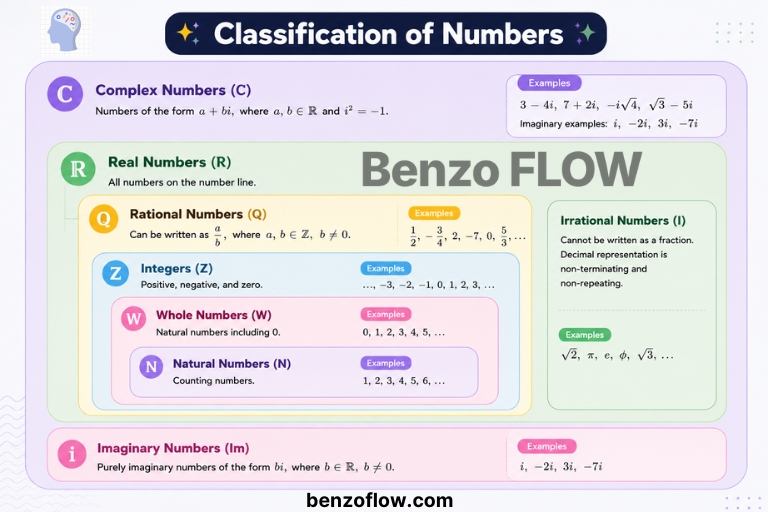
Set theory is closely connected to the number system because different kinds of numbers can themselves be organized into sets. You will often see symbols such as N, Z, Q, and R throughout mathematics, so understanding what each one represents is important.
These number sets are also nested, meaning that one set is contained within another. Understanding this hierarchy makes it easier to see how different types of numbers are related.
Natural Numbers (ℕ)
The natural numbers are the numbers commonly used for counting.
A common definition is: ℕ = {1,2,3,4,5,…}
Natural numbers continue indefinitely: 1,2,3,4,5,…
They are used for counting objects, positions, quantities, and other discrete values.
For example, if there are 5 books on a table, the number of books is represented by the natural number: 5
Does 0 Belong To The Natural Numbers?
There is a convention difference here. Some textbooks define natural numbers as: ℕ = {1,2,3,…}
while others include zero: ℕ = {0,1,2,3,…}
Because both conventions are used, it is important to check which definition a particular textbook or course follows.
In this guide, we use: ℕ = {1,2,3,…}
and treat zero as a whole number.
Whole Numbers (𝕎)
The whole numbers are the natural numbers together with zero.
Using the convention above: 𝕎 = {0,1,2,3,4,5,…}
So the main difference between natural numbers and whole numbers in this convention is the inclusion of 0.
For example: 0 ∈ 𝕎
but: 0 ∉ ℕ
Therefore: ℕ ⊆ 𝕎
Whole numbers are useful for representing quantities that can include zero but do not include negative numbers or fractions.
Integers (ℤ)
The integers include all positive whole numbers, zero, and their negative counterparts.
They are represented by: ℤ
and can be written as: ℤ = {…,−3,−2,−1,0,1,2,3,…}
For example: −5,−1,0,4,12
are all integers.
However: 1/2
is not an integer.
Similarly: 2.5
is not an integer.
The integers are especially useful when dealing with quantities that can move in either direction, such as temperature changes, elevations, profits and losses, or positions on a number line.
Because every whole number is an integer: 𝕎 ⊆ ℤ
Rational Numbers (ℚ)
A rational number is any number that can be written as a ratio of two integers:p/q
where: p,q ∈ ℤ
and: q ≠ 0
The set of rational numbers is represented by: ℚ
Examples include: 21,43,−5,0,2.75
Integers are also rational numbers because every integer can be written as a fraction with denominator 1.
For example: 5 = 5/1
and: −3 = −3/1
Therefore: ℤ ⊆ ℚ
Rational Numbers And Decimal Expansions
A rational number has a decimal expansion that either terminates or repeats indefinitely.
For example: 1/2 = 0.5
terminates, while: 1/3 = 0.333…
has a repeating decimal expansion.
Another example is: 2/11 = 0.181818…
which repeats.
Irrational Numbers
An irrational number is a real number that cannot be expressed as a ratio of two integers.
In other words, there do not exist integers p and q, with q ≠ 0, such that: x = p/q
Some common examples are: 2,3,π,e
Their decimal expansions are non-terminating and non-repeating.
For example: √2 = 1.41421356…
The digits continue indefinitely without settling into a repeating pattern.
Rational Vs Irrational Numbers
The rational and irrational numbers together make up the real numbers.
Every real number is either rational or irrational: ℝ = ℚ ∪ {irrational numbers}
and: ℚ ∩ {irrational numbers} = ∅
So rational and irrational numbers do not overlap.
Real Numbers (ℝ)
The real numbers include all rational and irrational numbers.
They are represented by: ℝ
Examples include: −5, 0, 21, 2.75, 2, π
Real numbers can be represented as points on the real number line.
The real numbers include:
- Natural numbers
- Whole numbers
- Integers
- Rational numbers
- Irrational numbers
Therefore: ℚ ⊆ ℝ
and the irrational numbers are also contained within ℝ.
Numbers such as 4i (an imaginary number), which are not real, do not belong to ℝ.
Complex Numbers
The complex numbers extend the real number system by introducing the imaginary unit: i = √(−1)
A complex number has the general form: a+bi
where a and b are real numbers.
For example: 3 + 2i
is a complex number.
So are: 5, −2, 4i, 7−3i
Real numbers are actually a special type of complex number. Any real number a can be written as: a+0i
For example: 5 = 5 + 0i
Complex numbers are especially important in areas such as algebra, calculus, electrical engineering, signal processing, physics, and control systems.
The Relationship Between The Number Sets
The common number sets form a hierarchy: ℕ ⊂ 𝕎 ⊂ ℤ ⊂ ℚ ⊂ ℝ ⊂ ℂ
This means that each set is contained within the next larger set.
For example: ℕ ⊂ 𝕎
means every natural number is also a whole number.
Similarly: ℤ ⊂ ℚ
means every integer is also a rational number.
And: ℚ ⊂ ℝ
means every rational number is a real number.
Finally: ℝ ⊂ ℂ
means every real number is also a complex number.
A Number Can Belong To Multiple Sets
A single number can belong to several of these sets at the same time.
For example: 5 ∈ N
Since every natural number is also a whole number: 5 ∈ W
It is also an integer: 5 ∈ Z
and a rational number: 5 ∈ Q
because: 5 = 5/1
It is also a real number: 5 ∈ R
and a complex number: 5 ∈ C
So one number can belong to several nested number sets.
Number Sets At A Glance
| Number set | Symbol | Description | Examples |
|---|---|---|---|
| Natural numbers | ℕ | Positive counting numbers under the convention used here | 1,2,3,… |
| Whole numbers | 𝕎 | Natural numbers together with 0 | 0,1,2,3,… |
| Integers | ℤ | Positive and negative whole numbers, including 0 | …,−2,−1,0,1,2,… |
| Rational numbers | ℚ | Numbers expressible as p/q, where p,q∈Z and q=0 | 21,−3,0.75 |
| Irrational numbers | — | Real numbers that cannot be written as p/q | 2,π,e |
| Real numbers | ℝ | All rational and irrational numbers | 3,−2,21,2,π |
| Complex numbers | ℂ | Numbers of the form a+bi | 3+2i,5i,−1 |
An Important Point About The Hierarchy
The chain: ℕ ⊂ 𝕎 ⊂ ℤ ⊂ ℚ ⊂ ℝ ⊂ ℂ
does not mean that every number in one set belongs to every category in the same way.
For example: 1/2 ∈ ℚ
but: 1/2 ∉ ℤ
because 1/2 is not an integer.
Likewise: √2 ∈ ℝ
but: √2 ∉ ℚ
because √2 is irrational.
And: 2i ∈ ℂ
but: 2i ∉ ℝ
because i = √(−1) is not a real number.
Understanding these distinctions helps you determine which number set a particular number belongs to.
Why These Sets Matter In Set Theory
These standard number sets provide familiar examples of subsets and set relationships.
For example: ℕ ⊂ ℤ
illustrates a subset relationship, while: ℚ ⊂ ℝ
shows that every rational number is also a real number.
They also appear frequently when using set-builder notation. For example, the set of positive even integers can be written as: A = {x ∈ Z ∣ x > 0 and x is even}
Similarly, the real numbers between 0 and 1 can be written as: B = {x ∈ R ∣ 0 < x < 1}
So learning these standard number sets will make later topics such as set-builder notation, subsets, intervals, functions, relations, probability, and calculus much easier to understand.
If you want to explore these number sets in greater detail, including their definitions, properties, examples, and relationships, read our complete guide to All Types of Numbers.
Set Notations
Set theory uses a collection of symbols to express mathematical ideas clearly and concisely. Instead of repeatedly explaining relationships in words, we can use symbols to show whether something belongs to a set, whether one set is contained within another, how many elements a set has, and what subsets a set contains.
Learning these symbols is essential because they appear throughout set theory and later become useful when studying relations, functions, probability, logic, and discrete mathematics.
Curly Braces: { }
Curly braces are used to indicate the elements of a set.
For example: A = {1,2,3,4,5}
Here, the curly braces show that 1,2,3,4, and 5 are being considered together as one set.
Another example is: V = {a,e,i,o,u}
Where V is the set of vowels.
Curly braces can also be used to represent a set containing just one element: A = {7}
This is called a singleton set because it contains exactly one element.
Order Does Not Matter
In set notation, changing the order of the elements does not create a different set: {1,2,3} = {3,2,1}
Both expressions represent the same set.
Repeated Elements Are Ignored
If an element is written more than once, it is still considered only one element: {1,2,2,3,3} = {1,2,3}
Therefore, curly braces represent a collection of distinct elements, rather than an ordered list.
Membership Symbols: ∈ And ∉
The symbols ∈ and ∉ are used to show whether an object is an element (member) of a set.
- ∈ = is an element of / belongs to
- ∉ = is not an element of / does not belong to
For example, if: A = {1,2,3,4,5} Then: 3 ∈ A
Means 3 is an element of A, while: 7 ∉ A
Means 7 is not an element of A.
Important Distinction
Membership symbols are used between an element and a set: 3 ∈ A
They should not be confused with subset notation: {3} ⊆ A
Here, 3 is an element of A, whereas {3} is a set that is a subset of A.
For example, if: A = {1,2,3} then: 3 ∈ A is true, but: {3} ∈ A is false because A contains the number 3, not the set {3}.
However: {3} ⊆ A is true.
In short: ∈ and ∉ answer the question “Does this object belong to this set?”
Equality And Inequality: = And ≠
The symbols = and ≠ are used to compare two mathematical objects and indicate whether they are equal or different.
- = means is equal to
- ≠ means is not equal to
For sets, two sets are equal if they contain the same elements. The order of the elements does not matter, and repeating an element does not create a new element.
For example: A = {1,2,3}
and: B = {3,2,1}
Then: A = B
because both sets contain the same elements.
Similarly: {1,2,2,3} = {1,2,3}
because repeated elements are ignored in sets.
On the other hand: {1,2,3} ≠ {1,2,4}
because the two sets do not contain the same elements.
Subset Symbols: ⊆ And ⊂
Subset notation is used to describe how one set is contained within another set. Unlike the membership symbol ∈, which connects an element to a set, subset symbols always describe a relationship between two sets.
- ⊆ = is a subset of
- ⊂ = is a proper subset of when this notation is used for strict inclusion
Subset: ⊆
A set A is a subset of a set B if every element of A is also an element of B.
For example:
A = {1,2}, B = {1,2,3,4}
Since both 1 and 2 are elements of B : A ⊆ B
In other words, there is no element in A that is outside B.
A useful way to think about it is:
If you can find even one element of A that is not in B, then A is not a subset of B.
For example:
A = {1,2,5}, B = {1,2,3,4}
Here: A ⊈ B
because 5 ∈ A, but 5 ∉ B
A Set Can Be a Subset of Itself
Every set is a subset of itself: A⊆A
For example: {1,2,3} ⊆ {1,2,3} is true.
This is because every element of the set is obviously contained in the same set.
The empty set is also a subset of every set: ∅ ⊆ A for any set A.
Proper Subset: ⊂
A proper subset is a subset that is strictly smaller than the set it is contained in.
If: A ⊂ B, then two conditions must be true:
- Every element of A is in B.
- A ∉ B.
For example: A = {1,2}, B = {1,2,3}
Therefore: A ⊂ B, because every element of A is in B, and A does not contain all the elements of B.
But: A ⊂ A is false when ⊂ means proper subset, because a set cannot be a proper subset of itself.
Subset ⊆ Vs Proper Subset ⊂
The easiest way to remember the difference is: A ⊆ B allows: A = B
While: A ⊂ B does not allow: A = B
For example, if: A = {1,2,3}, then: A ⊆ {1,2,3} is true.
But A ⊂ {1,2,3} is false because the two sets are equal.
Subset Vs Membership
This is one of the most important distinctions in elementary set theory.
Suppose: A = {1,2,3}
Then: 1 ∈ A means 1 is an element of A.
But: {1} ⊆ A means the set {1} is a subset of A.
These statements are different because 1 is a number, while {1} is a set containing that number.
So: 1 ∈ A
and: {1} ⊆ A
are both true, but they express different relationships.
You should not write: 1 ⊆ A
because 1 is not being treated as a set here.
Likewise, you should not replace: 1 ∈ A
with: {1} ∈ A
because {1} is a different object from 1.
Superset Symbols: ⊇ And ⊃
Superset notation describes the same containment relationship as subset notation, but from the opposite direction. If one set contains every element of another set, the larger set is called a superset.
- ⊇ — is a superset of
- ⊃ — is a proper superset of when used for strict inclusion
Superset: ⊇
A set B is a superset of A if every element of A is also an element of B.
For example: A = {1,2}, B = {1,2,3,4}
Since every element of A is contained in B: B ⊇ A
This is the same relationship as: A ⊆ B
So: A ⊆ B ⟺ B ⊇ A
The difference is simply the direction in which we describe the relationship.
Proper Superset: ⊃
A set B is a proper superset of A if:
- Every element of A is also in B, and
- A and B are not equal.
For example: A = {1,2} and B = {1,2,3}
Then: B ⊃ A, because B contains every element of A, plus at least one additional element.
Equivalently: A ⊂ B
Superset Vs Proper Superset
The key difference is whether the two sets are allowed to be equal. B ⊇ A allows: B=A
While: B ⊃ A requires: B ≠ A
For example, if: A = {1,2,3} then: A ⊇ A is true because every set is a superset of itself.
But: A ⊃ A is false when ⊃ means proper superset.
Subset And Superset Are Opposite Directions
If: A ⊆ B then automatically: B ⊇ A
Likewise, if: A ⊂ B then: B ⊃ A
For example: {1,2} ⊆ {1,2,3} can be written in the opposite direction as: {1,2,3} ⊇ {1,2}
Both statements express the same containment relationship.
| Symbol | Meaning | Example |
|---|---|---|
| ⊆ | Subset; equality allowed | A ⊆ B |
| ⊂ | Proper subset; equality not allowed | A ⊂ B |
| ⊇ | Superset; equality allowed | B ⊇ A |
| ⊃ | Proper superset; equality not allowed | B ⊃ A |
Empty Set: ∅
The symbol ∅ represents the empty set, which is a set containing no elements.
It can also be written as: {}
Therefore: ∅ = {}
The cardinality of the empty set is: ∣∅∣ = 0
For example, consider the set of positive integers smaller than 0: A={x ∈ N: x<0}
There are no positive integers satisfying this condition, so: A = ∅
Empty Set Vs Zero
The empty set is not the same thing as zero. ∅ ≠ 0
The symbol 0 represents a number, while ∅ represents a set containing no elements.
Similarly: ∅ ≠ {0} because {0} contains one element, namely 0.
Therefore: ∣∅∣ = 0, but: ∣{0}∣ = 1
This is a very common beginner mistake.
Cardinality: ∣A∣
The notation: ∣A∣ represents the cardinality of a set A.
For a finite set, cardinality simply means the number of distinct elements in the set.
For example: A = {2,4,6,8,10} contains five elements, so: ∣A∣ = 5
Similarly: B = {a,b,c} has: ∣B∣ = 3
Repeated elements are counted only once.
For example: A = {1,1,2,2,3,3} is equivalent to: A = {1,2,3}
Therefore: ∣A∣ = 3
Cardinality of the empty set
Because the empty set contains no elements: ∣∅∣ = 0
Cardinality becomes even more interesting when we study infinite sets, where mathematicians can compare different sizes of infinity.
Power Set: P(A)
The notation: P(A) represents the power set of A.
The power set is the set containing every possible subset of A.
Suppose: A = {1,2}
The subsets of A are: ∅ {1} {2} {1,2}
Therefore: P(A) = {∅,{1},{2},{1,2}}
Notice something important: the elements of the power set are themselves sets.
Since A contains two elements, its power set contains:2² = 4 elements.
In general, if a finite set A has n elements, then: ∣P(A)∣ = 2ⁿ
For example, if: ∣A∣ = 3, then: ∣P(A)∣ = 2³ = 8
So a set with 3 elements has 8 different subsets.
Why Does The Power Set Have 2ⁿ Elements?
For each element, there are two possibilities when constructing a subset:
- Include the element.
- Do not include the element.
If there are n elements, there are therefore: 2×2×⋯×2=2ⁿ possible combinations.
This makes the power set an important concept later in combinatorics, probability, relations, and discrete mathematics.
Set Notation At A Glance
Here are the essential symbols covered in this section:
| Symbol | Meaning | Example |
|---|---|---|
| {} | Set brackets | A = {1,2,3} |
| ∈ | Is an element of | 2 ∈ A |
| ∉ | Is not an element of | 5 ∉ A |
| = | Is equal to | A = B |
| ≠ | Is not equal to | A ≠ B |
| ⊆ | Is a subset of | A ⊆ B |
| ⊂ | Is a proper subset of* | A ⊂ B |
| ⊇ | Is a superset of | B ⊇ A |
| ⊃ | Is a proper superset of* | B ⊃ A |
| ∅ | Empty set | A = ∅ |
| P(A) | Power set of A | P(A) = {∅,…} |
Final Takeaway
These symbols form the basic vocabulary of set theory.
If: A = {1,2,3} then: 1 ∈ A tells us that 1 is an element of A.
If: B = {1,2,3,4,5} then: A ⊆ B tells us that every element of A is also an element of B.
The notation: ∣A∣ tells us how many elements A contains, while: P(A) gives us the collection of all subsets of A.
Once these symbols become familiar, the rest of elementary set theory becomes much easier to read and understand. The next major step is learning the different ways to represent a set, particularly roster form, set-builder form, and descriptive form.
Ways to Represent Sets
Sets can be represented in different ways depending on the type of information you want to show. The four common methods are roster form, set-builder form, descriptive form, and interval notation.
Understanding these forms is essential because the same set can often be written in more than one way.
Roster Form (Tabular Form)
Roster form, also called tabular form, represents a set by explicitly listing its elements inside curly braces { }.
Example
The set of the first five natural numbers can be written as: A = {1,2,3,4,5}
Each number inside the braces is an element of the set.
Important Rules
- Separate elements with commas.
- Enclose the elements in curly braces { }.
- The order of elements does not matter.
For example, {1,2,3} = {3,1,2}
- Repeated elements are written only once: {1,2,2,3,3} = {1,2,3}
When to Use Roster Form
Roster form is most useful when a set has few or easily listable elements.
For example: B = {a,e,i,o,u}
However, listing every element becomes impractical for large or infinite sets.
Set-Builder Form
When a set contains many elements, listing every element individually can become difficult or even impossible. Set-builder notation provides a compact way to describe a set by stating a condition that its elements must satisfy.
Instead of listing the elements, we describe the rule that determines which objects belong to the set.
For example, the positive integers can be written as: A = {1,2,3,4,5,…}
Using set-builder notation, the same idea can be expressed more compactly as: A = {x ∈ Z ∣ x>0}
This means:
A is the set of all integers x such that x is greater than 0.
Basic Structure of Set-Builder Notation
A general set-builder expression can be written as: A = {x ∣ P(x)}
Here, each part has a specific meaning:
- A → the name of the set
- { } → curly braces showing that we are describing a set
- x → the variable representing an element of the set
- ∣ → means “such that”
- P(x) → the condition that x must satisfy
For example: A={x ∣ x>0}
can be read as:
A is the set of all x such that x>0.
The condition x > 0 determines which values are included in the set.
Specifying the Type of Number
It is often useful to specify what type of number x represents.
For example: A = {x ∈ Z ∣ x>0}
Here: x ∈ Z means that x must be an integer.
Therefore, the set contains: A = {1,2,3,4,5,…}
If we instead write: B = {x ∈ R ∣ x>0} then x can be any positive real number, including numbers such as: 21,2,π
So the number system specified after x∈ can significantly change the set.
The Meaning of the Vertical Bar ∣
The vertical bar: ∣ is read as “such that.”
For example: A = {x ∈ Z ∣ x>5} is read as:
A is the set of all integers x such that x > 5.
The vertical bar separates two important parts: what x can be x ∈ Z ∣ condition x must satisfy (x > 5)
The first part identifies the universe or type of objects being considered, while the second part specifies the condition those objects must satisfy.
The Colon Can Also Be Used
The vertical bar is not the only notation used for “such that.” A colon can also be used.
For example: A = {x ∈ Z ∣ x>0} can also be written as: A = {x ∈ Z : x>0}
These expressions have the same meaning.
Both say:
The set of all integers x such that x>0.
You may therefore encounter both ∣ and : in textbooks, websites, and mathematical writing.
Example 1: Positive Integers
Suppose we want to describe the set of all positive integers.
In roster form: A = {1,2,3,4,5,…}
In set-builder form: A = {x ∈ Z ∣ x>0}
The expression tells us:
- x is an integer.
- x must be greater than 0.
- Every integer satisfying the condition belongs to A.
Example 2: Even Integers
Suppose we want the set of all even integers.
We can write: A = { x ∈ Z ∣ x is even}
This describes: {…,−6,−4,−2,0,2,4,6,…}
We could also describe an even integer using a formula: A = {2n ∣ n ∈ Z}
Both forms describe the set of even integers, although the second uses the fact that every even integer can be written as 2n.
Example 3: Real Numbers Between 2 and 5
Suppose we want the set of all real numbers between 2 and 5, including 2 and 5.
We can write: A = {x ∈ R ∣ 2≤x≤5}
This includes numbers such as: 2,2.5,3,10,4.99,5 but excludes values such as: 1,5.5,10
The inequalities are important: 2≤x≤5 means that both endpoints are included.
In interval notation, the same set can be written as: A = [2,5]
Example 4: Real Numbers Between 2 and 5, Excluding the Endpoints
If we want only the real numbers strictly between 2 and 5, we use: A = {x ∈ R ∣ 2<x<5}
Here, 2 and 5 are not included.
In interval notation: A = (2,5)
Notice the difference: 2≤x≤5 includes the endpoints, while: 2<x<5 excludes them.
Example 5: Multiples of 3
The set of all integers that are multiples of 3 can be written as: A = {x ∈ Z ∣ x = 3n, n ∈ Z}
This represents: {…,−9,−6,−3,0,3,6,9,…}
Every element can be obtained by choosing an integer value for n.
Example 6: Numbers Less Than 10
The set of natural numbers less than 10 can be written as: A = {x ∈ N ∣ x<10}
Using the convention in this guide that: N = {1,2,3,…} the set is: A = {1,2,3,4,5,6,7,8,9}
Example 7: Square Numbers
The set of non-negative square integers can be described as: A = {x ∈ Z ∣ x = n², n ∈ Z}
which gives: A = {0,1,4,9,16,25,…}
The condition provides a rule for generating every element of the set.
Descriptive Form
Descriptive form represents a set by describing its elements in words.
It is the simplest form when the defining property of a set can be clearly expressed in ordinary language.
Example
Instead of writing: A = {1,3,5,7,9}
you can describe it as:
A is the set of odd natural numbers less than 10.
Similarly, B = {a,e,i,o,u}
can be described as:
B is the set of vowels in the English alphabet.
When to Use Descriptive Form
Descriptive form is especially useful for introducing or explaining a set in words before expressing it mathematically.
However, it may be less precise than set-builder notation when the defining condition is complicated.
Interval Notation
Interval notation is mainly used to represent sets of real numbers that form a continuous range.
Instead of writing every number in a range, interval notation uses parentheses ( ) and brackets [ ] to indicate whether endpoints are excluded or included.
Basic Examples
The set of real numbers from 2 to 5, including both endpoints, is: [2,5]
This means: 2≤x≤5
The set of real numbers between 2 and 5, excluding both endpoints, is: (2,5)
This means: 2<x<5
Including One Endpoint
If 2 is included but 5 is excluded: [2,5), which means: 2≤x<5
If 2 is excluded but 5 is included: (2,5] which means: 2<x≤5
Infinity in Interval Notation
Infinity is always written with a parenthesis, because infinity is not a real number and cannot be included as an endpoint.
For example: (3,∞) means: x>3
And: (−∞,4] means: x≤4
Roster vs Set-Builder vs Descriptive vs Interval
Consider the set of even natural numbers less than 10.
Roster Form, A = {2,4,6,8}
Set-Builder Form, A = {x ∈ N ∣ x is even and x<10}
Descriptive Form,
A is the set of even natural numbers less than 10.
Interval Notation,
Interval notation is not appropriate for this set because the elements are discrete rather than a continuous range of real numbers.
This distinction is important: interval notation is generally used for continuous subsets of the real numbers, not for sets such as {2, 4, 6, 8}.
Can the Same Set Be Represented in Different Ways?
Yes. A set can often be expressed using multiple representations.
For example, the set of real numbers between 1 and 4, including both endpoints, can be written as:
Descriptive form:
The real numbers from 1 to 4, inclusive.
Set-builder form: A = {x ∈ R ∣ 1≤x≤4}
Interval notation: A = [1,4]
Each representation describes the same set, but each emphasizes something different.
| Representation | Main Idea | Best Used For |
|---|---|---|
| Roster / Tabular | List the elements | Small or finite sets |
| Set-Builder | State a defining rule | Large or infinite sets |
| Descriptive | Explain in words | Simple descriptions |
| Interval | Show a continuous range | Subsets of real numbers |
Venn Diagrams
A Venn diagram is a visual way to represent sets and show the relationships between them. Instead of describing sets only with mathematical symbols, a Venn diagram uses circles or other closed shapes to make it easier to see which elements belong to which sets and which sets overlap.
Venn diagrams are especially useful for understanding unions, intersections, complements, differences, subsets, and disjoint sets.
The Basic Structure Of A Venn Diagram
A typical Venn diagram has a few important parts.
Universal Set
The universal set is represented by a rectangle surrounding the entire diagram.
It is usually denoted by: U
The universal set contains all the objects under consideration in a particular problem.
For example, suppose: U = {1,2,3,4,5,6,7,8} and A = {1,2,3,4}
Everything being considered belongs somewhere inside U, whether it is also an element of A or not.
The rectangle represents U, while the circles inside it represent individual sets.
Sets As Circles
A set is commonly represented by a closed circle or oval inside the universal-set rectangle.
For example: A = {1,2,3,4} can be represented by a circle labeled A.
The elements of A are placed inside the circle.
Elements of the universal set that do not belong to A are placed outside the circle but inside the rectangle.
This gives us a simple visual rule:
Inside the set → belongs to the set.
Outside the set → does not belong to the set.
Using Two Sets
Let’s use the following two sets throughout this section: A = {1,2,3,4} and B = {3,4,5,6}
Notice that both sets contain 3 and 4.
So: A ∩ B = {3,4}
These common elements are represented by the overlapping region of the two circles.
The elements 1 and 2 belong only to A, while 5 and 6 belong only to B.
Conceptually, the diagram can be understood as:
- A-only region: 1,2
- Overlap: 3,4
- B-only region: 5,6
This simple arrangement allows us to visualize several set operations.
Elements Inside And Outside A Set
Suppose A = {1,2,3,4}
An element such as 2 is placed inside the circle representing A: 2 ∈ A
An element such as 7, if it belongs to the universal set but not to A, is placed outside the circle: 7 ∉ A
So a Venn diagram visually represents membership.
If an element is inside a circle, it belongs to that set.
If it is outside the circle, it does not belong to that set.
Intersection
The intersection of two sets consists of the elements that belong to both sets.
The symbol for intersection is: ∩
For our sets: A = {1,2,3,4} and B={3,4,5,6}
The common elements are 3 and 4.
Therefore: A ∩ B = {3,4}
In a Venn diagram, the intersection is the overlapping region of the two circles.
A useful way to remember it is:
Intersection = what the sets have in common.
Union
The union of two sets contains every element that belongs to either set or both sets.
The symbol for union is: ∪
Using our example: A = {1,2,3,4} and B = {3,4,5,6}
We get: A ∪ B = {1,2,3,4,5,6}
Notice that 3 and 4 are written only once, even though they occur in both sets.
In a Venn diagram, the union is represented by the entire area covered by both circles, including their overlapping region.
A useful way to remember it is:
Union = everything in the sets combined.
Complement
The complement of a set contains all the elements in the universal set that are not in that set.
The complement of A is commonly written as: Aᶜ
Suppose the universal set is: U = {1,2,3,4,5,6,7,8} and A = {1,2,3,4}
Then: Aᶜ = {5,6,7,8}
In a Venn diagram, Ac is represented by everything inside the universal-set rectangle but outside the circle for A.
The universal set is important here because the complement depends on what objects are being considered.
Difference Of Sets
The difference between two sets contains the elements that belong to one set but not the other.
The difference A − B means:
Elements that are in A but not in B.
Using: A = {1,2,3,4} and: B = {3,4,5,6}
We get: A − B = {1,2}
Similarly: B − A = {5,6}
In a Venn diagram:
- A − B is the part of A that does not overlap with B.
- B − A is the part of B that does not overlap with A.
The order matters: A − B ≠ B − A in general.
Overlapping Sets
Two sets overlap, or intersect, when they have at least one element in common.
For our example: A = {1,2,3,4} and B = {3,4,5,6}
We have : A ∩ B = {3,4}
Since the intersection is not empty, A ∩ B ≠ ∅ , the sets overlap.
In a Venn diagram, overlapping sets are shown as two circles that intersect.
The overlapping region represents their common elements.
Disjoint Sets
Two sets are disjoint if they have no elements in common.
For example: A = {1,2,3} and: B = {4,5,6} have no common elements.
Therefore: A ∩ B = ∅
In a Venn diagram, disjoint sets are represented by separate circles that do not overlap.
A useful way to remember this is:
Disjoint sets have an empty intersection.
Subsets In Venn Diagrams
Venn diagrams can also show subset relationships.
Suppose: A = {1,2,3,4} and B = {1,2}
Every element of B is also an element of A.
Therefore: B ⊆ A
In a Venn diagram, the circle representing B is drawn completely inside the circle representing A.
This provides an intuitive way to understand subsets:
If one set’s entire circle fits inside another set’s circle, the inner set is a subset of the outer set.
If: B ⊆ A then every element of B is also an element of A.
Three-Set Venn Diagrams
Venn diagrams can represent more than two sets. With three sets, the diagram contains several regions showing different combinations of membership.
Suppose we have: A, B, C
A three-set Venn diagram can show: A ∩ B, A ∩ C, B ∩ C, and the common intersection: A ∩ B ∩ C
The center region represents elements that belong to all three sets.
For example, suppose:
A = {students who study mathematics}
B = {students who study physics}
C = {students who study computer science}
Then: A ∩ B ∩ C represents students who study all three subjects.
A three-set Venn diagram is particularly useful when several groups overlap, and you need to determine which elements satisfy multiple conditions simultaneously.
Venn Diagrams And Set Operations At A Glance
Venn diagrams make the main set operations easier to visualize:
| Set concept | Symbol | Venn diagram region |
|---|---|---|
| Union | A ∪ B | Everything inside A or B |
| Intersection | A ∩ B | The overlapping region |
| Difference | A − B | The part of A outside B |
| Complement | Aᶜ | Everything outside A but inside U |
| Disjoint sets | A ∩ B = ∅ | Circles do not overlap |
| Subset | B ⊆ A | B is completely inside A |
This makes Venn diagrams more than just pictures; they provide a visual interpretation of set notation and set operations.
A Simple Example Using Everything
Consider the universal set: U = {1,2,3,4,5,6,7,8}
With: A = {1,2,3,4} and: B = {3,4,5,6}
From the Venn diagram, we can identify:
Elements Only In A
A − B = {1,2}
Elements Common To A And B
A ∩ B = {3,4}
Elements Only In B
B − A = {5,6}
Elements In Either Set
A ∪ B = {1,2,3,4,5,6}
Elements Outside Both Sets
(A ∪ B)ᶜ = {7, 8}
The entire rectangle represents U, the two circles represent A and B, and each region tells us something about the relationships between the sets.
Why Venn Diagrams Are Useful
Venn diagrams are useful because they turn abstract set notation into something that can be seen and compared visually.
They are especially helpful when:
- Finding intersections
- Finding unions
- Finding complements
- Finding set differences
- Identifying overlapping sets
- Identifying disjoint sets
- Understanding subsets
- Solving counting problems
- Solving probability problems
- Working with two or three groups simultaneously
Once you understand how each region of a Venn diagram corresponds to a set operation, expressions such as: (A ∪ B)ᶜ or: A ∩ (B ∪ C)
become much easier to interpret.
Venn diagrams therefore provide an important bridge between set notation, set operations, and visual reasoning.
Types of Sets
Sets can look very different depending on how many elements they contain and how those elements relate to other sets. A set might contain nothing, exactly one element, a small finite collection, or infinitely many elements. Two sets may contain the same elements, have the same number of elements without being identical, or have no elements in common at all.
Understanding these different types of sets is an essential part of set theory because the same set can often belong to more than one category at the same time.
For example, A = {5}
Is a singleton set because it has exactly one element. It is also a finite set because one is a finite number. And, of course, it is a non-empty set because it contains an element.
In this guide, we will examine the major types of sets one by one, with definitions, examples, notation, important properties, and common points of confusion.
Empty Set / Null Set — ∅
The empty set is a set that contains no elements.
It is commonly represented by: ∅
It can also be written using empty braces: {}
Therefore: ∅ = {}
The empty set is also called the null set or void set.
Example
Consider the set of natural numbers less than 0: A={x ∈ N :x<0}
There are no natural numbers less than 0, so: A = ∅
Another example is the set of months containing 32 days: B = {months with 32 days}
Since no month has 32 days: B = ∅
Cardinality Of The Empty Set
Because the empty set contains no elements: ∣∅∣ = 0
This is its cardinality.
Empty Set Is Still A Set
The empty set may contain nothing, but it is still a set.
This is an important idea for beginners. “Empty” does not mean “does not exist.” It means the set exists but has zero elements.
Empty Set Vs Zero
The empty set and zero are completely different: ∅ ≠ 0
Here:
- 0 is a number.
- ∅ is a set.
Similarly: ∅ ≠ {0}
The set {0} contains one element, the number 0.
Therefore: ∣∅∣ = 0 but: ∣{0}∣ = 1
This distinction is extremely important.
Empty Set Is a Subset of Every Set
One of the fundamental properties of the empty set is: ∅⊆A for every set A.
For example, if: A = {1,2,3} then: ∅ ⊆ A is true.
The reason is simple: a subset requires every element of the smaller set to also belong to the larger set. Since the empty set has no elements that could violate this condition, it is a subset of every set.
Singleton Set / Unit Set
A singleton set, also called a unit set, is a set containing exactly one element.
If A is a singleton, then: ∣A∣ = 1
Examples
A = {5}
Is a singleton set because it contains only the element 5.
Another example is:
B = {Earth}
This is a singleton containing the object “Earth.”
We can also have a singleton whose only element is another set: C = {{1,2,3}}
Here, C contains exactly one element: {1,2,3}
Notice the difference between: {1,2,3} and: {{1,2,3}}
The first set has three elements: 1, 2, 3
The second set has one element, which happens to be another set.
Therefore: ∣{1,2,3}∣ = 3 while: ∣{{1,2,3}}∣ = 1
Singleton Vs Empty Set
A singleton contains exactly one element: ∣{a}∣ = 1
An empty set contains no elements: ∣∅∣ = 0
Therefore: {a} ≠ ∅
Every Singleton Is Finite
Because a singleton contains one element, it is automatically a finite set.
So: Singleton ⊂ Finite Sets
In the sense that every singleton is a finite set.
Finite Set
A finite set is a set containing a finite number of distinct elements.
In other words, if we can count all the elements of a set and obtain some non-negative integer n, then the set is finite.
For a finite set A: ∣A∣ = n for some non-negative integer n.
Examples
The set: A = {1,2,3,4,5} is finite because: ∣A∣ = 5
Similarly: B = {a,b,c} has: ∣B∣ = 3 and is therefore finite.
The empty set is also finite: ∣∅∣ = 0
A singleton is also finite: ∣{7}∣ = 1
Finite Sets Can Be Large
“Finite” does not mean “small.”
For example, the set: A = {1,2,3,…,1,000,000}
Is still finite because it contains a definite number of elements: ∣A∣ = 1,000,000
The important characteristic is not how large the set is, but whether its number of elements is finite.
Repeated Elements Do Not Increase Cardinality
Consider: A = {1,2,2,3,3,3}
As a set, this is simply: A = {1,2,3}
Therefore: ∣A∣ = 3 not 6.
Infinite Set
An infinite set is a set that contains infinitely many elements.
Unlike a finite set, its elements cannot be completely counted using a finite number.
Example: Natural Numbers
The set of natural numbers is infinite: ℕ = {1,2,3,4,5,…}
The dots indicate that the pattern continues indefinitely.
There is no largest natural number, because whenever we choose a natural number n, we can always find a larger one: n+1
Therefore, ℕ is infinite.
Other Examples
The integers: ℤ = {…,−3,−2,−1,0,1,2,3,…} are infinite.
The rational numbers Q are also infinite.
The real numbers R are infinite as well.
Even a restricted-looking set can be infinite.
For example: A = {2,4,6,8,…} is the set of positive even integers and is infinite.
Finite vs Infinite
The basic distinction is:
| Type | Number of elements |
|---|---|
| Empty set | 0 |
| Singleton | 1 |
| Finite set | Some finite integer n |
| Infinite set | Infinitely many |
One interesting point is that infinite sets can have different sizes of infinity. For example, the natural numbers and real numbers are both infinite, but they do not have the same cardinality.
That topic belongs to more advanced set theory, where we study countable and uncountable sets.
Non-Empty Set
A non-empty set is simply a set containing at least one element.
In terms of cardinality: ∣A∣≥1
A set is non-empty if: A ≠ ∅
Examples
A = {1}
Is non-empty.
B = {2,4,6,8}
Is also non-empty.
An infinite set such as: ℕ = {1,2,3,…}
Is also non-empty.
Non-Empty Is Not a Completely Separate Size Category
“Non-empty” tells us only that the set contains at least one element. It does not tell us how many elements it contains.
A non-empty set could be:
- A singleton
- A finite set with many elements
- An infinite set
For example:
{5} is non-empty and finite.
{1,2,3,4,5} is non-empty and finite.
ℕ is non-empty and infinite.
So a single set can belong to several categories at the same time.
Universal Set
The universal set is the set containing all objects under consideration in a particular problem or discussion.
It is usually represented by: U
The important phrase here is “under consideration.”
There is no single universal set that contains absolutely everything in every mathematical problem. The universal set depends on the context.
Example
Suppose we are discussing the numbers from 1 to 10.
We might define: U = {1,2,3,4,5,6,7,8,9,10}
Now consider the set of even numbers: A = {2,4,6,8,10}
Clearly: A ⊆ U
The universal set U provides the complete collection from which we are considering our sets.
Another Example
Suppose a class has 30 students and we are analyzing their test results.
We might define: U = {all 30 students in the class}
Then: A = {students who scored above 80}
Is a subset of U and A ⊆ U
Universal Set and Complement
The universal set is especially important when studying complements.
If: U = {1,2,3,4,5,6} and A = {2,4,6}
Then the complement of A, written as Aᶜ, contains the elements of U that are not in A: Aᶜ = {1,3,5}
Notice that the complement depends on the universal set.
If we changed U, the complement could also change.
Universal Set Is Context-Dependent
Suppose: A = {1,2,3}
If our universal set is: U = {1,2,3,4,5} then: Aᶜ = {4,5}
But if: U = {1,2,3,4,5,6,7} then Aᶜ = {4,5,6,7}
So the universal set establishes the boundary of the discussion.
Equal Sets
Two sets are called equal sets if they contain the same elements.
If sets A and B are equal, we write: A = B
The order in which elements are written does not matter.
Example
Suppose: A = {1,2,3} and: B = {3,1,2}
Then: A = B because both sets contain exactly: 1, 2, 3
Repeated Elements Do Not Matter
Consider: A = {1,2,3} and B = {1,1,2,2,3,3}
As sets: B = {1,2,3}
Therefore: A = B
How to Test Whether Two Sets Are Equal
Two sets A and B are equal if: A ⊆ B and: B ⊆ A
In other words, every element of A must be in B, and every element of B must be in A.
Equal Sets vs Similar-Looking Sets
Consider: A = {1,2,3} and: B = {1,2,4}
These are not equal: A ≠ B
Because 3 ∈ A but 3 ∉ B and 4 ∈ B but 4 ∉ A.
Equivalent Sets
Two sets are equivalent if they have the same cardinality, meaning they contain the same number of elements.
For finite sets: ∣A∣ = ∣B∣ means that A and B are equivalent.
Importantly, equivalent sets do not have to contain the same elements.
Example
Consider: A = {1,2,3} and B = {a,b,c}
We have: ∣A∣ = 3 and ∣B∣ = 3
Therefore, A and B are equivalent sets.
However: A ≠ B because their elements are different.
Equal vs Equivalent Sets
This is one of the most important distinctions in basic set theory.
Equal sets have the same elements.
Equivalent sets have the same number of elements.
For example: A = {1,2,3} and B = {3,2,1}
These sets are equal and therefore also equivalent.
But: C = {a,b,c} is equivalent to A, but not equal to A.
So: A = B implies: ∣A∣ = ∣B∣
But: ∣A∣ = ∣B∣ does not necessarily imply A = B.
Simple Way to Remember
Think of two boxes.
If the boxes contain the same objects, the sets are equal.
If the boxes contain the same number of objects, the sets are equivalent.
For example: {1,2,3} and {a,b,c}
have different objects but the same number of objects.
Therefore, they are equivalent but not equal.
Disjoint Sets
Two sets are disjoint if they have no elements in common.
In mathematical notation: A ∩ B = ∅ where ∩ represents intersection.
Example
Consider: A = {1,2,3} and B = {4,5,6}
There is no element that belongs to both sets.
Therefore: A ∩ B = ∅ and A and B are disjoint.
Another Example
Let: E = {2,4,6,8} and O = {1,3,5,7}
Here, E contains even numbers, and O contains odd numbers.
No integer can be both even and odd, so: E ∩ O = ∅
Therefore, the sets are disjoint.
Disjoint Sets Can Still Be Related
Disjoint does not mean that the sets are unrelated or that one set has to be empty.
For example: A = {1,2} and: B = {3,4} are disjoint even though both are non-empty.
The important condition is simply:
They have no common elements.
Empty Set and Disjointness
The empty set is disjoint from every set: ∅ ∩ A = ∅
because there are no elements in the empty set that could be shared with A.
Overlapping / Intersecting Sets
Two sets are overlapping or intersecting when they have at least one element in common.
Mathematically: A ∩ B ≠ ∅
The common elements form the intersection of the sets.
Example
Suppose: A = {1,2,3,4} and B = {3,4,5,6}
The elements 3 and 4 appear in both sets.
Therefore: A ∩ B = {3,4}
Since: A ∩ B ≠ ∅ the sets A and B are overlapping or intersecting sets.
Another Example
Suppose:
P = {students who play football}
and: Q = {students who play cricket}
Some students may play both sports.
Those students belong to: P ∩ Q
Therefore, P and Q overlap if: P ∩ Q ≠ ∅
Overlap Does Not Mean the Sets Are Equal
Two sets can overlap without being equal.
For example: A = {1,2,3} and B = {3,4,5}
They overlap because: A ∩ B = {3}
But: A ≠ B
They simply share one common element.
Intersecting vs Disjoint
These two ideas are opposites in the basic sense:
Disjoint: A ∩ B = ∅
Intersecting: A ∩ B ≠ ∅
So if two sets have at least one common element, they intersect. If they have no common elements, they are disjoint.
Quick Comparison Table of the Main Types of Sets
Sets can be classified into different types based on the number of elements they contain, the relationship between sets, and their role in a particular problem.
The table below summarizes the main types of sets, along with their definitions and simple examples, making it easy to compare their key characteristics at a glance.
| Type of set | Definition | Example |
|---|---|---|
| Empty / Null | Contains no elements | ∅ |
| Singleton / Unit | Contains exactly one element | {5} |
| Finite | Contains a finite number of elements | {1,2,3,4} |
| Infinite | Contains infinitely many elements | ℕ = {1,2,3,…} |
| Non-empty | Contains at least one element | {1,2} |
| Universal | Contains all objects under consideration | U = {1,2,…,10} |
| Equal | Contains the same elements | {1,2,3} and {3,2,1} |
| Equivalent | Has the same cardinality | {1,2,3} and {a,b,c} |
| Disjoint | Has no common elements with another set | {1,2}, {3,4} |
| Overlapping / Intersecting | Shares at least one element with another set | {1,2,3}, {3,4,5} |
Set Operations
Set operations are rules used to combine, compare, or modify sets to create new sets. They are among the most important concepts in set theory because they allow us to describe relationships between different collections of objects.
The main operations on sets are:
- Union
- Intersection
- Difference
- Complement
- Symmetric Difference
- Cartesian Product
For each operation, we will look at its definition, notation, formula, examples, Venn diagram interpretation, and important properties.
Union of Sets
The union of two or more sets is the set containing every element that belongs to at least one of the sets.
In simple terms, the union combines the elements of the sets while removing duplicates.
Symbol
The union of sets A and B is represented by:
A ∪ B
The symbol ∪ is called the union symbol.
It is read as:
“A union B”
Formula
The union can be written as:
A ∪ B = {x | x ∈ A or x ∈ B}
This means that an element belongs to A ∪ B if it belongs to A, to B, or to both.
Example
Suppose: A = {1, 2, 3, 4} and B = {3, 4, 5, 6}
Then: A ∪ B = {1, 2, 3, 4, 5, 6}
Notice that 3 and 4 appear in both sets, but they are written only once in the union.
Venn Diagram Interpretation
In a Venn diagram, the union A ∪ B represents the entire area covered by both circles.
For two overlapping sets, this includes:
- The part belonging only to A
- The part belonging only to B
- The overlapping part belonging to both A and B
So, when asked to shade A ∪ B, shade both circles completely.
Important Properties of Union
Commutative law:
A ∪ B = B ∪ A
The order of the sets does not matter.
Associative law:
(A ∪ B) ∪ C = A ∪ (B ∪ C)
The grouping of sets does not matter.
Identity law:
A ∪ ∅ = A
Taking the union with the empty set does not change the set.
Domination law:
A ∪ U = U
The union of a set with the universal set is the universal set.
Idempotent law:
A ∪ A = A
Combining a set with itself does not add anything new.
Intersection of Sets
The intersection of two sets is the set containing the elements that are common to both sets.
In other words, an element belongs to the intersection only when it belongs to both sets.
Symbol
The intersection of A and B is written as:
A ∩ B
The symbol ∩ is called the intersection symbol.
It is read as:
“A intersection B”
Formula
A ∩ B = {x | x ∈ A and x ∈ B}
The word and is important here. An element must belong to both sets.
Example
Suppose: A = {1, 2, 3, 4} and B = {3, 4, 5, 6}
The elements common to both sets are 3 and 4.
Therefore: A ∩ B = {3, 4}
Venn Diagram Interpretation
In a Venn diagram, the intersection represents the overlapping region between two or more sets.
For A ∩ B, shade only the region where the two circles overlap.
If the sets have no elements in common, their intersection is the empty set:
A ∩ B = ∅
Such sets are called disjoint sets.
Important Properties of Intersection
Commutative law:
A ∩ B = B ∩ A
Associative law:
(A ∩ B) ∩ C = A ∩ (B ∩ C)
Identity law:
A ∩ U = A
Domination law:
A ∩ ∅ = ∅
Idempotent law:
A ∩ A = A
Difference of Sets
The difference of two sets contains the elements that belong to the first set but do not belong to the second set.
The order is important when finding a difference.
Symbol
The difference of A and B is commonly written as: A − B
It can also be written as: A \ B
Both mean the elements of A that are not in B.
Formula
A − B = {x | x ∈ A and x ∉ B}
Example
Let: A = {1, 2, 3, 4, 5} and B = {4, 5, 6, 7}
The elements in A that are not in B are 1, 2, and 3.
Therefore: A − B = {1, 2, 3}
Now reverse the order: B − A = {6, 7}
This shows why set difference is not generally commutative.
In general: A − B ≠ B − A
Venn Diagram Interpretation
In a Venn diagram, A − B represents the part of A that lies outside B.
For two overlapping circles, shade the portion of circle A that does not overlap with circle B.
Important Properties of Difference
Difference with itself:
A − A = ∅
Difference with the empty set:
A − ∅ = A
Empty set minus a set:
∅ − A = ∅
Difference with the universal set:
A − U = ∅
Difference is not commutative:
A − B ≠ B − A
There is also an important connection between difference and intersection with a complement:
A − B = A ∩ Bᶜ
This means that the elements in A but not in B are the same as the elements in A that belong to the complement of B.
Complement of a Set
The complement of a set contains all the elements in the universal set that are not in the given set.
The complement therefore depends on the universal set being considered.
If the universal set is:
U = {1, 2, 3, 4, 5, 6, 7, 8} and A = {2, 4, 6, 8}
Then the elements of U that are not in A are: {1, 3, 5, 7}
Therefore, the complement of A is: Aᶜ = {1, 3, 5, 7}
Symbols
The complement can be represented in several ways:
Aᶜ or A′
The notation Aᶜ is particularly common in modern mathematical writing.
Formula
Aᶜ = U − A or equivalently: Aᶜ = {x ∈ U | x ∉ A}
Venn Diagram Interpretation
In a Venn diagram, the universal set is usually represented by a rectangle, while A is represented by a circle inside it.
The complement Aᶜ is everything inside the universal set but outside A.
Therefore, to visualize Aᶜ, shade the area of the rectangle outside the circle representing A.
Important Properties of Complement
Complement of the universal set:
Uᶜ = ∅
Complement of the empty set:
∅ᶜ = U
Double complement:
(Aᶜ)ᶜ = A
Union with complement:
A ∪ Aᶜ = U
Intersection with complement:
A ∩ Aᶜ = ∅
These properties are especially important when learning De Morgan’s laws.
Symmetric Difference of Sets
The symmetric difference of two sets contains the elements that belong to exactly one of the two sets.
In other words, elements that occur in both sets are excluded.
Symbol
The symmetric difference is commonly represented by:
A △ B
The symbol △ is called the symmetric difference symbol.
Formula
The symmetric difference can be expressed as:
A △ B = (A − B) ∪ (B − A)
It can also be written as:
A △ B = (A ∪ B) − (A ∩ B)
Both formulas give the same result.
Example
Let: A = {1, 2, 3, 4} and B = {3, 4, 5, 6}
The elements appearing only in A are: A − B = {1, 2}
The elements appearing only in B are: B − A = {5, 6}
Therefore: A △ B = {1, 2, 5, 6}
The common elements 3 and 4 are excluded.
Venn Diagram Interpretation
In a Venn diagram, the symmetric difference represents the parts of the two sets that do not overlap.
For two sets, shade:
- The A-only region
- The B-only region
Do not shade the intersection.
Important Properties
Commutative:
A △ B = B △ A
Associative:
(A △ B) △ C = A △ (B △ C)
Identity:
A △ ∅ = A
Self-symmetric difference:
A △ A = ∅
With the universal set:
A △ U = Aᶜ
Symmetric difference is particularly useful when we want to identify what is different between two collections.
Cartesian Product of Sets
The Cartesian product is slightly different from the other set operations because it produces ordered pairs rather than simply combining existing elements.
Definition
The Cartesian product of two sets A and B is the set of all possible ordered pairs (a, b), where:
- a ∈ A
- b ∈ B
The first element of every ordered pair comes from A, and the second comes from B.
Symbol
The Cartesian product is represented by:
A × B
Formula
A × B = {(a, b) | a ∈ A and b ∈ B}
Example
Let: A = {1, 2} and B = {a, b}
Then: A × B = {(1, a), (1, b), (2, a), (2, b)}
Every element of A is paired with every element of B.
Notice that: A × B ≠ B × A in general.
For example: B × A = {(a, 1), (a, 2), (b, 1), (b, 2)}
The ordered pairs are different because the order of the elements matters.
Cardinality of a Cartesian Product
If A and B are finite sets, then: |A × B| = |A| × |B|
For example, if: |A| = 2 and |B| = 3 then |A × B| = 2 × 3 = 6
So A × B contains six ordered pairs.
Venn Diagram Interpretation
The Cartesian product is not usually represented by shading a region of a standard Venn diagram like union or intersection.
Instead, it can be visualized using a grid or coordinate plane, where every possible combination of an element from A and an element from B forms an ordered pair.
For example, if: A = {1, 2} and B = {3, 4, 5}
The Cartesian product contains six points:
(1, 3), (1, 4), (1, 5), (2, 3), (2, 4), (2, 5)
This idea becomes especially important when studying relations and functions, because a relation from A to B is a subset of A × B.
Important Properties
Cardinality:
|A × B| = |A||B|
Cartesian product with the empty set:
A × ∅ = ∅ and ∅ × A = ∅
Not generally commutative:
A × B ≠ B × A
Associativity requires care:
(A × B) × C and A × (B × C) are generally structured differently because their ordered-pair groupings differ.
Cartesian product of three sets:
A × B × C contains ordered triples of the form: (a, b, c)
Where: a ∈ A, b ∈ B, and c ∈ C.
Set Operations at a Glance (With Table)
The six operations can be summarized as follows:
| Operation | Symbol | What it gives you |
|---|---|---|
| Union | A ∪ B | Elements in A or B or both |
| Intersection | A ∩ B | Elements common to A and B |
| Difference | A − B | Elements in A but not B |
| Complement | Aᶜ | Elements in U but not A |
| Symmetric difference | A △ B | Elements in exactly one of A or B |
| Cartesian product | A × B | All possible ordered pairs from A and B |
A useful way to remember the first five is:
- Union → combine
- Intersection → common
- Difference → remove
- Complement → outside
- Symmetric difference → different
The Cartesian product is different: instead of selecting or combining existing elements into one set, it creates ordered pairs from two sets.
Understanding these operations is essential because they form the foundation for many later topics in set theory, including Venn diagrams, set identities, De Morgan’s laws, cardinality, relations, functions, probability, and discrete mathematics.
Laws of Set Algebra
Set algebra provides a collection of rules that describe how sets behave when they are combined using operations such as union, intersection, and complement. These laws are useful for simplifying set expressions, proving that two sets are equal, solving problems, and understanding the relationships between different sets.
Many of these laws are similar to familiar rules from ordinary algebra. However, instead of working with numbers, set algebra works with sets and their elements.
Throughout this section, let A, B, and C be sets, U be the universal set, and ∅ be the empty set.
1. Commutative Laws
The commutative laws state that changing the order of the sets does not change the result.
Commutative Law Of Union
A ∪ B = B ∪ A
This means that the union of A and B is the same as the union of B and A.
For example, let: A = {1,2,3} and B = {3,4,5}
Then: A ∪ B = {1,2,3,4,5} and B ∪ A = {1,2,3,4,5}
Therefore: A ∪ B = B ∪ A
Commutative Law Of Intersection
A ∩ B = B ∩ A
The order also does not matter when finding the intersection.
For example, let: A = {1,2,3} and B = {3,4,5}
A ∩ B = {3} and B ∩ A = {3}
Therefore: A ∩ B = B ∩ A
Key idea
For both union and intersection:
Changing the order does not change the result.
2. Associative Laws
The associative laws state that when three sets are combined using only union or only intersection, changing the grouping does not change the result.
Associative Law Of Union
(A ∪ B) ∪ C = A ∪ (B ∪ C)
The parentheses only change which union is performed first. The final set remains the same.
Associative Law Of Intersection
(A ∩ B) ∩ C = A ∩ (B ∩ C)
Again, changing the grouping does not affect the final result.
For example, if: A = {1,2,3}, B = {2,3,4}, C = {3,4,5}
Then, (A ∩ B) ∩ C = {3} and A ∩ (B ∩ C) = {3}
Therefore: (A ∩ B) ∩ C = A ∩ (B ∩ C)
Key idea
Associative laws allow regrouping without changing the result.
3. Distributive Laws
The distributive laws describe how union and intersection interact with each other.
There are two important distributive laws.
Union Distributes Over Intersection
A ∪ (B ∩ C) = (A ∪ B) ∩ (A ∪ C)
This is similar in structure to the distributive law from ordinary algebra.
For example, the set A is combined with the intersection of B and C, producing the same result as intersecting the two unions.
Intersection Distributes Over Union
A ∩ (B ∪ C) = (A ∩ B) ∪ (A ∩ C)
Here, the intersection distributes over the union.
Key Idea
Unlike ordinary arithmetic, both union and intersection distribute over each other:
A ∪ (B ∩ C) = (A ∪ B) ∩ (A ∪ C) and A ∩ (B ∪ C) = (A ∩ B) ∪ (A ∩ C)
These laws are particularly useful when simplifying complicated set expressions.
4. Identity Laws
The identity laws describe operations that leave a set unchanged.
Identity Law Of Union
A ∪ ∅ = A
Adding the empty set to A does not add any new elements because the empty set contains no elements.
For example: A = {1,2,3}
Then: A ∪ ∅ = {1,2,3}
Therefore: A ∪ ∅ = A
Identity Law Of Intersection
A ∩ U = A
Every element of A is already contained in the universal set U. Therefore, taking the intersection of A with U leaves A unchanged.
Key idea
The empty set is the identity for union, while the universal set is the identity for intersection.
5. Domination Laws
The domination laws describe what happens when a set is combined with the universal set or the empty set in certain operations.
Domination Law Of Union
A ∪ U = U
The universal set contains every element under consideration. Therefore, combining A with U simply gives U.
Domination Law Of Intersection
A ∩ ∅ = ∅
Because the empty set contains no elements, there can be no elements common to both A and ∅.
Key idea
Union with the universal set gives the universal set, while intersection with the empty set gives the empty set.
6. Idempotent Laws
The idempotent laws state that combining a set with itself does not change the set.
Idempotent Law Of Union
A ∪ A = A
Since A already contains all of its own elements, taking its union with itself adds nothing new.
Idempotent Law Of Intersection
A ∩ A = A
Every element of A is obviously common to A and itself.
For example, if: A = {1,2,3} then A ∪ A = {1,2,3} and A ∩ A = {1,2,3}
Therefore: A ∪ A = A and: A ∩ A = A
Key idea
Combining a set with itself does not change it.
7. Complement Laws
The complement laws describe what happens when a set is combined with its complement.
The complement of A, written as: Aᶜ
contains all elements of the universal set that are not in A.
Complement Law Of Union
A ∪ Aᶜ = U
Every element in the universal set must either belong to A or not belong to A. Therefore, combining A with its complement gives the entire universal set.
Complement Law Of Intersection
A ∩ Aᶜ = ∅
No element can simultaneously belong to A and not belong to A. Therefore, their intersection is empty.
Key idea
A set and its complement together make the universal set, but they have no elements in common.
8. Double Complement Law
Taking the complement of a set twice returns the original set. (Aᶜ)ᶜ = A
For example, if Aᶜ contains everything outside A, then taking the complement of Aᶜ gives everything that is not outside A, which is exactly A.
Therefore: (Aᶜ)ᶜ = A
Key idea
The complement of the complement of a set is the original set.
9. Absorption Laws
For a more complete set algebra reference, it is useful to include the absorption laws as well.
Absorption Law 1
A ∪ (A ∩ B) = A
The intersection A∩B is already contained within A, so taking its union with A adds nothing new.
Absorption Law 2
A ∩ (A ∪ B) = A
The set A is already contained within A ∪ B, so their intersection is simply A.
These laws are particularly useful when simplifying expressions.
10. De Morgan’s Laws
De Morgan’s Laws are two of the most important laws in set algebra. They explain how the complement of a union or intersection can be rewritten using the complements of the individual sets.
They are particularly important because they connect set theory with mathematical logic. The same patterns appear in logical statements involving AND, OR, and NOT.
The two laws are: (A ∪ B)ᶜ = Aᶜ ∩ Bᶜ and: (A ∩ B)ᶜ = Aᶜ ∪ Bᶜ
Let’s understand what each one means rather than simply memorizing the formulas.
De Morgan’s First Law
(A ∪ B)ᶜ = Aᶜ ∩ Bᶜ
In plain English:
The complement of a union is the intersection of the complements.
To understand this, remember that: A ∪ B contains everything that belongs to A or B.
Therefore: (A ∪ B)ᶜ contains everything that belongs to neither A nor B.
But being outside both A and B means that the element must be:
- Outside A, and
- Outside B.
That is exactly what Aᶜ ∩ Bᶜ represents.
So: (A ∪ B)ᶜ = Aᶜ ∩ Bᶜ
Venn Diagram Interpretation
Imagine two overlapping circles representing A and B.
The union A ∪ B covers the entire area inside either circle, including the overlapping region.
Its complement, (A ∪ B)ᶜ, is everything outside both circles.
Now look at: Aᶜ ∩ Bᶜ
Aᶜ means everything outside A, while Bᶜ means everything outside B. Their intersection is the region that is outside both circles.
Therefore, both expressions shade the same region: (A ∪ B)ᶜ = Aᶜ ∩ Bᶜ
A useful way to remember it is:
NOT (A OR B) = NOT A AND NOT B
This is the direct connection to mathematical logic.
De Morgan’s Second Law
(A ∩ B)ᶜ = Aᶜ ∪ Bᶜ
In plain English:
The complement of an intersection is the union of the complements.
The intersection: A ∩ B contains elements that belong to both A and B.
Therefore: (A ∩ B)ᶜ contains everything that is not in both sets.
An element is not in both sets if it is missing from at least one of them. In other words, it is:
- Outside A, or
- Outside B, or
- Outside both.
That is exactly what Aᶜ ∪ Bᶜ represents.
Therefore: (A ∩ B)ᶜ = Aᶜ ∪ Bᶜ
Venn Diagram Interpretation
In a Venn diagram, the intersection: A ∩ B is only the overlapping region of the two circles.
Its complement: (A ∩ B)ᶜ is therefore everything except that overlapping region.
Now consider: Aᶜ ∪ Bᶜ
This means everything outside A or outside B. That includes:
- The part belonging only to A,
- The part belonging only to B,
- Everything outside both sets.
The only region excluded is the area belonging to both A and B.
Therefore: (A ∩ B)ᶜ = Aᶜ ∪ Bᶜ
A useful logical interpretation is:
NOT (A AND B) = NOT A OR NOT B
De Morgan’s Laws Side by Side
| Set expression | Equivalent expression | Plain-English meaning |
|---|---|---|
| (A ∪ B)ᶜ | Aᶜ ∩ Bᶜ | Outside both A and B |
| (A ∩ B)ᶜ | Aᶜ ∪ Bᶜ | Outside at least one of A or B |
The important pattern is that when taking a complement: ∪ ⟷ ∩
The union changes to intersection, and the intersection changes to union.
At the same time, each set receives a complement:
A → Aᶜ
B → Bᶜ
So you can remember De Morgan’s Laws as:
Complement everything and switch union with intersection.
Example Using Actual Sets
Let: U = {1,2,3,4,5,6,7,8}, A = {1,2,3,4}, B = {3,4,5,6}
First find the union: A ∪ B = {1,2,3,4,5,6}
Therefore: (A ∪ B)ᶜ = {7, 8}
Now find the individual complements: Aᶜ = {5,6,7,8} and Bᶜ = {1,2,7,8}
Their intersection is: Aᶜ ∩ Bᶜ = {7, 8}
Therefore: (A ∪ B)ᶜ = Aᶜ ∩ Bᶜ
The first De Morgan’s Law is verified.
For the second law: A ∩ B = {3,4}, so (A ∩ B)ᶜ = {1, 2, 5, 6, 7, 8}
Meanwhile: Aᶜ ∪ Bᶜ gives: {5,6,7,8} ∪ {1,2,7,8} which is: {1,2,5,6,7,8}
Therefore: (A ∩ B)ᶜ = Aᶜ ∪ Bᶜ.
Connection To Mathematical Logic
De Morgan’s Laws become even more useful when you see their connection to logical operators.
In logic:
∪ corresponds to OR,
∩ corresponds to AND,
c (complement) corresponds to NOT.
Therefore, the two set laws correspond to the logical rules: NOT (A OR B) = (NOT A) AND (NOT B)
and: NOT (A AND B) = (NOT A) OR (NOT B)
This is why De Morgan’s Laws appear not only in set theory but also in mathematical logic, Boolean algebra, programming, digital electronics, and computer science.
The Key Idea
The most important thing to remember is not simply the formulas, but the pattern: Take the complement → switch ∪ and ∩
Thus: (A ∪ B)ᶜ = Aᶜ ∩ Bᶜ and (A ∩ B)ᶜ = Aᶜ ∪ Bᶜ
Once you understand this pattern visually through Venn diagrams and logically through NOT, AND, and OR, De Morgan’s Laws become much easier to remember and apply.
Set Algebra Laws at a Glance
| Law | Union | Intersection |
|---|---|---|
| Commutative | A ∪ B = B ∪ A | A ∩ B = B ∩ A |
| Associative | (A ∪ B) ∪ C = A ∪ (B ∪ C) | (A ∩ B) ∩ C = A ∩ (B ∩ C) |
| Distributive | A ∪ (B ∩ C) = (A ∪ B) ∩ (A ∪ C) | A ∩ (B ∪ C) = ( A ∩ B) ∪ (A ∩ C) |
| Identity | A ∪ ∅ = A | A ∩ U = A |
| Domination | A ∪ U = U | A ∩ ∅ = ∅ |
| Idempotent | A ∪ A = A | A ∩ A = A |
| Complement | A ∪ Aᶜ = U | A ∩ Aᶜ = ∅ |
Additional Important Laws
Double Complement
(Aᶜ)ᶜ = A
Absorption
A ∪ (A ∩ B) = A
Absorption
A ∩ (A ∪ B) = A
De Morgan’s First Law
(A ∪ B)ᶜ = Aᶜ ∩ Bᶜ
De Morgan’s Second Law
(A ∩ B)ᶜ = Aᶜ ∪ Bᶜ
Why These Laws Matter
Learning the laws of set algebra is not just about memorizing formulas. They give you a systematic way to simplify, transform, and prove statements involving sets.
For example, a complicated expression such as: A ∪ (A ∩ B) can immediately be simplified using the absorption law: A ∪ (A ∩ B) = A
Similarly: (A ∪ B)ᶜ can be rewritten using De Morgan’s law as: Aᶜ ∩ Bᶜ
These laws become particularly useful when solving set theory problems, Venn diagram problems, probability problems, Boolean expressions, logic problems, and proofs.
A good strategy is to first understand what each law means visually and logically, and then memorize the formulas. Once the underlying idea is clear, the formulas become much easier to remember.
Common Mistakes In Set Theory
Set theory uses a small number of symbols and rules, but some of them are easy to confuse, especially when you are first learning the subject. A small change in notation can completely change the meaning of a statement.
Here are some of the most common mistakes students make when working with sets, along with simple explanations and examples.
Mistake 1: Confusing Membership ∈ With Subset ⊆
One of the most common mistakes is treating ∈ and ⊆ as if they mean the same thing.
The symbol ∈ means “is an element of”.
While: ⊆ means “is a subset of.”
For example, let: A = {1,2,3}
Then: 1 ∈ A is true because 1 is an element of A.
But: {1} ⊆ A is true because the set {1} is a subset of A.
Notice the difference: 1 ∈ A uses an element on the left, whereas: {1} ⊆ A uses a set on the left.
Therefore, you should not confuse: 1 ∈ A with: 1 ⊆ A
The first is a membership statement; the second is not a valid subset relationship when 1 is being treated as a number.
Easy Rule To Remember
∈ → element-to-set
⊆ → set-to-set
Mistake 2: Thinking ∅ = 0
The empty set and zero are not the same thing. ∅ ≠ 0
The symbol 0 represents a number, while ∅ represents a set containing no elements.
There is an important difference between: ∅ and: {0}
The empty set contains no elements: ∣∅∣ = 0
The set {0} contains exactly one element, the number 0: ∣{0}∣ = 1
Therefore: ∅ ≠ {0} and: 0 ≠ {0}
Remember
Empty set = a set with zero elements.
Zero = a number.
Mistake 3: Thinking {1,2,3} And {3,2,1} Are Different Sets
In set theory, the order of elements does not matter.
Therefore: {1,2,3} = {3,2,1}
Both sets contain exactly the same elements: 1, 2, 3
Changing their order does not create a different set.
This is different from an ordered tuple, where position matters. For example: (1,2,3) ≠ (3,2,1) in general.
So remember:
Sets are unordered collections.
Mistake 4: Counting Repeated Elements Multiple Times
Another common mistake is counting repeated elements as separate elements.
For example: A = {1,2,2,3,3,3} might look like it contains six elements, but it does not.
In a set, an element is either present or absent. Repeating an element does not create another element.
Therefore: A = {1,2,3} and: ∣A∣ = 3 not 6.
Similarly: {a,a,a,b,b} = {a,b} and: ∣{a,a,a,b,b}∣ = 2
Remember
Sets do not count duplicates.
This is one of the fundamental differences between sets and collections where repetition matters, such as lists or multisets.
Mistake 5: Confusing {1} With 1
The number: 1 and the set containing the number 1: {1} are two different mathematical objects.
They are not equal: 1 ≠ {1}
The number 1 is an element, while {1} is a set whose only element is 1.
For example, if: A = {1,2,3} then: 1 ∈ A is true.
Also: {1} ⊆ A is true.
But these statements have different meanings.
The first says:
1 belongs to A.
The second says:
The set containing 1 is a subset of A.
A useful comparison
1 – has no elements because it is a number.
But: {1} has one element: ∣{1}∣ = 1
This distinction becomes especially important when working with subsets, power sets, and sets whose elements are themselves sets.
Mistake 6: Confusing Equal Sets With Equivalent Sets
Equal and equivalent sets are related, but they do not mean the same thing.
Two sets are equal if they contain exactly the same elements: A = B
Two sets are equivalent if they have the same cardinality: ∣A∣ = ∣B∣
For example: A = {1,2,3} and B = {3,2,1} are equal because they contain exactly the same elements.
They are also equivalent because they contain the same number of elements.
However: C = {a,b,c} is equivalent to A, because: ∣A∣ = ∣C∣ = 3 but: A ≠ C because they contain different elements.
The key relationship
If two sets are equal, they must have the same cardinality: A = B ⇒ ∣A∣ = ∣B∣
But having the same cardinality does not necessarily mean that the sets are equal: ∣A∣ = ∣B∣ ≠ A = B
Remember
Equal = same elements.
Equivalent = same number of elements.
Mistake 7: Thinking The Universal Set Is Always The Same
The universal set is not a fixed set that is always the same in every problem.
It depends on what objects are being considered.
For example, suppose we are discussing the numbers from 1 to 10: U = {1,2,3,4,5,6,7,8,9,10}
If: A = {2,4,6,8,10} then the complement of A is: Aᶜ = {1,3,5,7,9}
But if the universal set is instead: U = {1,2,3,4,5,6,7,8,9,10,11,12}
Then the complement becomes: Aᶜ = {1,3,5,7,9,11,12}
The set A has not changed, but its complement has changed because the universal set changed.
Remember
The universal set contains everything under consideration in the current problem.
This is especially important when finding complements.
Mistake 8: Using Interval Notation For Discrete Sets
Interval notation is designed primarily for continuous ranges of real numbers. It should not be used to represent a set of isolated values simply because those values fall between two endpoints.
For example: A = {1,2,3,4,5} should not be written as, A = [1,5]
These represent different sets.
The set: {1,2,3,4,5} contains only five elements.
But: [1,5], represents every real number between 1 and 5, including the endpoints.
For example: 1.5,2.37,3.14159 are all elements of [1,5], but they are not elements of {1,2,3,4,5}.
If you want to represent the integers from 1 through 5, you can write: {x ∈ Z ∣ 1≤x≤5} or simply: {1,2,3,4,5}
Remember
Interval notation represents continuous ranges, while roster notation can represent individual or discrete elements.
A Few More Common Mistakes Worth Knowing
The eight mistakes above cover the most important beginner errors, but a few additional ones are worth including in an ultimate set theory guide.
Mistake 9: Confusing The Empty Set With A Set Containing The Empty Set
These are different: ∅ and {∅}
The first contains zero elements: ∣∅∣ = 0
The second contains one element, and that element is the empty set: ∣{∅}∣ = 1
Therefore: ∅ ≠ {∅}
The key distinction is:
- {∅} = a set containing one element, and that element is ∅.
- ∅ = empty set, contains no elements.
This is a particularly important distinction when learning power sets.
Mistake 10: Assuming A ⊆ B Means A = B
If: A ⊆ B, it only means that every element of A is also in B. The two sets may or may not be equal.
For example: A = {1,2} and B = {1,2,3} give: A ⊆ B but: A ≠ B
However, if both: A ⊆ B and: B ⊆ A are true, then: A = B
Mistake 11: Confusing A − B With B − A
Set difference is not commutative.
For example: A = {1,2,3} B = {3,4,5}
Then: A − B = {1,2}, but: B − A = {4,5}
Therefore, in general: A − B ≠ B − A
The order matters.
Mistake 12: Thinking A ∩ B Contains Everything In Either Set
The intersection contains only the elements that belong to both sets.
If: A = {1,2,3} and: B = {3,4,5} then: A ∩ B = {3}
The union, not the intersection, contains everything that belongs to either set: A ∪ B = {1,2,3,4,5}
Remember
∩ → AND
∪ → OR
Mistake 13: Thinking A ∪ B Contains Only Elements Unique To Each Set
The union includes all elements from both sets, including elements they have in common.
For example: A = {1,2,3} B = {3,4,5}
Then: A ∪ B = {1,2,3,4,5}
The shared element 3 is included once.
If you want elements that belong to one set but not the other, you are looking at the symmetric difference: A △ B = {1,2,4,5}
Mistake 14: Forgetting That A Set Can Contain Another Set
Sets can contain other sets as elements.
For example: A = {{1,2},{3,4}}
Here, A contains two elements: {1,2} and: {3,4}
Therefore: ∣A∣ = 2
This is different from: B = {1,2,3,4} where: ∣B∣ = 4
This idea becomes particularly important when studying power sets.
Set Theory Mistakes: Quick Reference
| Mistake | Correct idea |
|---|---|
| Confusing ∈ and ⊆ | ∈ is element-to-set; ⊆ is set-to-set |
| Thinking ∅ = 0 | ∅ is a set; 0 is a number |
| Thinking order matters | {1,2,3} = {3,2,1} |
| Counting duplicates | Repeated elements are counted only once |
| Confusing 1 and {1} | 1 is an element; {1} is a set |
| Confusing equal and equivalent | Equal = same elements; equivalent = same cardinality |
| Assuming one universal set | The universal set depends on the context |
| Misusing interval notation | Intervals represent continuous ranges |
| Confusing ∅ and {∅} | The first has 0 elements; the second has 1 |
| Assuming A ⊆ B means A = B | A subset can be smaller than the containing set |
| Confusing A − B and B − A | Difference depends on order |
| Confusing ∩ and ∪ | Intersection = common elements; union = all elements |
| Misunderstanding union | Common elements are included once |
| Forgetting sets can contain sets | A set can have other sets as its elements |
Final Takeaway
Most set theory mistakes come from confusing elements, sets, and relationships between sets. The easiest way to avoid them is to always ask what kind of objects are being compared.
For example:
1 ∈ A compares an element with a set.
{1} ⊆ A compares a set with another set.
A = B compares two sets for equality.
Once these distinctions become clear, many of the more advanced topics in set theory, such as power sets, Cartesian products, relations, functions, cardinality, and set algebra, become much easier to understand.
Complete Set Theory Symbols Cheat Sheet
Set theory uses a relatively small collection of symbols to describe sets, elements, relationships between sets, operations, and number systems. Understanding these symbols makes set notation much easier to read and write.
The table below brings the most important set theory symbols together in one place, from basic notation to operations, cardinality, power sets, Cartesian products, and common number sets.
| Symbol | Meaning | Example |
|---|---|---|
| { } | Set braces | A = {1,2,3} |
| ∈ | Is an element of / belongs to | 2 ∈ A |
| ∉ | Is not an element of | 5 ∉ A |
| = | Is equal to | A = B |
| ≠ | Is not equal to | A ≠ B |
| ⊆ | Is a subset of | A ⊆ B |
| ⊂ | Is a proper subset of | A ⊂ B |
| ⊇ | Is a superset of | B ⊇ A |
| ⊃ | Is a proper superset of | B ⊃ A |
| ∅ | Empty set / null set | A = ∅ |
| U | Universal set | A ⊆ U |
| P(A) | Power set of A | P (A) = {∅,{1},{2},{1,2}} |
| ∪ | Union | A ∪ B |
| ∩ | Intersection | A ∩ B |
| A − B | Set difference | A − B |
| Aᶜ | Complement of A | Aᶜ = U − A |
| A △ B | Symmetric difference | A △ B |
| A × B | Cartesian product | A × B |
| ∣ | Such that / satisfying the condition | {x∣ x>0} |
| : | Such that | {x: x>0} |
| ℕ | Natural numbers | ℕ = {1,2,3,…} |
| 𝕎 | Whole numbers | 𝕎 = {0,1,2,3,…} |
| ℤ | Integers | ℤ = {…,−2,−1,0,1,2,…} |
| ℚ | Rational numbers | 21 ∈ ℚ |
| ℝ | Real numbers | 2 ∈ ℝ |
| ℂ | Complex numbers | 2+3i ∈ ℂ |
Set Theory Formula Sheet
Here is a quick reference to the most important formulas and identities in set theory.
Cardinality Formulas
∣A ∪ B∣ = ∣A∣ + ∣B∣ − ∣A ∩ B∣
∣A − B∣ = ∣A∣ − ∣A ∩ B∣
∣B − A∣ = ∣B∣ − ∣A ∩ B∣
∣Aᶜ∣ = ∣U∣ − ∣A∣
For three sets:
∣A ∪ B ∪ C∣ = ∣A∣ + ∣B∣ + ∣C∣ − ∣A ∩ B∣ − ∣A ∩ C∣ − ∣B ∩ C∣ + ∣A ∩ B ∩ C∣
Power Set and Cartesian Product
∣P(A)∣ = 2^|A|
The power set of a set with |A| elements contains 2^|A| subsets.
∣A × B∣ = ∣A∣∣B∣
The Cartesian product contains every possible ordered pair from A and B.
∣Aⁿ∣ = ∣A∣ⁿ
The n-fold Cartesian product of A contains |A|ⁿ ordered n-tuples.
Basic Set Identities
A ∪ ∅ = A
A ∩ U = A
A ∪ U = U
A ∩ ∅ = ∅
A ∪ A = A
A ∩ A = A
A ∪ Aᶜ = U
A ∩ Aᶜ = ∅
(Aᶜ)ᶜ = A
∅ᶜ = U
Uᶜ = ∅
Commutative Laws
You can change the order of the sets, but the answer stays the same.
- Union:
- Intersection:
Associative Laws
When combining three sets, it doesn’t matter which two sets you combine first.
Union: → grouping doesn’t matter.
Intersection: → grouping doesn’t matter.
Distributive Laws
Intersection distributes over union
A ∩ (B ∪ C) = (A ∩ B) ∪ (A ∩ C)
Union distributes over intersection
A ∪ (B ∩ C) = (A ∪ B) ∩ (A ∪ C)
De Morgan’s Laws
Complement of a union
(A ∪ B)ᶜ = Aᶜ ∩ Bᶜ
Complement of an intersection
(A ∩ B)ᶜ = Aᶜ ∪ Bᶜ
Set Difference
Set Difference
A − B = A ∩ Bᶜ
Universal Set Difference
U − A = Aᶜ
Symmetric Difference
Symmetric Difference Definition
A △ B = (A − B) ∪ (B − A)
Equivalent Form
A △ B = (A ∪ B) − (A ∩ B)
Cardinality Formula
|A △ B| = |A| + |B| − 2|A ∩ B|
Subset Relationships
A ⊆ B ⇔ A ∩ B = A
If A is a subset of B, their intersection is A.
A ⊆ B ⇔ A ∪ B = B
If A is a subset of B, their union is B.
A ⊆ B ⇔ Bᶜ ⊆ Aᶜ
Taking complements reverses the subset relationship.
Solved Examples / Practice Problems
Learning set theory is much easier when you move beyond definitions and notation and start solving problems. The examples below progress from basic membership and cardinality questions to more advanced problems involving power sets, inclusion-exclusion, Venn diagrams, Cartesian products, and relations.
The goal is not just to find the answer, but to understand why each answer is correct.
Example 1: Determine Whether An Element Belongs To A Set
Let: A = {2,4,6,8,10}
Determine whether each statement is true or false: 4 ∈ A, 7 ∈ A, 10 ∉ A
Solution
Since 4 appears in A, 4 ∈ A is true.
Since 7 does not appear in A: 7 ∈ A is false. Equivalently: 7 ∉ A is true.
Since 10 appears in A: 10 ∉ A is false.
Answer
4 ∈ A True, 7 ∈ A False, 10 ∉ A False
Remember that membership is about whether an element belongs to a set.
Example 2: Find The Cardinality Of A Set
Let: A = {3,6,9,12,15}
Find ∣A∣.
Solution
The set contains five distinct elements: 3, 6, 9, 12, 15
Therefore: ∣A∣ = 5
Answer
∣A∣ = 5
Now consider: B = {1,2,2,3,3,3}
The repeated elements are counted only once, so: B = {1,2,3}
Therefore: ∣B∣ = 3
This is an important reminder that sets do not count duplicate elements.
Example 3: Identify The Type of Set
Identify the type of each set.
A.
A = ∅
This set contains no elements, so it is an empty set.
B.
B = {7}
This set contains exactly one element, so it is a singleton set.
C.
C = {1,2,3,4,5}
This set contains a finite number of elements, so it is a finite set.
D.
D = {1,2,3,4,…}
This set continues indefinitely, so it is an infinite set.
E.
E = {2,4,6}
This set contains at least one element, so it is a non-empty set.
Notice that a set can belong to more than one category.
For example, {7} is simultaneously a singleton, finite, and non-empty set.
Example 4: Write A Set In Roster Form
Write the set of positive even integers less than 10 in roster form.
Solution
The positive even integers less than 10 are: 2,4,6,8
Therefore: A = {2,4,6,8}
Answer
A = {2,4,6,8}
Roster form lists the elements explicitly inside curly braces.
Example 5: Write A Set In Set-Builder Form
Write the following set in set-builder form: A = {2,4,6,8,10}
Solution
These are the positive even integers from 2 through 10.
One possible set-builder representation is: A = {x ∈ N ∣ x is even and 2≤x≤10}
An alternative is: A = {2n ∣ n ∈ N, 1≤n≤5}
Both descriptions generate the same set.
Example 6: Find A ∪ B
Let: A = {1,2,3,4} and B = {3,4,5,6}
Find: A ∪ B
Solution
The union contains every element that belongs to A, B, or both.
Combining the elements and removing duplicates gives: A ∪ B = {1,2,3,4,5,6}
Answer
A ∪ B = {1,2,3,4,5,6}
Example 7: Find A ∩ B
Using: A = {1,2,3,4} and B = {3,4,5,6}
Find: A ∩ B
Solution
The intersection contains only elements that belong to both sets.
The common elements are: 3, 4
Therefore: A ∩ B = {3,4}
A useful memory rule is: ∪ → everything in either set and ∩ → common elements
Example 8: Find A − B
Let: A = {1,2,3,4} and B = {3,4,5,6}
Find: A − B
Solution
A − B contains elements that are in A but not in B.
The elements of A are: 1,2,3,4
The elements 3 and 4 are also in B, so we remove them.
Therefore: A − B = {1,2}
Notice that: B − A = {5,6}
Therefore, in general: A − B ≠ B − A
The order matters.
Example 9: Find the Complement Aᶜ
Let the universal set be: U = {1,2,3,4,5,6,7,8,9,10} and A = {2,4,6,8,10}
Find Aᶜ.
Solution
The complement contains all elements of the universal set that are not in A.
The elements left over are: 1,3,5,7,9
Therefore: Aᶜ = {1,3,5,7,9}
Notice that the complement depends on the universal set U.
Example 10: Determine Whether Two Sets Are Equal
Let: A = {1,2,3,4} and B = {4,3,2,1}
Are A and B equal?
Solution
The order of elements does not matter in a set.
Both sets contain exactly: 1,2,3,4
Therefore: A = B
Example 11: Determine Whether Two Sets Are Equivalent
Let: A = {1,2,3,4} and B = {a,b,c,d}
Determine whether the sets are equivalent.
Solution
We have: ∣A∣ = 4 and ∣B∣ = 4
Since they have the same cardinality, A and B are equivalent
However, A ≠ B because their elements are different.
Therefore, these sets are equivalent but not equal.
Example 12: Determine Whether Two Sets Are Disjoint
Let: A = {1,3,5,7} and B = {2,4,6,8}
Determine whether A and B are disjoint.
Solution
The sets have no elements in common.
Therefore: A ∩ B = ∅
So: A and B are disjoint
Example 13: Find The Power Set
Let: A = {1,2,3}
Find P(A).
Solution
The power set contains every subset of A.
The subsets are: ∅,{1},{2},{3} {1,2},{1,3},{2,3} and {1,2,3}
Therefore: P(A) = {∅,{1},{2},{3},{1,2},{1,3},{2,3},{1,2,3}}
Since: ∣A∣ = 3, the number of subsets is: ∣P(A)∣ = 2³ = 8
Example 14: Count The Number Of Subsets
A set has 5 elements. How many subsets does it have?
Solution
If a set contains n elements, its power set contains 2ⁿ subsets.
Here n = 5, therefore: ∣P(A)∣ = 2⁵ = 32
Answer
32
If the question asks for the number of proper subsets, exclude the set itself: 2⁵ − 1 = 31
Therefore: 31 proper subsets
Example 15: Use The Inclusion-Exclusion Formula
Suppose: ∣A∣ = 25 ∣B∣ = 18 and ∣A ∩ B∣ = 7
Find: ∣A ∪ B∣
Solution
For two finite sets: ∣A ∪ B∣ = ∣A∣ + ∣B∣ − ∣A ∩ B∣
Substitute the values: ∣A ∪ B∣ = 25 + 18 − 7, ∣A ∪ B∣ = 36
Therefore: ∣A ∪ B∣ = 36
Why Do We Subtract The Intersection?
If we simply calculated: 25 + 18 = 43, the 7 elements that belong to both sets would have been counted twice.
Subtracting 7 corrects the double counting.
Example 16: Solve A Venn Diagram Problem
In a class of 50 students:
- 30 students study mathematics.
- 25 students study physics.
- 15 students study both mathematics and physics.
Find:
- Students studying at least one of the two subjects.
- Students studying only mathematics.
- Students studying only physics.
- Students studying neither subject.
Solution
Let: ∣M∣ = 30, ∣P∣ = 25, ∣M ∩ P∣ = 15
1. Students Studying At Least One Subject
Use inclusion-exclusion: ∣M ∪ P∣ = ∣M∣ + ∣P∣ − ∣M ∩ P∣ = 30 + 25 − 15 = 40
So 40 students study at least one subject.
2. Students Studying Only Mathematics
Subtract those studying both: ∣M∣ − ∣M ∩ P∣ = 30 − 15 = 15
So 15 students study only mathematics.
3. Students Studying Only Physics
∣P∣ − ∣M ∩ P∣ = 25 − 15 = 10
So 10 students study only physics.
4. Students Studying Neither
There are 50 students in total and 40 study at least one subject: 50 − 40 = 10
Therefore 10 students study neither mathematics nor physics.
Example 17: Find A Cartesian Product
Let: A = {1,2} and: B = {x,y,z}
Find: A × B
Solution
The Cartesian product contains all ordered pairs (a,b) where: a ∈ A and: b ∈ B
Therefore: A × B = {(1,x),(1,y),(1,z),(2,x),(2,y),(2,z)}
So: ∣A×B∣ = 6 because: ∣A×B∣ = ∣A∣∣B∣, and: 2 × 3 = 6
Important
Order matters in ordered pairs.
Therefore: (1,x) ≠ (x,1) in general.
Conclusion
Set theory provides the foundation for understanding how mathematical objects are organized, related, and analyzed. By mastering sets, notation, subsets, cardinality, power sets, and set operations, you build a strong foundation for more advanced topics.
From here, the natural next steps are relations, functions, logic, and mathematical proofs, followed by combinatorics, probability, algebra, and calculus.