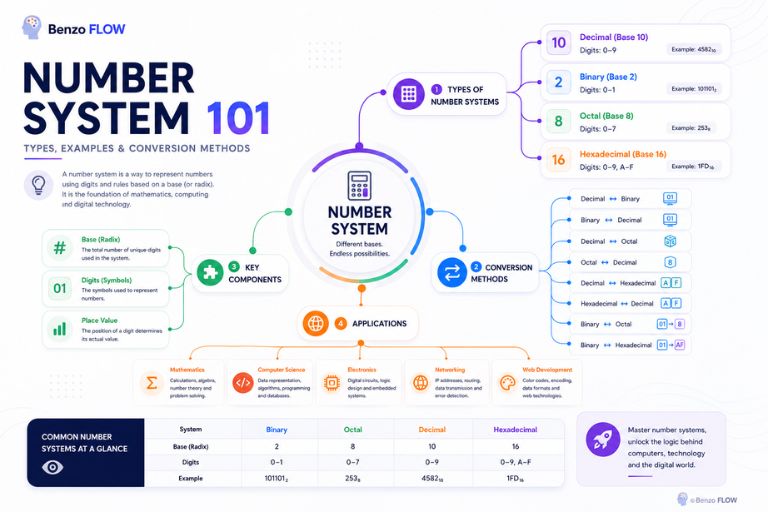
Number System 101: Types, Examples & Conversion Methods
Numbers are the foundation of mathematics and are used every day to count objects, measure distances, tell time, handle money, store digital information, and solve real-world problems. However, numbers themselves are meaningless unless there is a consistent way to represent and interpret them.
This is where the number system comes in.
A number system is a standardized method of representing numbers using a specific set of digits or symbols and a defined set of rules. Every number system is based on a base (or radix), which determines how many unique digits it uses and the place value of each digit.
For example, the decimal number system (base 10) uses the digits 0–9 and is used in everyday life. Computers rely on the binary number system (base 2) because electronic circuits operate using only two states: 0 and 1.
Understanding number systems is essential for mathematics, computer science, digital electronics, programming, and data representation.
In this guide, you’ll learn what a number system is, how it works, its key components, the different types of number systems, conversion methods, practical examples, real-world applications, and much more.
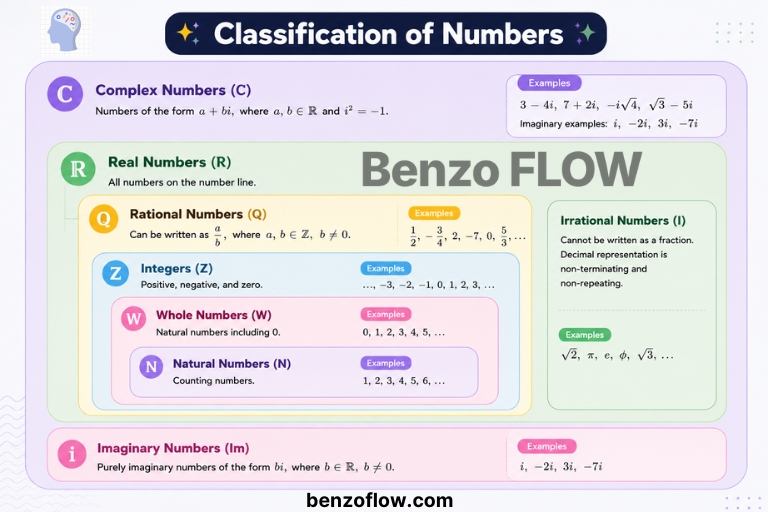
Before exploring different number systems and their bases, it’s helpful to understand the bigger picture. A number system is only one part of mathematics; numbers themselves belong to different families, such as natural, integers, rational, irrational, and complex numbers. If you’re unfamiliar with these classifications, read our guide on All Types of Numbers in Math first.
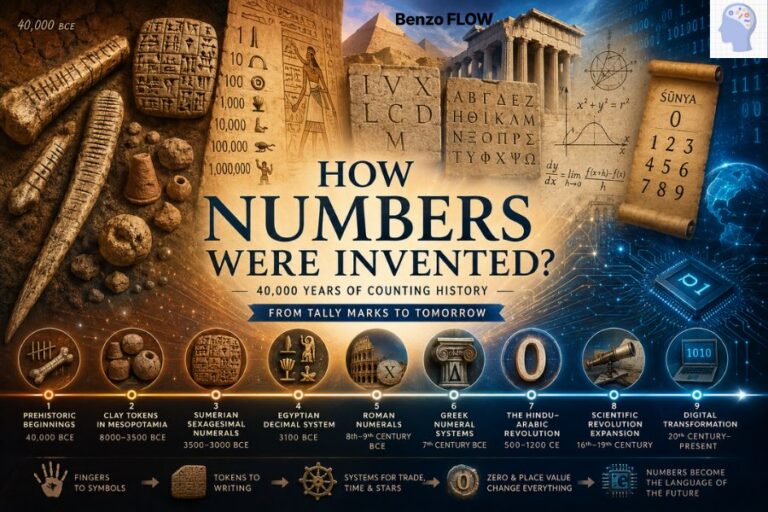
And if you’re curious about where number systems came from, don’t miss How Numbers Were Invented?, which traces humanity’s journey from prehistoric tally marks to the modern decimal, binary, and hexadecimal systems. Together, these guides provide the historical foundation and mathematical context for everything covered in this article.
The Chaos Before Positional Number Systems
Take a look at the number 888. At first glance, it seems to be nothing more than three identical digits placed side by side. But something remarkable is happening.
The digit on the right represents 8. The digit in the middle represents 80. The digit on the left represents 800. Although each digit is the same, its value changes entirely because of its position.
This simple idea that a digit’s value depends on its place is called place value, and it is the foundation of the modern number system. Today, it feels so natural that we rarely stop to think about it. Yet this concept was one of the greatest innovations in the history of mathematics.
Before positional number systems became widespread, numbers were written very differently.
For example, the Romans used symbols such as I, V, X, L, C, D, and M to represent numbers. To write 3, they wrote III. To write 13, they wrote XIII. To write 103, they wrote CIII.
Notice something interesting: the III always represents 3, regardless of where it appears. Unlike our modern decimal system, the symbols themselves do not change value based on their position. Instead, Roman numerals are interpreted by adding or subtracting fixed symbol values according to a set of rules.
This approach worked well for recording numbers, but it was not designed for efficient calculation. Performing operations such as multiplication, long division, or extracting square roots with Roman numerals is cumbersome and lacks the systematic algorithms we use today.
As a result, merchants, engineers, and scholars often relied on tools like the abacus or counting boards to perform calculations instead of working directly with the written numerals.
The invention of positional number systems changed everything. By allowing a digit’s value to depend on its position, mathematicians created a notation that made arithmetic faster, simpler, and scalable. Combined with the introduction of zero as a placeholder, this breakthrough laid the foundation for modern mathematics, science, engineering, and computing.
What Is a Number System?
A number system is a standardized method of representing numbers using a specific set of digits or symbols and a defined set of rules. These rules determine how numbers are written, interpreted, and used in mathematical operations.
Every number system is built around three key elements:
- Digits or symbols – The characters used to represent numbers (such as 0–9 in the decimal system or 0 and 1 in the binary system).
- Base (or radix) – The total number of unique digits available before place values repeat. For example, the decimal system has a base of 10, while the binary system has a base of 2.
- Place value – The position of each digit determines its actual value. As you move from right to left, each position represents an increasing power of the base.
Example: Decimal Number System
Consider the decimal number:
4,582
Since the decimal system uses base 10, each digit is multiplied by a power of 10 based on its position:
4 × 10³ + 5 × 10² + 8 × 10¹ + 2 × 10⁰
= 4000 + 500 + 80 + 2
= 4582
Notice that the digit 5 represents 500, not simply 5, because it occupies the hundreds place. Likewise, the digit 8 represents 80 because it is in the tens place.
This concept of place value is what makes modern positional number systems so efficient. Instead of inventing new symbols for larger numbers, we can represent numbers of any size using a small set of digits and their positions. This simple yet powerful idea is the reason modern arithmetic, scientific calculations, and computer systems are possible.
Why Do We Need Number Systems?
Imagine trying to record large quantities, perform calculations, or store digital data without a standardized way to represent numbers. It would be slow, confusing, and highly error-prone.
Number systems provide a consistent framework for writing, interpreting, and manipulating numbers, making mathematics, science, engineering, and modern technology possible.
Number systems are essential because they allow us to count objects, represent quantities, perform arithmetic operations, measure physical quantities such as length, time, and mass, and communicate numerical information accurately.
They also enable the storage, processing, and transmission of digital information, forming the foundation of modern computing and communication systems.
Different applications require different number systems. The decimal number system (base 10) is used in everyday life because it is intuitive for humans. While computers rely on the binary number system (base 2) since electronic circuits operate using only two stable states: ON (1) and OFF (0).
Similarly, programmers often use the octal (base 8) and hexadecimal (base 16) number systems because they provide a shorter and more readable way to represent binary data.
Without number systems, everything from basic arithmetic and financial transactions to scientific research and computer programming would be far more difficult. They provide the universal language that allows humans and computers alike to represent, process, and communicate numerical information efficiently.
Advantages Of The Number System
Number systems provide a standardized and efficient way to represent, process, and communicate numerical information. They form the foundation of mathematics, science, engineering, and modern computing by making calculations more accurate, organized, and scalable. Without number systems, many everyday tasks and technological advancements would be impossible.
| Advantage | Description |
|---|---|
| Simplify Calculations | Enable systematic methods for arithmetic operations such as addition, subtraction, multiplication, and division. |
| Represent Large Numbers Efficiently | Allow very large and very small numbers to be written using a limited set of digits and place value. |
| Support Digital Computing | Provide the foundation for binary, octal, and hexadecimal systems used in computers and digital electronics. |
| Enable Accurate Data Storage | Allow digital devices to store, process, and retrieve information reliably and efficiently. |
| Make Mathematical Operations Systematic | Standardized place value and positional notation make mathematical calculations faster and less error-prone. |
| Facilitate Communication of Numerical Information | Ensure numbers are represented consistently across mathematics, science, engineering, finance, and technology worldwide. |
The invention of positional number systems revolutionized the way humans work with numbers. Today, they not only simplify everyday calculations but also power computers, smartphones, communication networks, and countless digital technologies. Their efficiency, consistency, and versatility make number systems one of the most important concepts in mathematics and computer science.
Components of a Number System
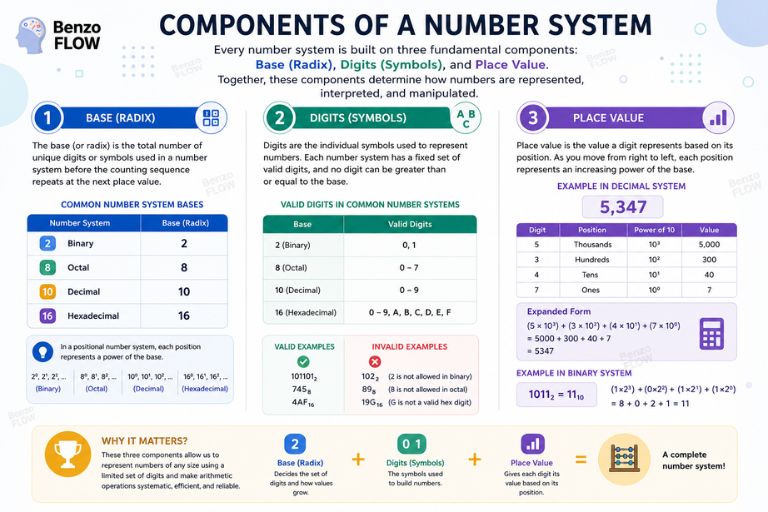
Every number system is built on three fundamental components: digits (or symbols), base (or radix), and place value. Together, these components determine how numbers are represented, interpreted, and manipulated.
Understanding them is essential for learning how different number systems work and why the same sequence of digits can have different values in different bases.
In the following sections, we’ll explore each of these components in detail and see how they combine to form the foundation of every positional number system.
1. Base (Radix)
The base, also known as the radix, is the total number of unique digits or symbols used in a number system before the counting sequence repeats at the next place value. It is one of the most important characteristics of any number system because it determines both the available digits and the value of each position within a number.
| Number System | Base |
|---|---|
| Binary | 2 |
| Octal | 8 |
| Decimal | 10 |
| Hexadecimal | 16 |
The base determines how numbers are represented and how place values increase. In a positional number system, each position represents a power of the base. For example, in the decimal system, the place values are powers of 10 (10⁰, 10¹, 10², …), while in the binary system, they are powers of 2 (2⁰, 2¹, 2², …). This is why the same sequence of digits can represent different values in different number systems.
2. Digits (Symbols)
Digits are the individual symbols used to represent numbers in a number system. Each number system has a fixed set of valid digits, and the number of unique digits depends on its base. A digit cannot have a value greater than or equal to the base of the number system.
For example, the binary number system (base 2) uses only two digits: 0 and 1. The octal number system (base 8) uses the digits 0 through 7, while the decimal number system (base 10) uses the familiar digits 0 through 9. The hexadecimal number system (base 16) extends the decimal digits by using the letters A, B, C, D, E, and F to represent the decimal values 10, 11, 12, 13, 14, and 15, respectively.
| Base | Valid Digits |
|---|---|
| 2 (Binary) | 0, 1 |
| 8 (Octal) | 0–7 |
| 10 (Decimal) | 0–9 |
| 16 (Hexadecimal) | 0–9, A, B, C, D, E, F |
Using a digit that is not part of a number system makes the number invalid. For instance, 102₂ is not a valid binary number because the digit 2 does not exist in the binary number system. Similarly, 89₈ is invalid in the octal system because the digit 8 is not allowed.
3. Place Value
Place value refers to the value a digit represents based on its position within a number. In a positional number system, the same digit can have different values depending on where it appears. As you move from right to left, each position represents an increasing power of the base.
For example, consider the decimal number:
5,347
- 5 → Thousands place (5,000)
- 3 → Hundreds place (300)
- 4 → Tens place (40)
- 7 → Ones place (7)
Expanded form:
(5 × 10³) + (3 × 10²) + (4 × 10¹) + (7 × 10⁰)
= 5000 + 300 + 40 + 7
= 5347
This example illustrates the importance of place value. Although the digits remain the same, their values change according to their positions.
This simple concept allows us to represent numbers of any size using a limited set of digits and makes arithmetic operations such as addition, subtraction, multiplication, and division both systematic and efficient.
Formula of a Number System
In a positional number system, the value of a number is determined by adding the value of each digit multiplied by the corresponding power of the base. This principle forms the mathematical foundation of every positional number system, including binary, octal, decimal, and hexadecimal.
A number represented in base b is written as:
(dₙ dₙ₋₁ … d₁ d₀)b
Its value in the decimal number system is calculated using the following formula:
(dₙ × bⁿ) + (dₙ₋₁ × bⁿ⁻¹) + … + (d₁ × b¹) + (d₀ × b⁰)
where:
- d = digit
- b = base
- n = highest digit position
Types of Number Systems
Several number systems exist, but four positional number systems are the most widely used in mathematics, computer science, and digital electronics.
Each uses a different base (radix), which determines the set of valid digits and the value of each place within a number. Although they all follow the same place value principle, each number system is designed for specific applications.
The four major number systems are binary (base 2), octal (base 8), decimal (base 10), and hexadecimal (base 16). The decimal system is used in everyday life, while the binary, octal, and hexadecimal systems play a crucial role in computing, programming, and digital systems.
In the following sections, we’ll explore each of these number systems in detail, including their bases, digits, examples, advantages, and real-world applications.
1. Decimal Number System (Base 10)
The decimal number system, also known as the base-10 number system, is the most widely used number system in the world. It is the standard system for everyday counting, arithmetic, measurements, commerce, and scientific calculations. The decimal system is believed to have developed because humans naturally count using ten fingers.
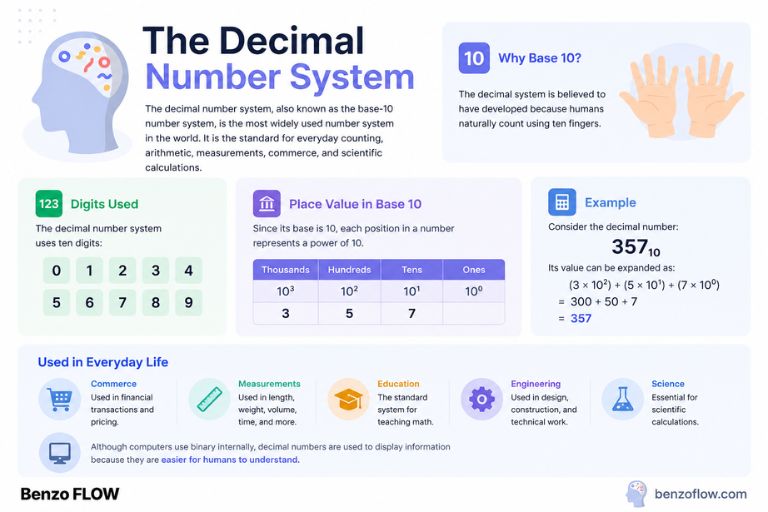
The decimal number system uses ten digits:
0, 1, 2, 3, 4, 5, 6, 7, 8, 9
Since its base is 10, each position in a number represents a power of 10. Starting from the right, the place values are 10⁰, 10¹, 10², 10³, and so on.
For example, consider the decimal number:
357₁₀
Its value can be expanded as:
(3 × 10²) + (5 × 10¹) + (7 × 10⁰)
= 300 + 50 + 7
= 357
The decimal number system is the foundation of everyday mathematics and is used in almost every aspect of daily life. It is the standard system for financial transactions, measurements, education, engineering, scientific calculations, and most forms of numerical communication.
Although computers internally use the binary number system, decimal numbers are typically used when displaying information to users because they are easier for humans to understand.
2. Binary Number System (Base 2)
The binary number system, also known as the base-2 number system, is the fundamental language of computers and digital electronics. Unlike the decimal system, which uses ten digits, the binary system uses only two digits: 0 and 1. These two digits correspond to the two stable states of electronic circuits: OFF (0) and ON (1).
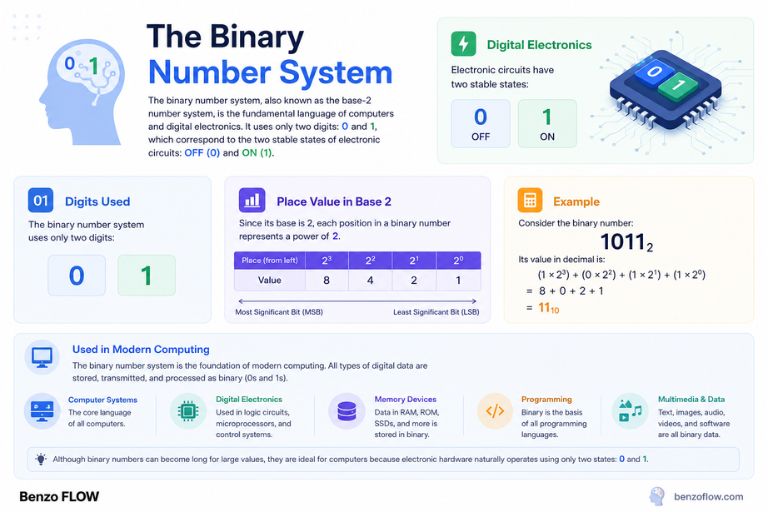
The binary number system uses the following digits:
0, 1
Since its base is 2, each position in a binary number represents a power of 2. Starting from the right, the place values are 2⁰, 2¹, 2², 2³, and so on.
For example, consider the binary number:
1011₂
Its value in the decimal number system is:
(1 × 2³) + (0 × 2²) + (1 × 2¹) + (1 × 2⁰)
= 8 + 0 + 2 + 1
= 11₁₀
The binary number system is the foundation of modern computing. Every piece of digital information, including text, images, audio, videos, and software, is ultimately stored and processed as binary data.
It is widely used in computer systems, digital electronics, logic circuits, microprocessors, memory devices, and computer programming. Although binary numbers can become long for large values, they are ideal for computers because electronic hardware naturally operates using only two states: 0 and 1.
3. Octal Number System (Base 8)
The octal number system, also known as the base-8 number system, uses eight digits, ranging from 0 to 7. Each position in an octal number represents a power of 8. Before hexadecimal became the standard, octal was widely used in early computer systems because every octal digit corresponds exactly to three binary digits (bits), making binary numbers shorter and easier to read.
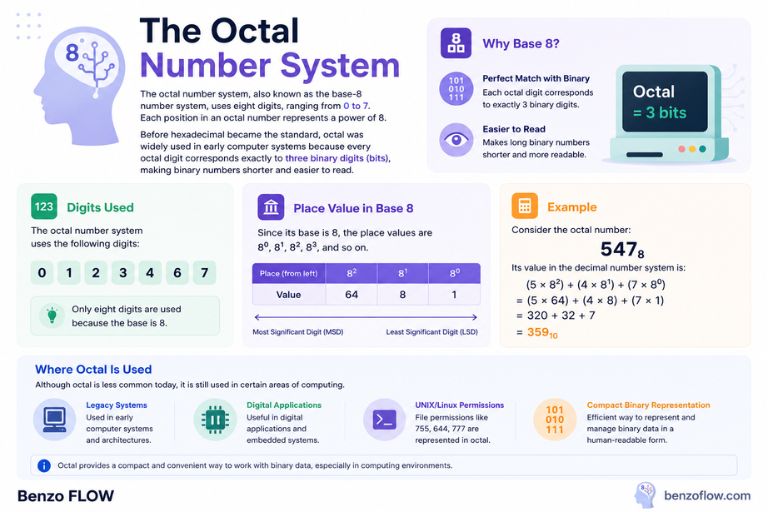
The octal number system uses the following digits:
0, 1, 2, 3, 4, 5, 6, 7
Since its base is 8, the place values are 8⁰, 8¹, 8², 8³, and so on.
For example, consider the octal number:
547₈
Its value in the decimal number system is:
(5 × 8²) + (4 × 8¹) + (7 × 8⁰)
= (5 × 64) + (4 × 8) + (7 × 1)
= 320 + 32 + 7
= 359₁₀
Although octal is less common today, it is still used in certain areas of computing. It appears in legacy computer systems, digital applications, embedded systems, and UNIX/Linux file permissions, where permission values such as 755, 644, and 777 are represented in octal. Its compact representation of binary data makes it useful in specialized computing environments.
4. Hexadecimal Number System (Base 16)
The hexadecimal number system, also known as the base-16 number system, uses sixteen unique symbols to represent numbers. It combines the decimal digits 0–9 with the letters A–F, where each letter represents a value greater than 9. Hexadecimal provides a compact and human-readable way to represent large binary numbers, with each hexadecimal digit corresponding to four binary digits (bits).
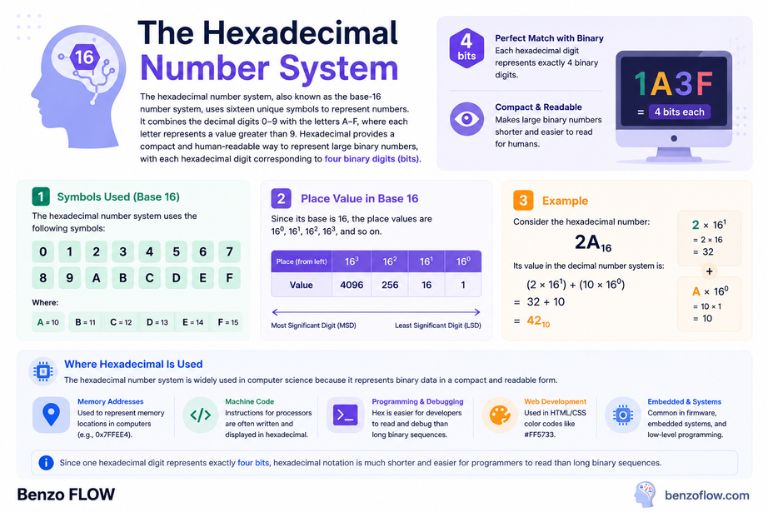
The hexadecimal number system uses the following symbols:
0, 1, 2, 3, 4, 5, 6, 7, 8, 9, A, B, C, D, E, F
Where:
- A = 10
- B = 11
- C = 12
- D = 13
- E = 14
- F = 15
Since its base is 16, the place values are 16⁰, 16¹, 16², 16³, and so on.
For example, consider the hexadecimal number:
2A₁₆
Its value in the decimal number system is:
(2 × 16¹) + (10 × 16⁰)
= 32 + 10
= 42₁₀
The hexadecimal number system is widely used in computer science because it represents binary data in a compact and readable form. It is commonly used for memory addresses, machine code, computer programming, debugging, and HTML/CSS color codes such as #FF5733.
Since one hexadecimal digit represents exactly four bits, hexadecimal notation is much shorter and easier for programmers to read than long binary sequences.
Comparison of Number Systems
| Feature | Binary | Octal | Decimal | Hexadecimal |
|---|---|---|---|---|
| Base (Radix) | 2 | 8 | 10 | 16 |
| Valid Digits | 0–1 | 0–7 | 0–9 | 0–9, A–F |
| Number of Symbols | 2 | 8 | 10 | 16 |
| Place Values | Powers of 2 | Powers of 8 | Powers of 10 | Powers of 16 |
| Example Number | 101101₂ | 745₈ | 4582₁₀ | 3AF₁₆ |
| Decimal Equivalent | 45 | 485 | 4582 | 943 |
| Primary Use | Computers & Digital Electronics | UNIX Permissions & Legacy Systems | Everyday Mathematics | Programming & Memory Addresses |
| Advantages | Simple electronic implementation | Compact form of binary | Easy for humans to understand | Compact, readable representation of binary |
| Common Applications | CPUs, Memory, Logic Circuits | UNIX/Linux, Embedded Systems | Finance, Education, Science | Programming, Machine Code, HTML/CSS Colors |
Number System Conversion
One number system can be converted into another because the value of a number remains the same regardless of the base in which it is represented. Number system conversion is the process of expressing a number from one base, such as binary (base 2), octal (base 8), decimal (base 10), or hexadecimal (base 16), into its equivalent value in another base.
These conversions are essential in mathematics, computer science, digital electronics, and programming, where different number systems are used for different purposes. Understanding how to convert between bases helps in data representation, programming, debugging, and performing calculations efficiently.
The most common number system conversions include:
Decimal to Binary
Decimal to binary conversion is the process of converting a base-10 (decimal) number into its equivalent base-2 (binary) representation. Since the binary number system uses only two digits, 0 and 1, every decimal number can be expressed as a unique sequence of binary digits (bits). This conversion is one of the most fundamental concepts in mathematics and computer science because computers store and process all data in binary form.
The most common method for converting a decimal integer to binary is the repeated division by 2 method. In this method, the decimal number is repeatedly divided by 2, and the remainder from each division (either 0 or 1) is recorded. The division continues until the quotient becomes 0. The binary equivalent is then obtained by reading the remainders from bottom to top.
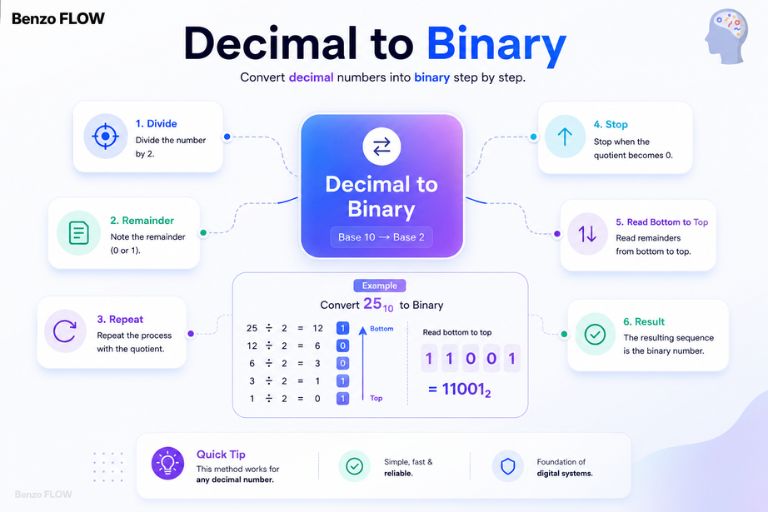
Steps to Convert Decimal to Binary
- Divide the decimal number by 2.
- Record the remainder (0 or 1).
- Divide the quotient again by 2.
- Repeat the process until the quotient becomes 0.
- Read the remainders from bottom to top to obtain the binary number.
Example: Convert 25₁₀ to Binary
| Division | Quotient | Remainder |
|---|---|---|
| 25 ÷ 2 | 12 | 1 |
| 12 ÷ 2 | 6 | 0 |
| 6 ÷ 2 | 3 | 0 |
| 3 ÷ 2 | 1 | 1 |
| 1 ÷ 2 | 0 | 1 |
Reading the remainders from bottom to top:
25₁₀ = 11001₂
Quick Tips
- Divide by 2 until the quotient becomes 0.
- Each remainder is always 0 or 1.
- Always read the remainders from the last remainder to the first (bottom to top).
- The last remainder becomes the Most Significant Bit (MSB), while the first remainder becomes the Least Significant Bit (LSB).
Binary to Decimal
Binary to decimal conversion is the process of converting a base-2 (binary) number into its equivalent base-10 (decimal) value. Since the binary number system uses only the digits 0 and 1, each digit represents a power of 2 based on its position. To convert a binary number to decimal, multiply each binary digit by its corresponding power of 2 and then add all the results together.
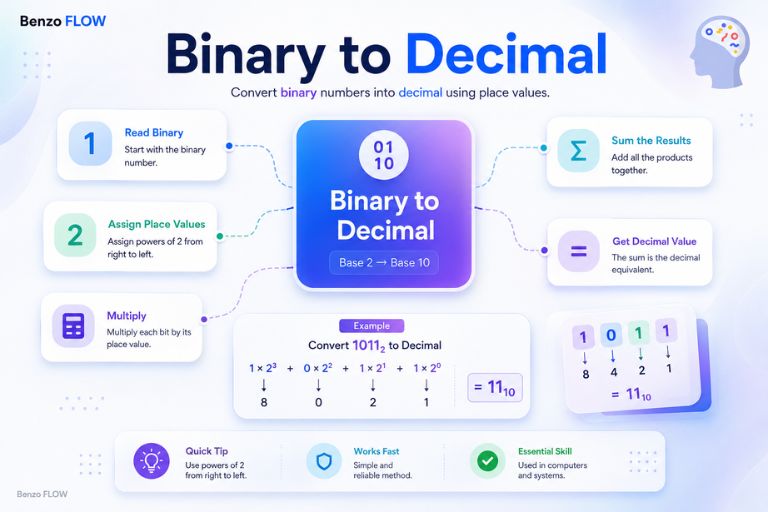
Steps to Convert Binary to Decimal
- Write the powers of 2 below each binary digit, starting from 0 at the rightmost digit.
- Multiply each binary digit by its corresponding power of 2.
- Add all the resulting values.
- The sum is the decimal equivalent.
Example: Convert 11001₂ to Decimal
| Binary Digit | 1 | 1 | 0 | 0 | 1 |
|---|---|---|---|---|---|
| Power of 2 | 2⁴ | 2³ | 2² | 2¹ | 2⁰ |
| Value | 16 | 8 | 0 | 0 | 1 |
Calculation:
(1 × 2⁴) + (1 × 2³) + (0 × 2²) + (0 × 2¹) + (1 × 2⁰)
= 16 + 8 + 0 + 0 + 1
= 25
Therefore,
11001₂ = 25₁₀
Quick Tips
- Start assigning powers of 2 from 0 at the rightmost digit.
- A binary digit of 0 contributes 0 to the total.
- A binary digit of 1 contributes the value of its corresponding power of 2.
- Add all the values to obtain the decimal equivalent.
Decimal to Octal
Decimal to octal conversion is the process of converting a base-10 (decimal) number into its equivalent base-8 (octal) representation. The octal number system uses eight digits (0–7), where each digit represents a power of 8. Converting decimal numbers to octal is useful in computer science and digital electronics because octal provides a more compact representation of binary numbers.
The most common method for converting a decimal integer to octal is the repeated division by 8 method. In this method, the decimal number is repeatedly divided by 8, and the remainder from each division is recorded. The process continues until the quotient becomes 0. The octal equivalent is then obtained by reading the remainders from bottom to top.
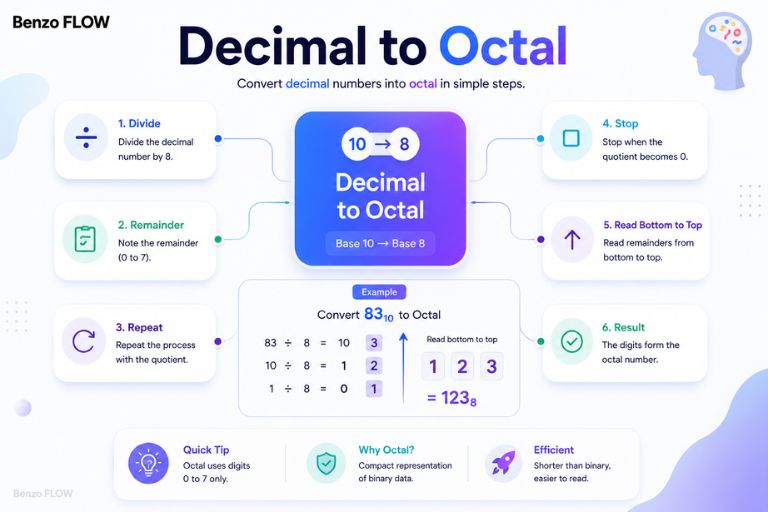
Steps to Convert Decimal to Octal
- Divide the decimal number by 8.
- Record the remainder (0–7).
- Divide the quotient again by 8.
- Repeat the process until the quotient becomes 0.
- Read the remainders from bottom to top to obtain the octal number.
Example: Convert 156₁₀ to Octal
| Division | Quotient | Remainder |
|---|---|---|
| 156 ÷ 8 | 19 | 4 |
| 19 ÷ 8 | 2 | 3 |
| 2 ÷ 8 | 0 | 2 |
Reading the remainders from bottom to top:
156₁₀ = 234₈
Quick Tips
- Divide by 8 until the quotient becomes 0.
- Each remainder will always be a digit between 0 and 7.
- Read the remainders from the last remainder to the first (bottom to top).
- The last remainder becomes the Most Significant Digit (MSD), while the first remainder becomes the Least Significant Digit (LSD).
Octal to Decimal
Octal to decimal conversion is the process of converting a base-8 (octal) number into its equivalent base-10 (decimal) value. The octal number system uses the digits 0 to 7, where each digit represents a power of 8 based on its position. To convert an octal number to decimal, multiply each digit by its corresponding power of 8 and add the results together.
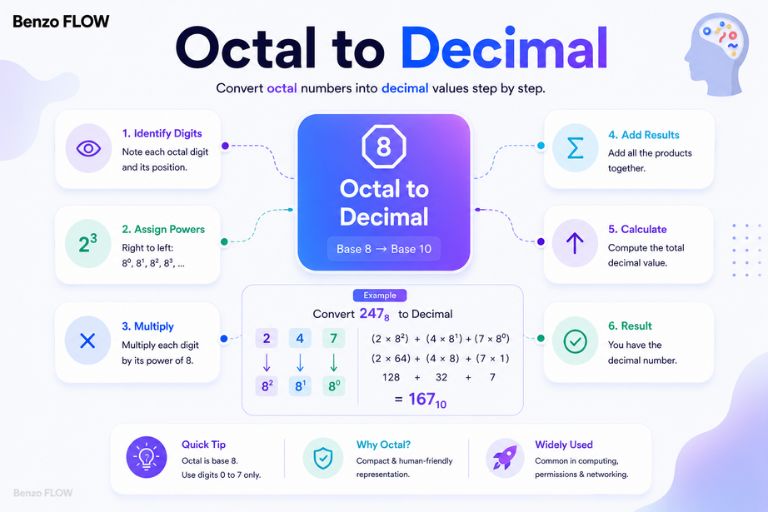
Steps to Convert Octal to Decimal
- Write the powers of 8 below each octal digit, starting from 0 at the rightmost digit.
- Multiply each octal digit by its corresponding power of 8.
- Add all the resulting values.
- The sum is the decimal equivalent.
Example: Convert 234₈ to Decimal
| Octal Digit | 2 | 3 | 4 |
|---|---|---|---|
| Power of 8 | 8² | 8¹ | 8⁰ |
| Value | 128 | 24 | 4 |
Calculation:
(2 × 8²) + (3 × 8¹) + (4 × 8⁰)
= (2 × 64) + (3 × 8) + (4 × 1)
= 128 + 24 + 4
= 156
Therefore,
234₈ = 156₁₀
Quick Tips
- Start assigning powers of 8 from 0 at the rightmost digit.
- Each octal digit contributes its value multiplied by the corresponding power of 8.
- Add all the resulting values to obtain the decimal equivalent.
- Since octal digits range from 0 to 7, any digit greater than 7 is not a valid octal digit.
Decimal to Hexadecimal
Decimal to hexadecimal conversion is the process of converting a base-10 (decimal) number into its equivalent base-16 (hexadecimal) number. Unlike the decimal system, hexadecimal uses 16 symbols: 0–9 and A–F, where A = 10, B = 11, C = 12, D = 13, E = 14, and F = 15. Because one hexadecimal digit represents 4 binary bits, hexadecimal provides a shorter and more readable way to represent binary values, making it widely used in programming, digital electronics, memory addressing, and web development.
The easiest way to convert a decimal integer to hexadecimal is the repeated division by 16 method. Divide the decimal number by 16, record the remainder, and continue dividing the quotient by 16 until the quotient becomes 0. If a remainder is between 10 and 15, replace it with the corresponding hexadecimal letter (A–F). Finally, read the remainders from bottom to top to obtain the hexadecimal equivalent.

Steps to Convert Decimal to Hexadecimal
- Divide the decimal number by 16.
- Write down the remainder.
- If the remainder is 10–15, replace it with A–F.
- Divide the quotient by 16 again.
- Repeat the process until the quotient becomes 0.
- Read the remainders from bottom to top to get the hexadecimal number.
Example: Convert 254₁₀ to Hexadecimal
| Step | Division | Quotient | Remainder |
|---|---|---|---|
| 1 | 254 ÷ 16 | 15 | 14 → E |
| 2 | 15 ÷ 16 | 0 | 15 → F |
Read the remainders from bottom to top:
254₁₀ = FE₁₆
Hexadecimal Digit Values
| Decimal | Hex | Decimal | Hex |
|---|---|---|---|
| 10 | A | 13 | D |
| 11 | B | 14 | E |
| 12 | C | 15 | F |
Quick Tips
- ✓ Divide by 16 until the quotient becomes 0.
- ✓ Replace remainders 10–15 with A–F.
- ✓ Read the remainders from bottom to top.
- ✓ The last remainder is the Most Significant Digit (MSD), while the first remainder is the Least Significant Digit (LSD).
Remember: Decimal uses the digits 0–9, whereas hexadecimal uses 0–9 and A–F. The letters A–F simply represent the decimal values 10–15. This is the only new concept you need to learn when converting from decimal to hexadecimal.
Hexadecimal to Decimal
Hexadecimal to decimal conversion is the process of converting a base-16 (hexadecimal) number into its equivalent base-10 (decimal) value. The hexadecimal number system uses 16 symbols: 0–9 and A–F, where A = 10, B = 11, C = 12, D = 13, E = 14, and F = 15. Each hexadecimal digit represents a power of 16 based on its position. To convert a hexadecimal number to decimal, multiply each digit by its corresponding power of 16 and add the results together.
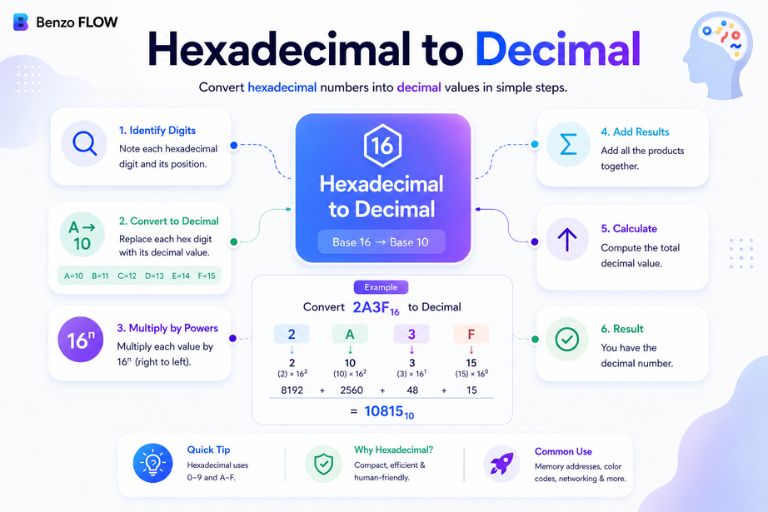
Hexadecimal Digit Values
| Hex | Decimal | Hex | Decimal |
|---|---|---|---|
| A | 10 | D | 13 |
| B | 11 | E | 14 |
| C | 12 | F | 15 |
Steps to Convert Hexadecimal to Decimal
- Replace any hexadecimal letters (A–F) with their decimal values (10–15).
- Write the powers of 16 below each digit, starting from 0 at the rightmost digit.
- Multiply each digit by its corresponding power of 16.
- Add all the resulting values.
- The sum is the decimal equivalent.
Example: Convert FE₁₆ to Decimal
| Hex Digit | F | E |
|---|---|---|
| Decimal Value | 15 | 14 |
| Power of 16 | 16¹ | 16⁰ |
| Value | 15 × 16 = 240 | 14 × 1 = 14 |
Calculation:
(15 × 16¹) + (14 × 16⁰)
= (15 × 16) + (14 × 1)
= 240 + 14
= 254
Therefore,
FE₁₆ = 254₁₀
Quick Tips
- Replace A–F with their decimal values (10–15) before calculating.
- Start assigning powers of 16 from 0 at the rightmost digit.
- Multiply each digit by its corresponding power of 16.
- Add all the resulting values to obtain the decimal equivalent.
- Any character other than 0–9 or A–F is not a valid hexadecimal digit.
Binary to Octal
Binary to octal conversion is the process of converting a base-2 (binary) number into its equivalent base-8 (octal) representation. Since 8 = 2³, each octal digit corresponds to exactly three binary digits (bits). This relationship makes binary-to-octal conversion simple because no arithmetic calculations are required, only grouping and substitution.
To convert a binary number to octal, group the binary digits into sets of three, starting from the rightmost digit. If the leftmost group contains fewer than three digits, add leading zeros to complete the group. Then replace each 3-bit group with its corresponding octal digit.
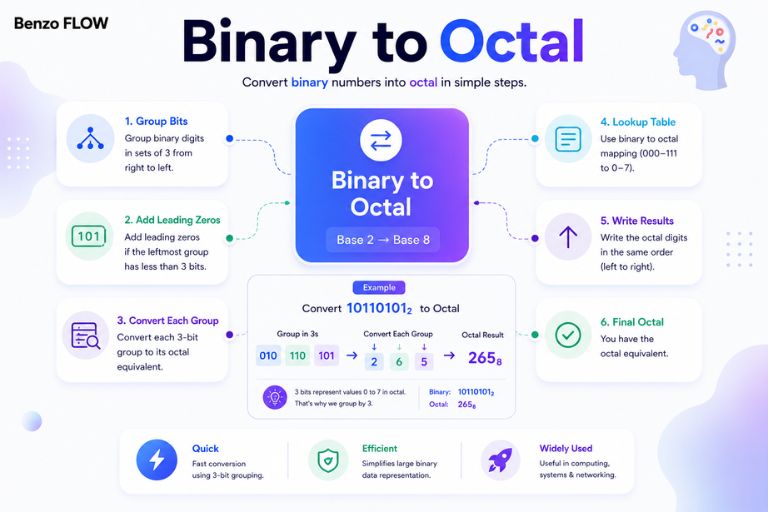
Binary to Octal Conversion Table
| Binary | Octal | Binary | Octal |
|---|---|---|---|
| 000 | 0 | 100 | 4 |
| 001 | 1 | 101 | 5 |
| 010 | 2 | 110 | 6 |
| 011 | 3 | 111 | 7 |
Steps to Convert Binary to Octal
- Group the binary digits into sets of three, starting from the right.
- Add leading zeros if the leftmost group has fewer than three digits.
- Replace each 3-bit group with its equivalent octal digit.
- Combine the octal digits to obtain the final answer.
Example: Convert 1101011₂ to Octal
Group the binary digits into sets of three:
001 101 011
Now convert each group:
| Binary Group | Octal Digit |
|---|---|
| 001 | 1 |
| 101 | 5 |
| 011 | 3 |
Therefore,
1101011₂ = 153₈
Quick Tips
- Group binary digits into 3-bit sets from right to left.
- Add leading zeros if necessary to complete the leftmost group.
- Use the binary-to-octal conversion table for quick lookup.
- No multiplication or division is required, only grouping and substitution.
Binary to Hexadecimal
Binary to hexadecimal conversion is the process of converting a base-2 (binary) number into its equivalent base-16 (hexadecimal) representation. Since 16 = 2⁴, each hexadecimal digit corresponds to exactly four binary digits (bits). This makes the conversion fast and straightforward because it only requires grouping the binary digits and replacing each group with its hexadecimal equivalent.
To convert a binary number to hexadecimal, group the binary digits into sets of four, starting from the rightmost digit. If the leftmost group contains fewer than four digits, add leading zeros to complete the group. Then replace each 4-bit group with its corresponding hexadecimal digit.

Binary to Hexadecimal Conversion Table
| Binary | Hex | Binary | Hex |
|---|---|---|---|
| 0000 | 0 | 1000 | 8 |
| 0001 | 1 | 1001 | 9 |
| 0010 | 2 | 1010 | A |
| 0011 | 3 | 1011 | B |
| 0100 | 4 | 1100 | C |
| 0101 | 5 | 1101 | D |
| 0110 | 6 | 1110 | E |
| 0111 | 7 | 1111 | F |
Steps to Convert Binary to Hexadecimal
- Group the binary digits into sets of four, starting from the right.
- Add leading zeros if the leftmost group has fewer than four digits.
- Replace each 4-bit group with its equivalent hexadecimal digit.
- Combine the hexadecimal digits to obtain the final answer.
Example: Convert 11111110₂ to Hexadecimal
Group the binary digits into sets of four:
1111 1110
Now convert each group:
| Binary Group | Hexadecimal Digit |
|---|---|
| 1111 | F |
| 1110 | E |
Therefore,
11111110₂ = FE₁₆
Quick Tips
- Group binary digits into 4-bit sets from right to left.
- Add leading zeros if necessary to complete the leftmost group.
- Use the binary-to-hexadecimal conversion table for quick lookup.
- No multiplication or division is required, only grouping and substitution.
Applications of Number Systems
Number systems are fundamental to mathematics, science, engineering, and modern technology. They provide a standardized way to represent, process, and communicate numerical information, making everything from basic calculations to advanced computing possible. Different number systems are used for different purposes, depending on the requirements of the application.
Mathematics
Number systems form the foundation of mathematics. Every branch of mathematics relies on a consistent way to represent and manipulate numbers, making number systems essential for both simple calculations and advanced mathematical concepts.
| Area | How Number Systems Are Used |
|---|---|
| Counting | Representing and counting quantities, from basic object counting to large numerical values. |
| Calculations | Performing arithmetic operations such as addition, subtraction, multiplication, division, powers, and roots. |
| Algebra | Representing variables, constants, equations, inequalities, and mathematical expressions. |
| Geometry | Measuring lengths, angles, areas, volumes, coordinates, and geometric transformations. |
Whether you’re counting apples, solving algebraic equations, or calculating the area of a circle, number systems provide the standardized language that makes mathematics accurate, consistent, and universally understood. They serve as the building blocks for nearly every mathematical concept taught in schools and used in science, engineering, economics, and technology.
Computer Science
Number systems are at the heart of computer science. Although humans primarily use the decimal number system, computers operate internally using the binary number system, where all data is represented as sequences of 0s and 1s. Other number systems, such as hexadecimal and octal, are also widely used because they provide more compact and readable representations of binary data.
| Application | How Number Systems Are Used |
|---|---|
| Data Representation | Storing text, images, audio, videos, and other digital data in binary form. |
| Programming | Representing numeric values, bitwise operations, hexadecimal constants, and debugging computer programs. |
| Memory Storage | Identifying memory locations and addresses using binary and hexadecimal notation. |
| Algorithms | Performing computations, logical operations, data processing, and optimization efficiently. |
Without number systems, modern computing would not exist. Every computer, smartphone, game console, and digital device relies on binary to process information, while programmers frequently use hexadecimal and octal to simplify low-level programming, memory management, and system development. Together, these number systems form the foundation of computer architecture, software development, and digital technology.
Electronics
Number systems play a crucial role in electronics, especially in the design and operation of digital devices. Since electronic circuits have only two stable states, ON and OFF. The binary number system is the natural choice for representing and processing information. Engineers also use hexadecimal and octal to simplify the representation of binary data during circuit design and debugging.
| Application | How Number Systems Are Used |
|---|---|
| Digital Circuits | Representing logic levels (0 and 1) in logic gates, flip-flops, and digital systems. |
| Microprocessors | Processing binary instructions, performing arithmetic operations, and executing machine code. |
| Embedded Systems | Programming microcontrollers and embedded devices used in appliances, automobiles, medical equipment, and IoT devices. |
From calculators and smartphones to automobiles and industrial automation systems, modern electronic devices depend on number systems to process information accurately and efficiently. Binary forms the foundation of digital electronics, while hexadecimal is commonly used for memory addresses, firmware development, and hardware debugging. Together, these number systems enable the reliable operation of today’s electronic technologies.
Networking
Number systems are fundamental to computer networking and digital communication. Every device connected to a network communicates by transmitting data as binary digits (0s and 1s). Binary, decimal, and hexadecimal number systems are all used to represent addresses, transfer data, and ensure reliable communication between devices.
| Application | How Number Systems Are Used |
|---|---|
| IP Addresses | Representing and identifying devices on a network using IPv4 (decimal) and IPv6 (hexadecimal) addresses. |
| Data Communication | Encoding, transmitting, and decoding digital data as binary signals between computers and network devices. |
| Error Detection | Using binary algorithms such as parity bits, checksums, and cyclic redundancy checks (CRC) to detect transmission errors. |
Every time you browse a website, send an email, stream a video, or make a video call, number systems work behind the scenes to transfer data accurately and efficiently.
Binary is used for data transmission, decimal notation makes IPv4 addresses easier for humans to read, and hexadecimal is commonly used for IPv6 addresses, MAC addresses, and network diagnostics. Together, these number systems form the backbone of modern computer networks and internet communication.
Web Development
Number systems are widely used in web development to represent colors, encode text, and build interactive web applications. While users see websites in a visual format, browsers and servers rely on binary, decimal, and hexadecimal number systems to process and display web content correctly.
| Application | How Number Systems Are Used |
|---|---|
| RGB and Hex Color Codes | Representing colors using hexadecimal values such as #FF5733 or RGB values like rgb(255, 87, 51). |
| Character Encoding | Representing letters, numbers, symbols, and emojis using encoding standards such as ASCII and Unicode. |
| Programming Languages | Using decimal, binary, hexadecimal, and octal literals for calculations, memory operations, and bitwise programming. |
Number systems are essential to modern web technologies. Hexadecimal color codes allow developers to define millions of colors efficiently, character encoding ensures text is displayed consistently across different devices and languages, and programming languages use various number systems to perform calculations and manipulate data. Together, these applications make it possible to build the websites and web applications we use every day.
Conclusion
A number system is the foundation of mathematics, computing, and digital technology. It provides a systematic way to represent numbers using digits, a base, and place value. While humans primarily use the decimal number system, computers rely on binary, and other systems such as octal and hexadecimal play important roles in programming and electronics.
Understanding how different number systems work is essential for learning mathematics, computer science, engineering, and many modern technologies. Whether you’re solving arithmetic problems or writing software, a solid understanding of number systems is a fundamental skill that supports countless real-world applications.